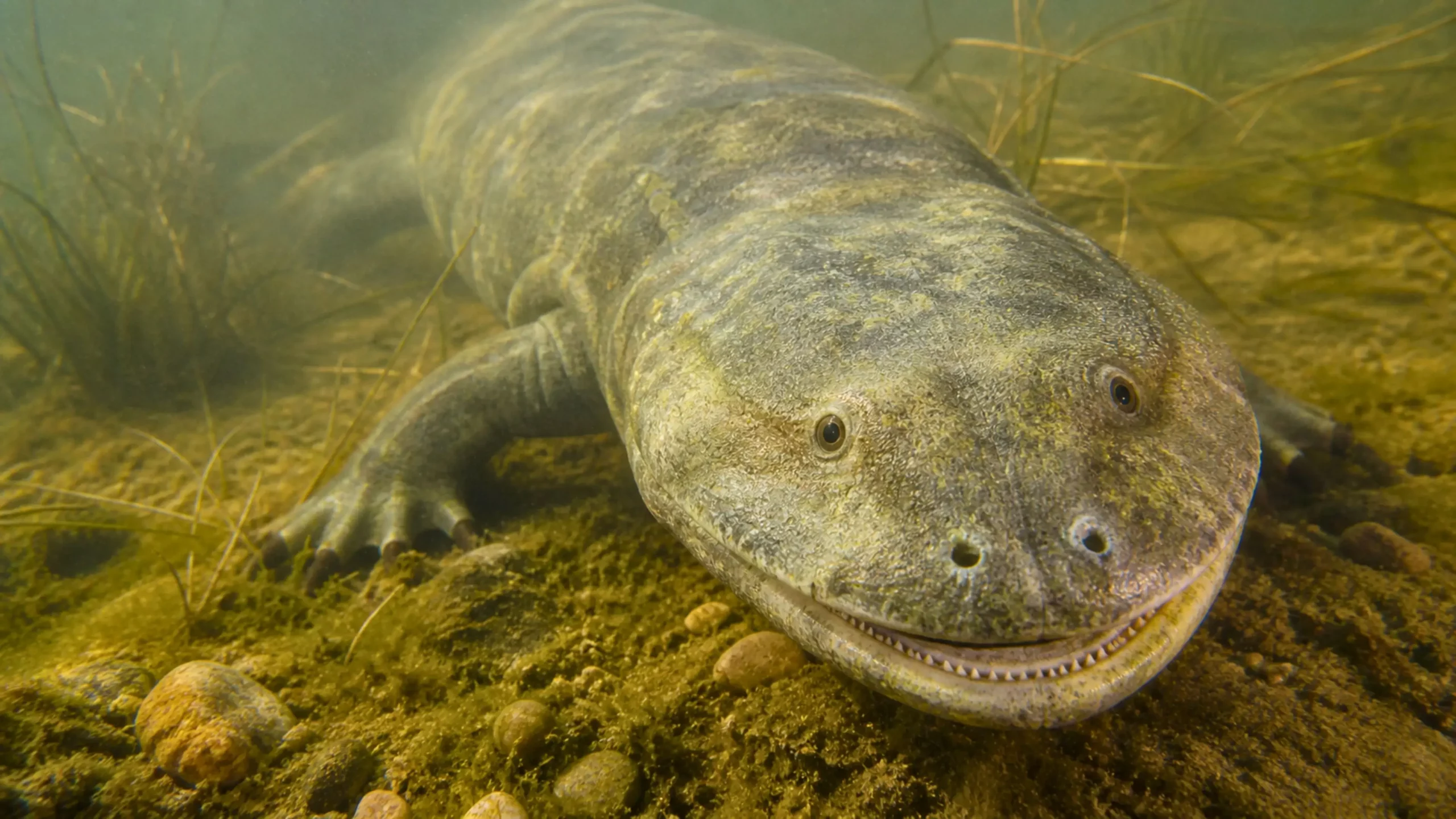
Its jaw looks less like a weapon and more like a makeshift tool built for survival. Tanyka amnicola, an aquatic creature described in 2026 in Brazil, lived about 275 million years before us, and its sideways-turned teeth change the reading of an ancient world.
A Twisted Jaw That Was Not a Fossilized Accident
The fossil does not reveal a complete skeleton, but a tight little puzzle embedded in the bone. The team describes nine lower jaws, each about 15 centimeters long, discovered in deposits in northeastern Brazil. This repetition makes the anomaly far less accidental.
Dr. Jason Pardo, a paleontologist at the Field Museum in Chicago, confirms that the jaws all bear the same twist. The teeth point to the sides, not upward. For researchers, this regularity converts a suspicion of deformation into an anatomical signature.
Minuscule Teeth That Tell Another Way of Feeding
The denticles, tiny secondary teeth, line the inner face of the jaw like a cheese grater. This rough surface does not merely help grip prey. It likely also enables grinding of resistant food, thereby broadening the animal’s possible menu.
Tanyka amnicola belongs to sister-tetrapod stem lineages, four-limbed vertebrates that predate the branch leading to modern forms. This distinction matters, because the animal is not a modern amphibian in disguise. It represents an ancient lineage still testing solutions.
The early Permian, a geological period spanning roughly between 299 and 273 million years ago, far predates dinosaurs. At that time, terrestrial ecosystems were reshaping themselves. A feeder capable of rasping plants or small invertebrates thus secures a less contested niche.
A Dietary Trace That Remains More Cautious Than an Herbivore Portrait
Researchers remain cautious about its diet. The study mentions either the processing of small invertebrates or the consumption of plant matter, a rare hypothesis among these ancient tetrapods. In either case, the jaw points to a specialized feeding strategy rather than a simple bite.
Anatomical comparisons give Tanyka a likely appearance of a large salamander, about a meter in length. This size is modest, yet it would have been enough to inhabit the placid waters of Gondwana. The animal would have exploited a lacustrine habitat where every resource counted.
Brazil Adds a Missing Piece to the Story of the Earliest Vertebrates
Gondwana denotes the ancient supercontinent that brought together, among others, South America and Africa. Brazilian fossils thus complete a map long dominated by Europe and North America. This locality compels a rethinking of a narrative built from incomplete archives.
The scientific dossier corrects a too-linear idea of evolution. Ancient lineages do not always disappear when more modern groups emerge. Tanyka functions as an old model still useful in a new workshop, because its jaw reveals a specific use.
This discovery mainly confirms that southern ecosystems remain underdocumented. A single animal, known from nine jaws, adds a piece to the vertebrate transition before the dinosaurs. The consequence is simple: Brazilian Permian becomes a key field to explore.

Contact details
Address:
Farmers Forum,
36, Dominick Street,
Mullingar,
Co. Westmeath,
Ireland
Phone:
+353 (0)44 9310206
Or email us:
For technical issues please check out our FAQ's page or email - [email protected]
For general Queries email - [email protected]
Request to add event to our Calendar - [email protected]
Send us your mart reports - [email protected]
Suggestions and feedbacks - [email protected]
News Items / Press Release - [email protected]
To Advertise on Farmers Forum - [email protected]