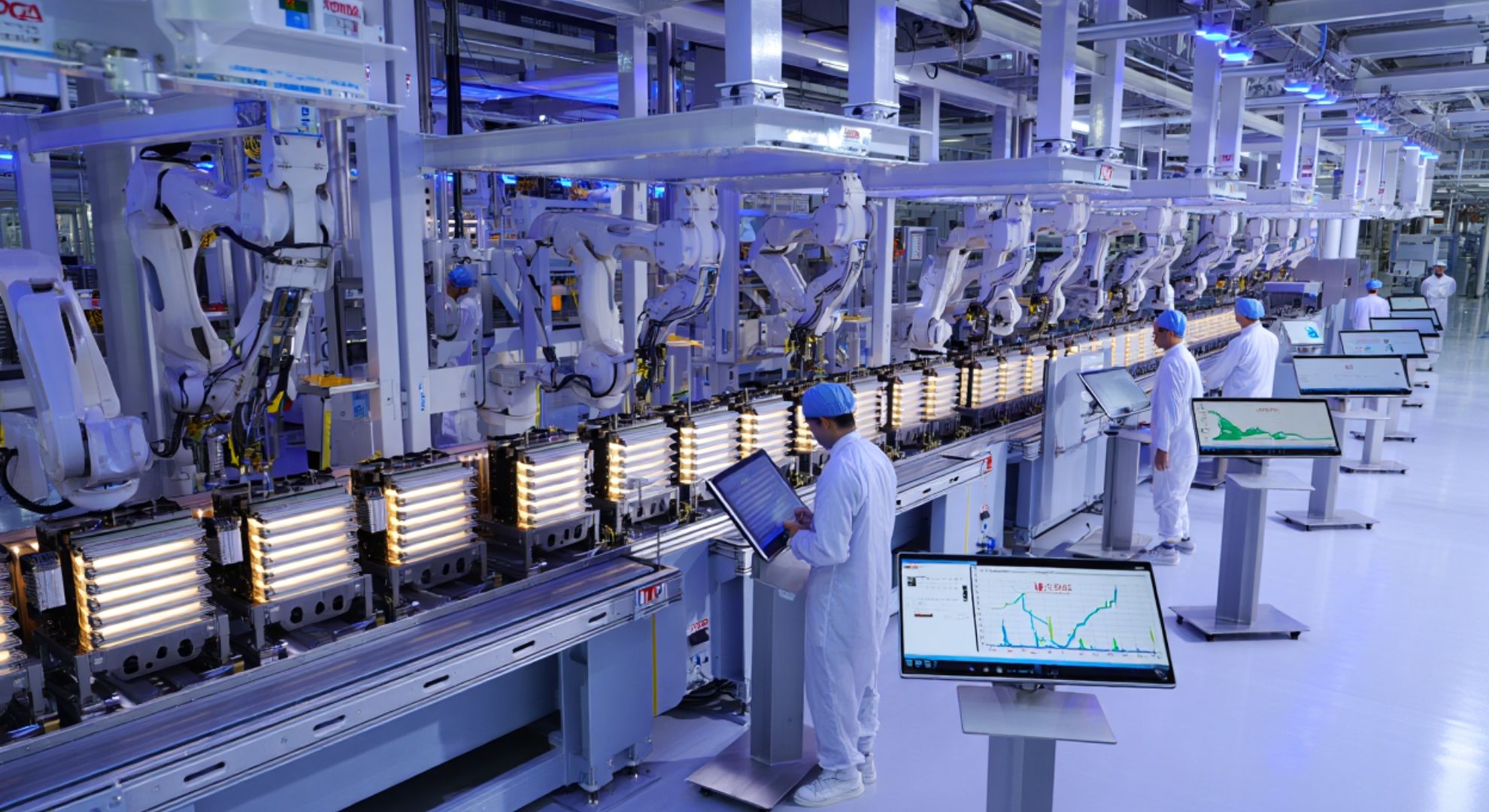
The ground just tilted beneath the EV market. A long‑promised shift is finally visible, not as a slide deck, but as a working line that stamps parts and tracks yield in real time. The hype has felt endless; now the machinery is finally on.
What just happened
Toyota has switched on a pilot line for solid‑state cells, the kind that abandon flammable liquid electrolytes for a solid alternative. It’s not a concept, and it’s not a lab‑bench rig; it’s an integrated, roll‑to‑roll process meant to prove repeatability, safety, and cost curves. “Design is easy; manufacturing is hard,” goes the quiet mantra inside battery factories, and this line aims to make the hard repeatable.
The company frames the platform as “scalable” and modular, designed to evolve from pilot to larger footprints with the same recipes. Think dry‑room corridors, moisture‑sensitive sulfide handling, stacked or laminated layers, and harsh inline metrology watching every pass.
Why solid‑state matters
Solid electrolytes unlock higher energy density, faster charge acceptance, and improved safety margins. No volatile liquid means less thermal runaway, and denser packaging means more range in the same footprint.
Targets long teased now look tangible: 20–50% energy‑density gains, sub‑15‑minute fast charging to 80%, longer lifespans, and better cold‑weather behavior. “Range anxiety becomes boring,” say optimists, because a lighter pack carries more kilometers without a packaging penalty.
Crucially, the cell architecture can favor high‑silicon or lithium‑metal anodes, swapping today’s graphite bottleneck for materials that store more lithium per gram. That’s the lever that turns the same vehicle mass into noticeably more range.
Under the hood of the line
Pilot lines live or die by yield. This one leans on precise slurry control, thin ceramic electrolyte tapes, and tight lamination pressures to keep interfaces clean and uniform. Moisture is the enemy for sulfide systems, so the dry‑room isn’t a room; it’s the whole ecosystem.
Inspection is everywhere: inline X‑ray for stack alignment, impedance checks for micro‑cracks, and machine‑learning models that catch faint defects before they escape the tool. “Trust, but verify” becomes “verify, then ship.”
Digital twins mirror the factory state, so engineers can nudge recipes without stopping the line. The goal is less art, more algorithm, because batteries must be built by the million, not the miracle.
What this means for drivers
For people who just want a car that charges fast and goes far, the appeal is simple.
- More range in a smaller pack, faster fast‑charging, improved safety margins, and potentially lower long‑term cost per kilometer
“Hurry up and wait” has defined EV shopping; this step makes the wait feel shorter, and the hurry feel safe.
A reality check
“Obsolete overnight” is a catchy headline, not an engineering timeline. Today’s best EVs won’t vanish; they’ll drop in price, shift to new segments, and keep moving families every single day. Cost per kilowatt‑hour still rules the roost, and pilot lines don’t erase raw‑material economics.
Sulfide systems demand immaculate dryness, tricky recycling, and robust sealing against moisture ingress. Mechanical stability across thousands of fast‑charge cycles has to prove out on roads, not only in labs. Cold‑start impedance, interface aging, and anode dendrites remain practical dragons to slay.
Regulators will want exhaustive data on abuse tests, shipping classification, and long‑term degradation. Warranty math will chase real‑world usage, not glossy graphs.
Ripple effects across the industry
Competitors now face a new clock. Expect accelerated joint ventures, electrolyte diversification, and renewed interest in high‑manganese or LFP cathodes paired with solid electrolytes. Charging networks may pivot from ever‑bigger plugs to smarter load management, because a car that sips fast for ten minutes stresses the grid differently.
Suppliers of separators, solvents, and formation equipment will re‑align portfolios. New winners will make ceramic films, stackers, dry‑room systems, and inline analytics. Old winners won’t disappear; they’ll retool, because volume manufacturing still rewards discipline.
Timelines and what to watch
Pilot to product is a two‑step dance: stabilize yield, then scale at cost. Watch for pack‑level demos in mule vehicles, not just coin‑cell charts. Look for third‑party validation of cycle life, calendar aging, and fast‑charge durability in winter and summer.
Key milestones to track feel pragmatic: announced pack sizes, verified energy densities, publicly audited yields, and the first customer cars with limited‑run packs. If those dominoes fall through 2026, wide availability by the second half of the decade stops being a promise and starts being a plan.
“Revolutions are slow, then sudden,” says the old line about technology. With this factory humming, the slow part feels done. The rest, as always, is scale, supply, and the stubborn poetry of manufacturing.

Contact details
Address:
Farmers Forum,
36, Dominick Street,
Mullingar,
Co. Westmeath,
Ireland
Phone:
+353 (0)44 9310206
Or email us:
For technical issues please check out our FAQ's page or email - [email protected]
For general Queries email - [email protected]
Request to add event to our Calendar - [email protected]
Send us your mart reports - [email protected]
Suggestions and feedbacks - [email protected]
News Items / Press Release - [email protected]
To Advertise on Farmers Forum - [email protected]