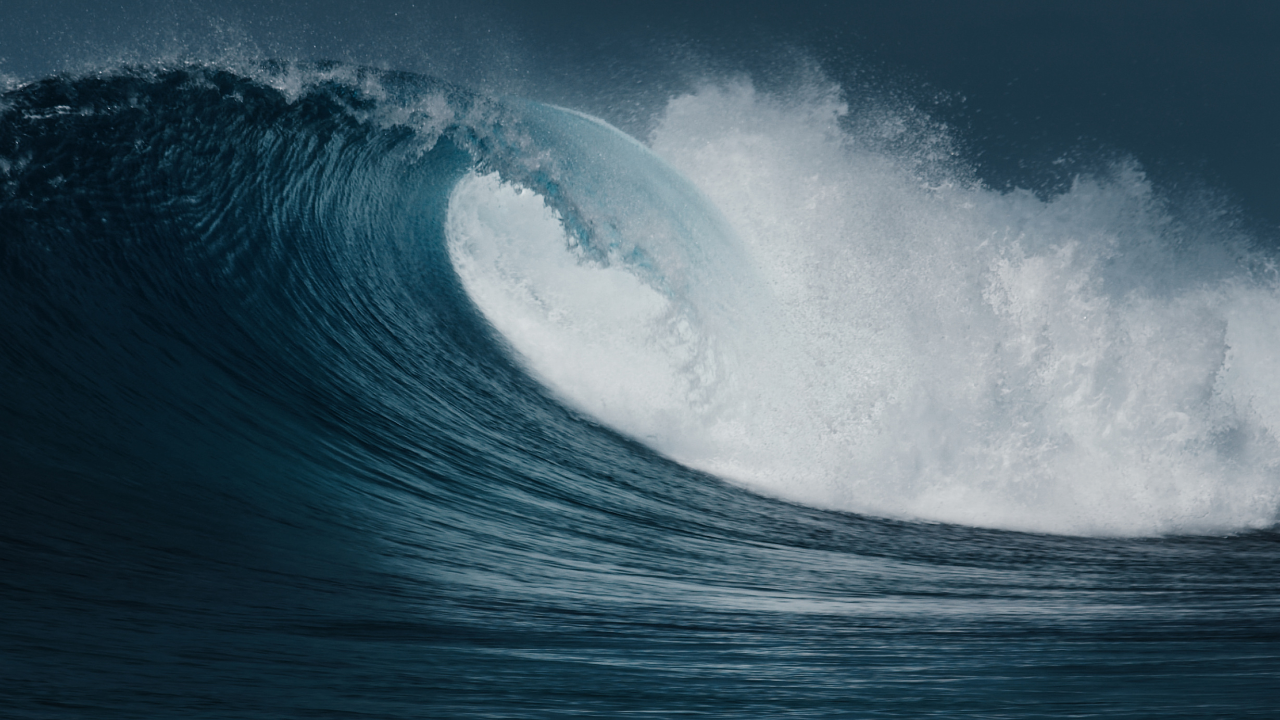
In the vast Pacific, satellites are now tracking swell systems with unprecedented clarity. Their instruments detect waves rising to nearly 35 meters, mapping energy that travels across entire basins. What once seemed chaotic at sea is being quantified, revealing patterns that matter for ships, coasts, and global safety.
Satellites turn the open ocean into a laboratory
The SWOT mission, a joint NASA–CNES effort, measures sea‑surface height with astonishing precision. Its radar interferometer resolves long waves whose crests sit hundreds of meters apart, even far from their stormy birthplaces.
By stitching wide‑swath passes over days, SWOT reconstructs swell fields that span thousands of kilometers. The result is a moving atlas of energy, crest length, and direction, where the ocean’s slow‑rolling giants become fully visible.
A remote storm that shook two oceans
In late 2024, a powerful system known as Eddie raked the North Pacific. Average significant wave height exceeded roughly 19 meters, with select walls of water pushing toward 35 meters in extreme bursts.
These long‑period waves did not simply crash and vanish; they propagated. They marched nearly 24,000 kilometers, threaded the Drake Passage, and spilled their power into the tropical Atlantic weeks after the winds had faded.
On Hawaiian and Californian shores, that distant energy enabled legendary big‑wave contests. Yet beyond spectacle, the episode exposed how off‑shore storms can telegraph risk across basins, long after barometers stop falling.
What the new measurements really show
Satellite data from December 2024 captured rare, very long‑period swell, with intervals up to about 30 seconds between crests. Such waves carry momentum differently than shorter, wind‑sea chop, shaping how they break and runup on coasts.
Crucially, the analysis indicates that earlier empirical formulas overestimated the energy of the longest waves by as much as a factor of twenty. Instead, energy clusters in a handful of dominant crests, like a fighter saving force for a few decisive blows.
Published in September 2025 in PNAS, work led by Fabrice Ardhuin and colleagues updated the spectral picture of extremes. Their framework accounts for nonlinear interactions between long swell and short waves, a coupling once treated as negligible.
As one researcher put it, “Satellites finally let us see how the ocean organizes its power, concentrating it in fewer, more consequential waves.” That insight reshapes how engineers and forecasters think about far‑field hazards.
Key takeaways emerge from the combined observations:
- Long‑period swell can travel inter‑ocean distances with limited energy loss.
- A small set of dominant crests can deliver disproportionate impacts at landfall.
- Traditional models may misallocate energy, skewing risk maps and design margins.
- Nonlinear wave‑wave coupling matters for extreme events, not just calm‑sea theories.
- Spaceborne data now validate and tune next‑generation forecasts, reducing nasty surprises.
Designing for tomorrow’s high‑energy coast
For ports and coastal towns, the distinction between short, steep storm seas and smooth, long‑period swell is not academic. Long waves drive deeper setups, overtop defenses, and infiltrate harbors with resonant surges that stress moorings and quay‑wall joints.
Engineers can now test designs against truly observed extremes, not only model stand‑ins. That means refining crest elevations, parapet geometries, and overtopping criteria, and revisiting assumptions for offshore platforms and subsea cables.
Climate change adds complexity without easy answers. Global warming may alter storm tracks, intensities, and fetch patterns, shifting where and when long swell is born. Yet local bathymetry still governs how that energy focuses on particular shores.
The prudent path blends satellite records, improved spectral physics, and high‑resolution coastal models. Communities can translate far‑off wind into near‑shore risk, producing warnings that are earlier, clearer, and more actionable.
Eddie’s waves were not a one‑off curiosity, but a preview of a better‑measured ocean. With SWOT and companion satellites, science is turning the sea’s largest motions into practical knowledge. When the next deep‑ocean storm uncoils its long swell, we will see it sooner, model it better, and prepare with greater confidence.

Contact details
Address:
Farmers Forum,
36, Dominick Street,
Mullingar,
Co. Westmeath,
Ireland
Phone:
+353 (0)44 9310206
Or email us:
For technical issues please check out our FAQ's page or email - [email protected]
For general Queries email - [email protected]
Request to add event to our Calendar - [email protected]
Send us your mart reports - [email protected]
Suggestions and feedbacks - [email protected]
News Items / Press Release - [email protected]
To Advertise on Farmers Forum - [email protected]