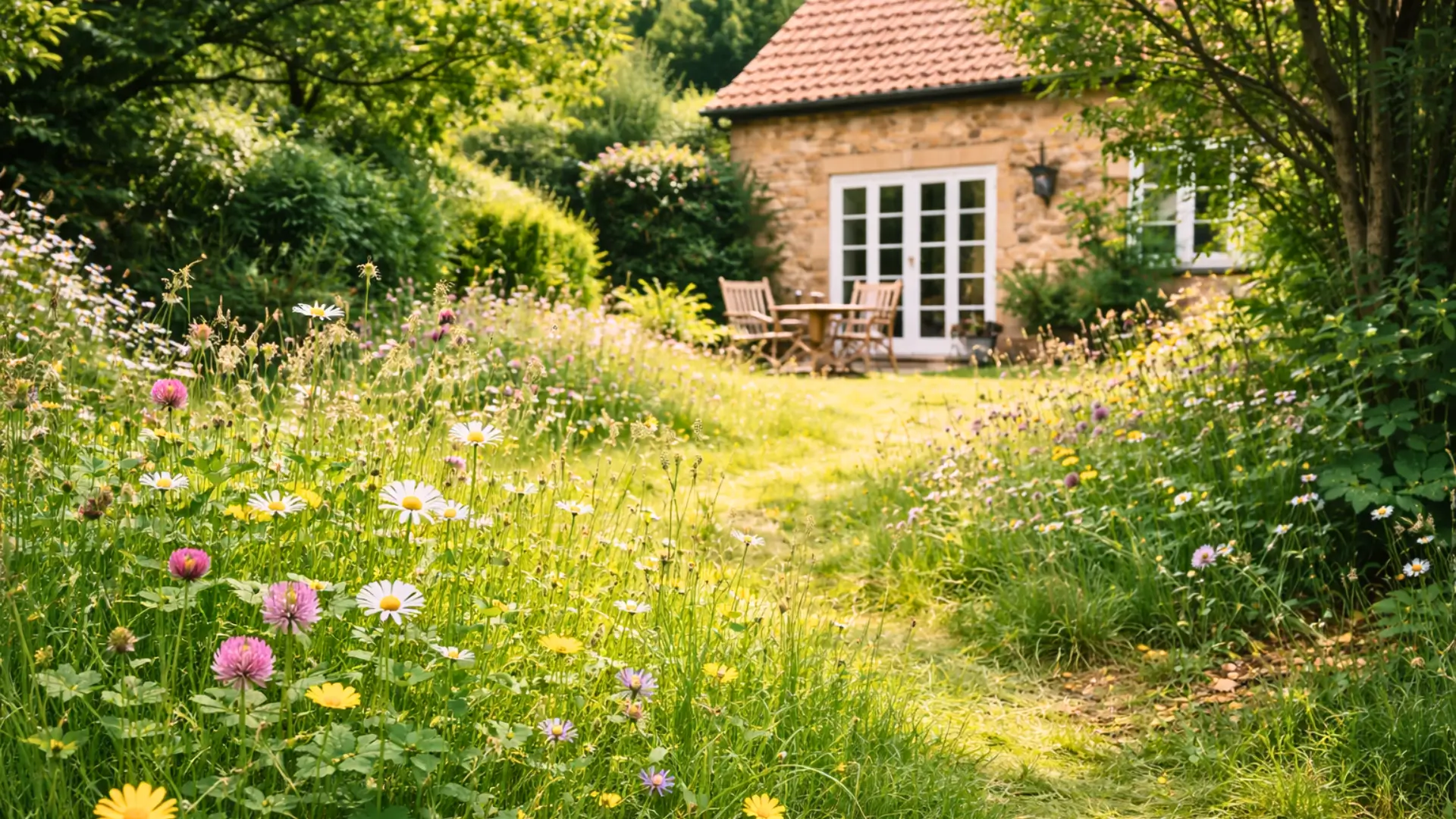
In spring, gardens come alive again and the mowing of lawns begins anew. Yet slowing down this reflex profoundly reshapes the natural balance. By letting a portion of the ground evolve freely, it becomes possible to support pollinators and naturally limit certain pests, without extra effort.
Why an overly mowed lawn disturbs the natural balances of soil and insects
Behind the reassuring image of a uniform lawn lies, in reality, a situation far less rosy. Indeed, frequent mowing prevents plants from flowering and robs insects of essential resources. Thus, a bare lawn becomes a biodiversity-poor environment, unable to feed bees, butterflies, or beetles essential to the cycle of life.
Moreover, several field observations and experiences in ecological management show that spaces left to grow freely attract markedly more pollinators. Consequently, these areas rich in spontaneous wildflowers become true ecological reservoirs, promoting reproduction and survival of local species.
Letting a zone of the garden grow creates a vital refuge for pollinators and microfauna
Concretely, reserving a small non-mown patch fundamentally changes the garden’s dynamics. In a matter of weeks, tall grasses retain moisture and provide a favorable microclimate. Thus, this freely growing vegetation acts as a multifunctional natural shelter, protecting insects from climatic variations and predators.
Moreover, this refuge also attracts species often invisible but essential, such as hoverflies or certain solitary bees. Consequently, the diversity of plants fosters a balanced food web, where each organism plays a precise role in the natural regulation of populations.
Finally, these zones contribute to improving soil quality. Indeed, deep roots aerate the soil and facilitate water infiltration. Thus, a living and structured soil becomes more resistant to drought, while reducing erosion and compaction.
Hedgehogs and beneficial insects become natural allies against garden pests
When the garden becomes welcoming, some unexpected visitors settle in for good. For example, the hedgehog finds shelter in the wildened areas. Thus, this small mammal plays a key role in pest regulation, feeding on slugs and undesirable insects.
At the same time, ladybugs and hoverflies complete this quiet but effective team. Their larvae consume large quantities of aphids. As a result, these beneficial insects adequately replace chemical treatments, while respecting the overall balance of the garden.
More broadly, this natural functioning rests on a simple yet powerful principle. Indeed, the richer the biodiversity, the more stable the system. Thus, a diverse ecosystem naturally limits imbalances, thereby reducing parasite invasions without human intervention.
Structuring an aesthetically pleasing and discreet wild corner without disorganizing the rest of the garden
However, adopting a more natural approach does not mean abandoning all organization. It is therefore possible to clearly delimit a non-mowed zone while keeping neat borders. Thus, this contrast between controlled areas and free spaces creates a visual balance that is harmonious, reassuring, and aesthetically pleasing.
Furthermore, the choice of location is also strategic. Installing this space in a rear corner or near a tree helps it blend into the scenery. In this way, a discreet corner that is nonetheless functional optimizes the welcome of biodiversity without disrupting everyday garden use.
Finally, adding branches or decaying leaves enhances the ecological value of this zone. Indeed, these elements serve as shelters for numerous species. Thus, a simple layout transforms an ordinary space into a living refuge, rich and evolving with the seasons.

Contact details
Address:
Farmers Forum,
36, Dominick Street,
Mullingar,
Co. Westmeath,
Ireland
Phone:
+353 (0)44 9310206
Or email us:
For technical issues please check out our FAQ's page or email - [email protected]
For general Queries email - [email protected]
Request to add event to our Calendar - [email protected]
Send us your mart reports - [email protected]
Suggestions and feedbacks - [email protected]
News Items / Press Release - [email protected]
To Advertise on Farmers Forum - [email protected]