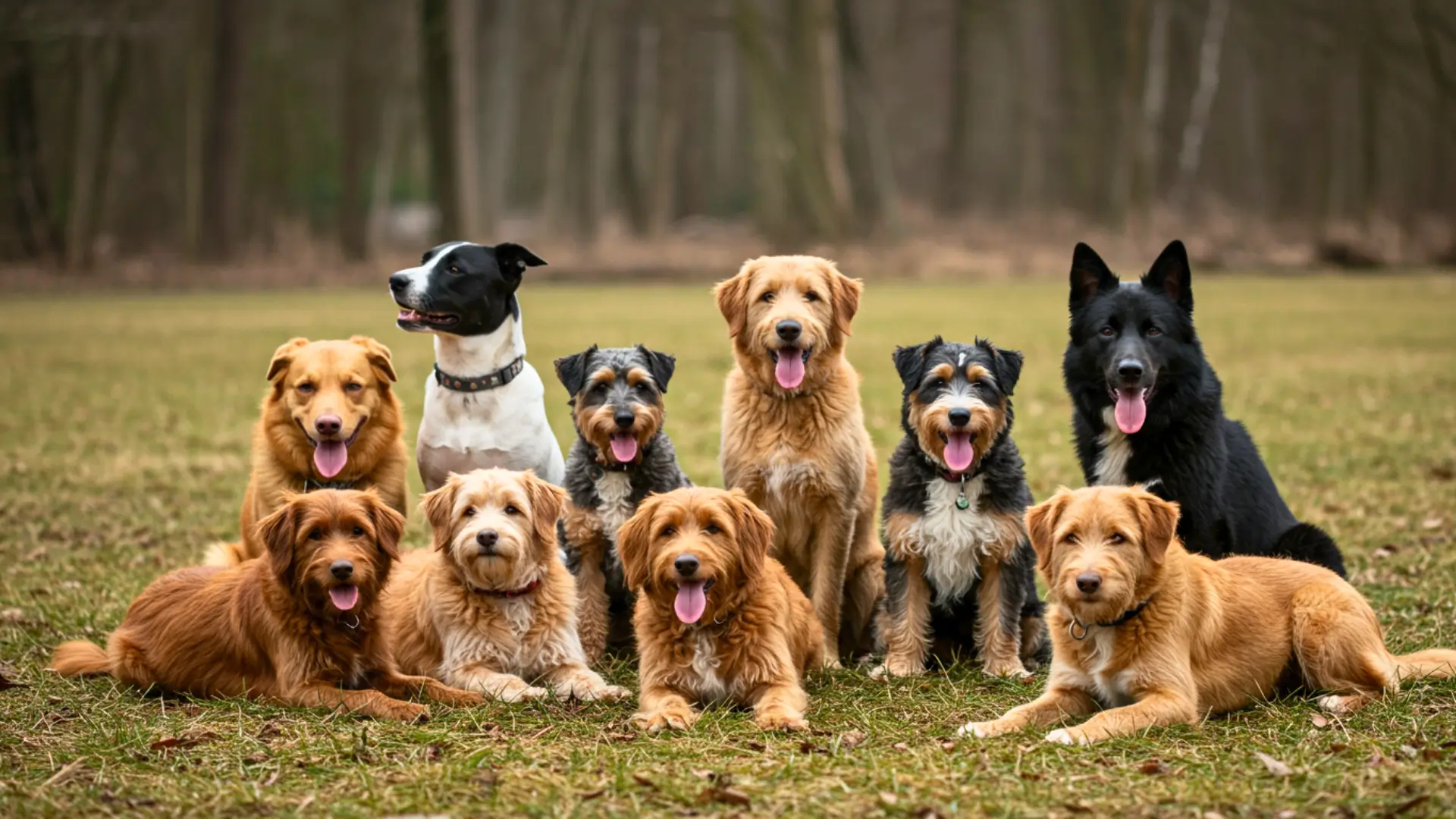
Before our eyes, dogs appear to embody centuries of human-driven selection. Yet recent scientific work reveals something different. In truth, their diversity goes back much further. Long before modern breeding, nature had already shaped a strikingly varied range of forms.
Analyses of Ancient Skulls Reveal Canine Diversity Already Established 11,000 Years Ago
Research conducted by the University of Montpellier and the University of Exeter draws on the study of hundreds of fossils. Using modern techniques, scientists examined more than 600 skulls. These span a 50,000-year timeframe. Ultimately, the results reveal an ancient morphological diversity within these fossil remains that had been unsuspected.
These observations show that, from the outset of the Holocene, dogs exhibited pronounced differences. For instance, size, snout, bone structure or proportions already varied considerably. Consequently, this suggests a physical variability comparable to today across all specimens studied.
Ancient Environments and Climates Naturally Shaped the First Lineages of Dogs
The results indicate that these differences are not solely tied to human influence. Indeed, climate changes played a key role. Ecological conditions as well. Together, they shaped the evolution of canine populations, promoting a natural adaptation to the varied environments observed across ecological contexts.
Additionally, available food resources also influenced this evolution. Similarly, interactions with human groups counted. Thus, this combination of factors allowed the gradual emergence of distinct traits. Consequently, this occurred well before any organized selection, illustrating a complex evolution that progressed across ancient generations.
A Persistent Proximity to Wolves Complicates the Distinction Between Dogs and Wild Ancestors
The study highlights a strong morphological closeness between certain modern dogs and wolves. Indeed, some contemporary breeds still retain traits close to their ancestors. This is especially evident in the skull, signaling a lupine heritage that remains visible in some contemporary lineages.
However, within a single breed, notable differences appear. Thus, some individuals diverge markedly from this original form. Therefore, this demonstrates a surprising internal variability still clearly seen today in these populations.
In this context, this situation makes identifying the first dogs particularly delicate. Indeed, scientists sometimes struggle to distinguish an ancient wolf from an primitive dog. Thus, this highlights a blurred boundary between species throughout their documented shared history.
An Ancient and Complex Domestication That Redefines the Real Role of Humans in Canine Evolution
Fossil discoveries over 10,000 years old, notably in Russia, confirm that certain typical dog forms already existed very early. Thus, these findings reinforce the idea of an incipient domestication long before the modern era, according to available fossil evidence.
The transformations observed would be linked to the end of the Pleistocene. Indeed, this period was marked by profound environmental upheavals. As a result, these changes created new ecological niches. Consequently, they fostered an accelerated diversification of canine populations during these transitional periods.
In light of these results, researchers call for expanding the databases. Moreover, they intend to explore more regions. Thus, a global perspective will allow a better understanding of this evolutionary history. It reveals a coevolution between humans, dogs and the environment far richer than imagined by classic models.

Contact details
Address:
Farmers Forum,
36, Dominick Street,
Mullingar,
Co. Westmeath,
Ireland
Phone:
+353 (0)44 9310206
Or email us:
For technical issues please check out our FAQ's page or email - [email protected]
For general Queries email - [email protected]
Request to add event to our Calendar - [email protected]
Send us your mart reports - [email protected]
Suggestions and feedbacks - [email protected]
News Items / Press Release - [email protected]
To Advertise on Farmers Forum - [email protected]