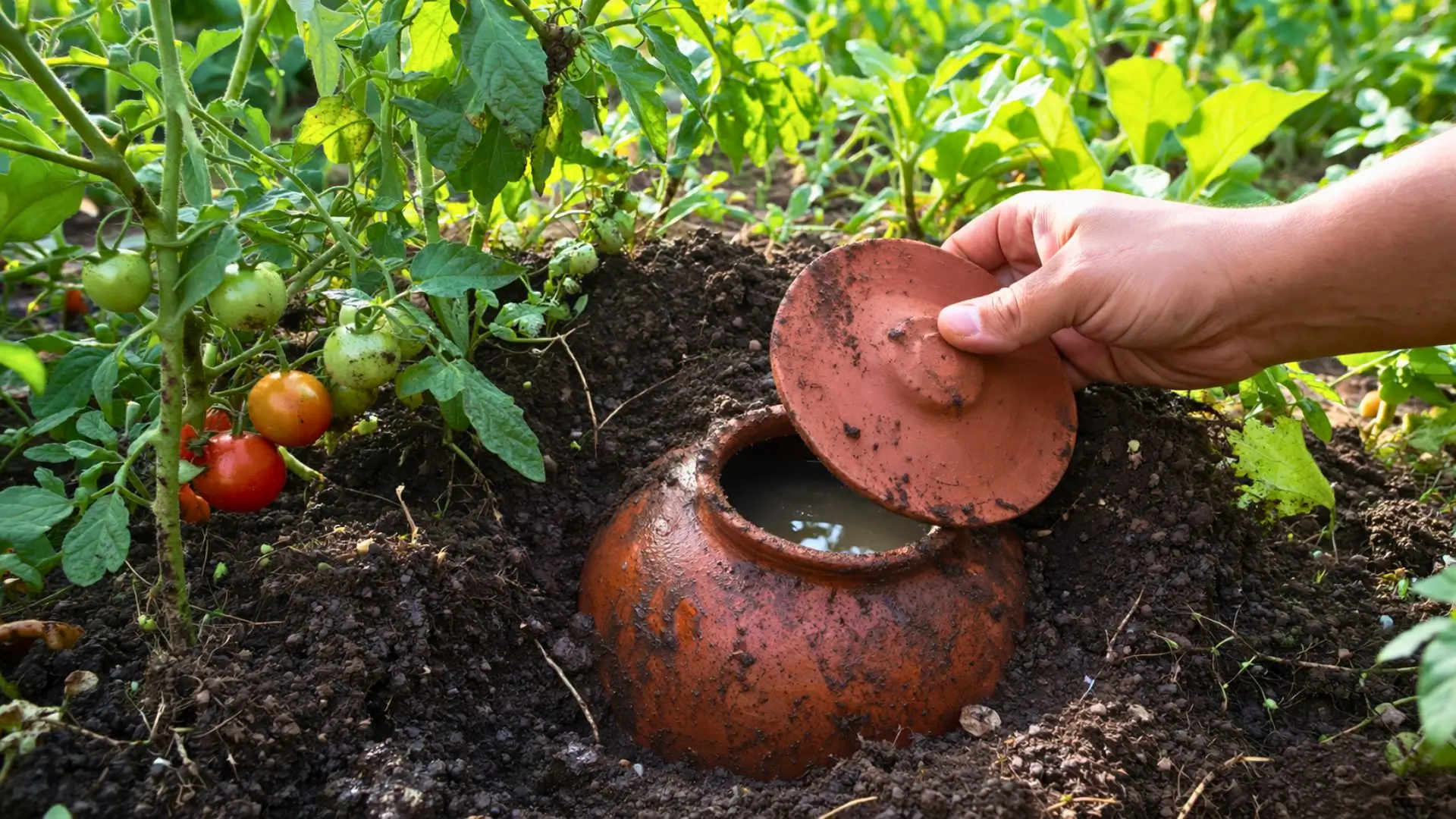
Watering restrictions return each summer with almost unsettling regularity. Yet a solution four thousand years old can deeply irrigate your crops, with little effort and no waste. A simple, porous clay pot buried just below the surface is enough to completely transform your relationship with water in the garden.
An unglazed clay pot used for 4,000 years to water roots without wasting a drop
The olla, also known as oya, is a fired clay vessel with porous walls whose use spans more than four thousand years. It appears to have emerged independently in several great civilizations: ancient China, Mediterranean cultures, and pre-Columbian peoples of Latin America. Its worldwide spread testifies to an effectiveness that time has never negated.
Its principle rests on a physical property of unglazed clay. Without glaze, the wall remains porous and lets water pass slowly through its micro-pores. Once the container is buried in the soil and filled, the surrounding earth soaks up the moisture by capillarity, exactly at the pace the roots require.
This mechanism acts as a natural regulator. When the soil is moist, diffusion slows almost to a standstill. As soon as the earth dries, the pressure on the wall intensifies and the water resumes its advance. Plants thus receive hydration continuously, without abrupt changes, without thermal shocks, without excess or deficit.
Up to 70% water savings compared with conventional surface irrigation: what field feedback reveals
The data have been converging for several years. A properly installed olla reduces water consumption by 50 to 70% relative to a traditional surface watering method. No evaporation loss, no unnecessary runoff: every drop goes straight to the root zone, where it is actually useful for the plants.
A five-liter model covers a drinking radius of roughly 40 to 50 centimeters around its base. Depending on heat and soil texture, such a volume is typically sufficient for three to five days before a refill. A precious autonomy for weekend getaways or extended absences.
Buy a handmade olla crafted in France or build your own: two approaches for every budget
French artisans have revived this technique by producing hand-made oyas, notably in Alsace and Occitanie. These pieces, shaped with local clay, guarantee optimal porosity and the complete absence of industrial additives. Their price range generally sits between 15 and 35 euros depending on capacity.
For larger cultivated plots, the home-made alternative is economically very attractive. Two raw terracotta pots of the same diameter, a cork stopper, and non-toxic silicone are enough. The assembly takes less than ten minutes. The cost comes to under ten euros per unit, often much less.
How to install your first jars this spring so your crops stand up to the first heat
The setup follows a simple logic. Plug the drain hole of the first pot with a cork. Flip the second pot and nestle it rim-to-rim. Seal the junction with a continuous bead of silicone. Let dry for twenty-four hours before the first water test to verify watertightness.
The garden installation should be prepared without delay. Dig a spot about 20 centimeters from the base of each plant. Bury the jar with the filling opening just above ground level. Tuck the surface back gently, fill with water, and cover the opening to prevent evaporation and the breeding of mosquitoes.
Taking advantage of the spring days to install this irrigation device offers a decisive edge. The root system has several weeks to expand around the jar before the first heat spikes. It thus enters summer with a deep water reserve, far more resilient than soil that is merely watered at the surface.

Contact details
Address:
Farmers Forum,
36, Dominick Street,
Mullingar,
Co. Westmeath,
Ireland
Phone:
+353 (0)44 9310206
Or email us:
For technical issues please check out our FAQ's page or email - [email protected]
For general Queries email - [email protected]
Request to add event to our Calendar - [email protected]
Send us your mart reports - [email protected]
Suggestions and feedbacks - [email protected]
News Items / Press Release - [email protected]
To Advertise on Farmers Forum - [email protected]