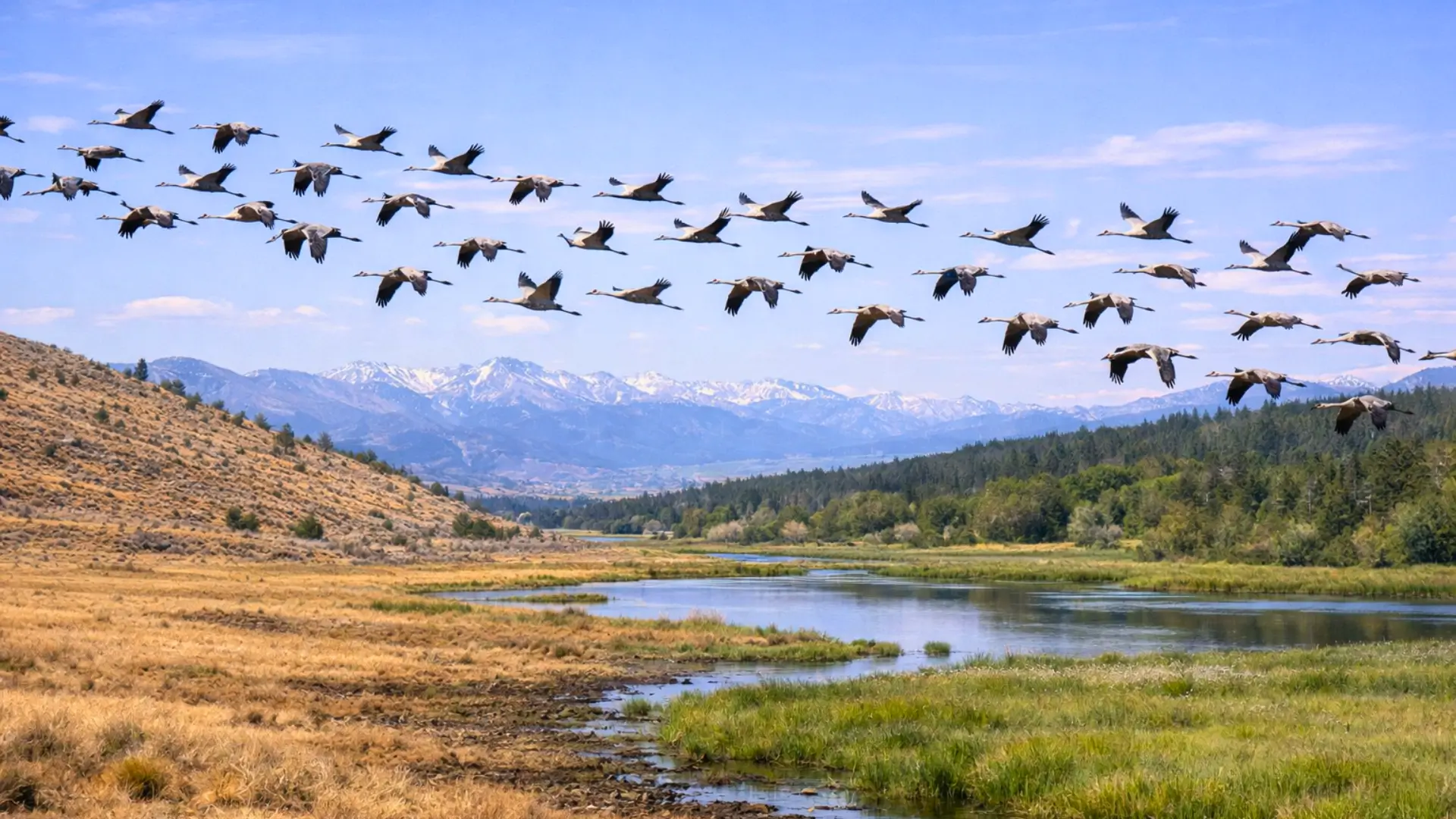
A broad scientific analysis reveals an unexpected upheaval. Animals and plants no longer follow the pace imagined by climate models. Their movement is accelerating rapidly, already redrawing natural balances at a speed that even seasoned researchers find astonishing.
Global analysis reveals that migratory species travel up to four times faster than expected
By cross-referencing thousands of observations drawn from the BIOSHIFTS database, scientists have spotlighted a striking, large-scale phenomenon. Indeed, the actual speed far surpasses estimates from traditional models, profoundly challenging our understanding of current natural dynamics.
The findings published in the scientific journal PNAS present an unequivocal conclusion that cannot be ignored today. Thus, species move on average four times faster than expected, revealing a major gap. Consequently, climate models become a central concern for research.
Why current climate models significantly underestimate the actual speed of migrations
The models used rely on climate projections and ideal habitat conditions that are often simplified. Yet, the ecological mechanisms escape these tools. In reality, biological interactions and adaptive behaviors markedly alter the trajectories observed.
In marine environments, the gap between theory and reality is even more pronounced and striking. Indeed, the accelerated migration is explained in particular by greater habitat continuity. Moreover, species respond more quickly to variations in global temperature.
On land, the situation appears more nuanced and depends heavily on the region studied and local constraints. Thus, mountains, cities, and agricultural lands fragment habitats. Consequently, physical obstacles slow some migrations while intensifying ecological pressures.
Rapid shifts disrupt ecosystems and directly affect human activities
This accelerated movement of species has consequences and is already observed in several regions around the world. Indeed, the reorganization of ecosystems alters food webs. Furthermore, it reshapes biological interactions and landscapes that had been considered stable for decades.
Human activities are also directly—and sometimes unexpectedly—impacted in certain areas. Thus, agriculture, fishing, and forest management must now contend with mobile species. Consequently, the economic impacts are becoming increasingly apparent.
Genetic diversity emerges as a key lever for surviving and colonizing new territories
A second study published in Ecology Letters provides a particularly insightful supplementary perspective for researchers. Indeed, species with high genetic diversity appear better able to withstand temperature increases. Thus, genetic diversity emerges as a determinant factor.
These species do not merely endure ongoing climate changes at a global scale. On the contrary, they also colonize new territories more effectively when conditions become favorable. Therefore, the climate-driven expansion illustrates their capacity to adapt.
These findings call for a reevaluation of conservation strategies currently in place in many countries. Indeed, researchers emphasize the importance of improving existing models. Thus, scientific tools become urgent to anticipate future transformations.

Contact details
Address:
Farmers Forum,
36, Dominick Street,
Mullingar,
Co. Westmeath,
Ireland
Phone:
+353 (0)44 9310206
Or email us:
For technical issues please check out our FAQ's page or email - [email protected]
For general Queries email - [email protected]
Request to add event to our Calendar - [email protected]
Send us your mart reports - [email protected]
Suggestions and feedbacks - [email protected]
News Items / Press Release - [email protected]
To Advertise on Farmers Forum - [email protected]