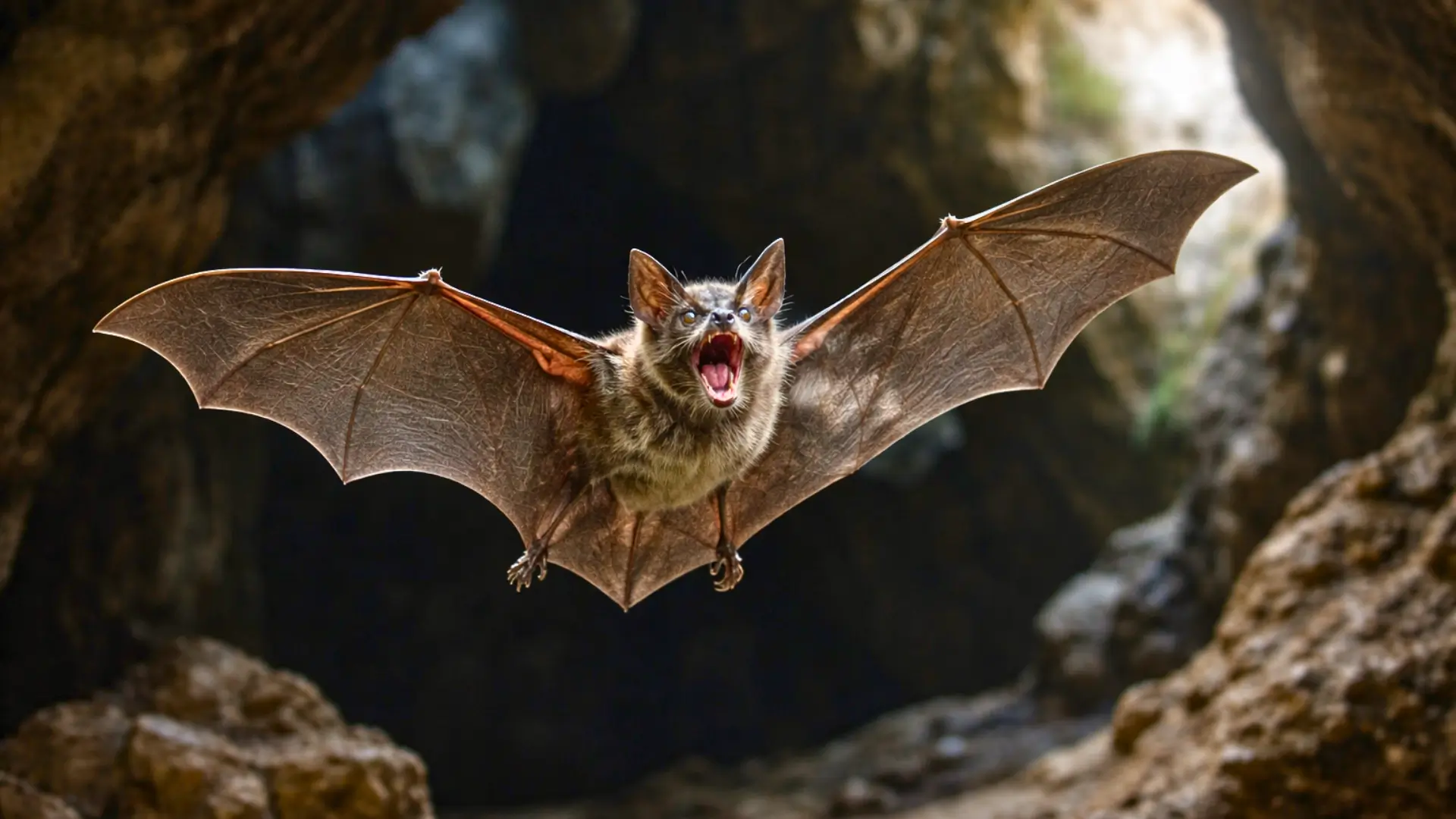
In the shadows of European caves, a surprising discovery upends conventional wisdom about the animal world. A bat may be able to imitate the buzzing of a dangerous insect to escape its predators. An unexpected strategy unveiled by a recent scientific study.
A Novel Acoustic Mimicry in a Mammal Revealed by a Recent Scientific Study
Mimicry is well known in nature. It is most often visual. Yet here, another register comes into play. A phenomenon of unprecedented acoustic mimicry is observed in the bat Myotis myotis. This behavior deeply intrigues researchers.
Moreover, the study published in the scientific journal Current Biology is conducted by the University of Naples Federico II. It highlights this fascinating behavior. Thus, the researchers describe how this species produces a sound resembling that of biting insects.
Comparative Experiments with Insects and Owls to Validate the Acoustic Mimicry Hypothesis
To validate this hypothesis, the researchers compare the bats’ sounds with those of the European hornet and the bee. Additionally, analyses reveal a strong similarity in the pulsated buzzing. This strengthens the credibility of this imitation.
Subsequently, scientists playback these sounds to tawny owls and little owls. The results are clear: the birds react in the same way to the sounds of insects and bats. This reveals an effective acoustic defense against danger.
The Owls’ Behavior Reveals an Avoidance Reflex to Sounds Associated with Potential Danger
Owls, whether wild or raised in captivity, avoid these sounds. They recall insects capable of stinging. Thus, this reflex suggests an avoidance behavior deeply rooted in their biology.
However, individuals raised in the wild react more strongly. Indeed, their experience reinforces this caution. It concerns sound signals potentially dangerous. This illustrates reinforced learning through the environment.
Meanwhile, the researchers broadcast natural bat sounds without buzzing. The owls then adopt an opposite stance. Thus, they approach. This confirms their role as sound-guided predators in their hunting strategies.
A Potential Survival Mechanism Likely Widespread Among Other Myotis Bats
This discovery opens up new perspectives. It concerns animal adaptation strategies. Indeed, researchers think this mimicry exists in other Myotis species. This reveals a underestimated phenomenon in nature.
Moreover, several European bats display comparable cries, notably in stressful situations. Thus, this similarity intrigues researchers. It suggests that the acoustic mimicry could be more widespread in the face of predators.
Finally, these studies mark an important advance. They concern the understanding of predator-prey interactions. Moreover, they remind us that nature is full of unforeseen mechanisms. These continue to surprise scientists.

Contact details
Address:
Farmers Forum,
36, Dominick Street,
Mullingar,
Co. Westmeath,
Ireland
Phone:
+353 (0)44 9310206
Or email us:
For technical issues please check out our FAQ's page or email - [email protected]
For general Queries email - [email protected]
Request to add event to our Calendar - [email protected]
Send us your mart reports - [email protected]
Suggestions and feedbacks - [email protected]
News Items / Press Release - [email protected]
To Advertise on Farmers Forum - [email protected]