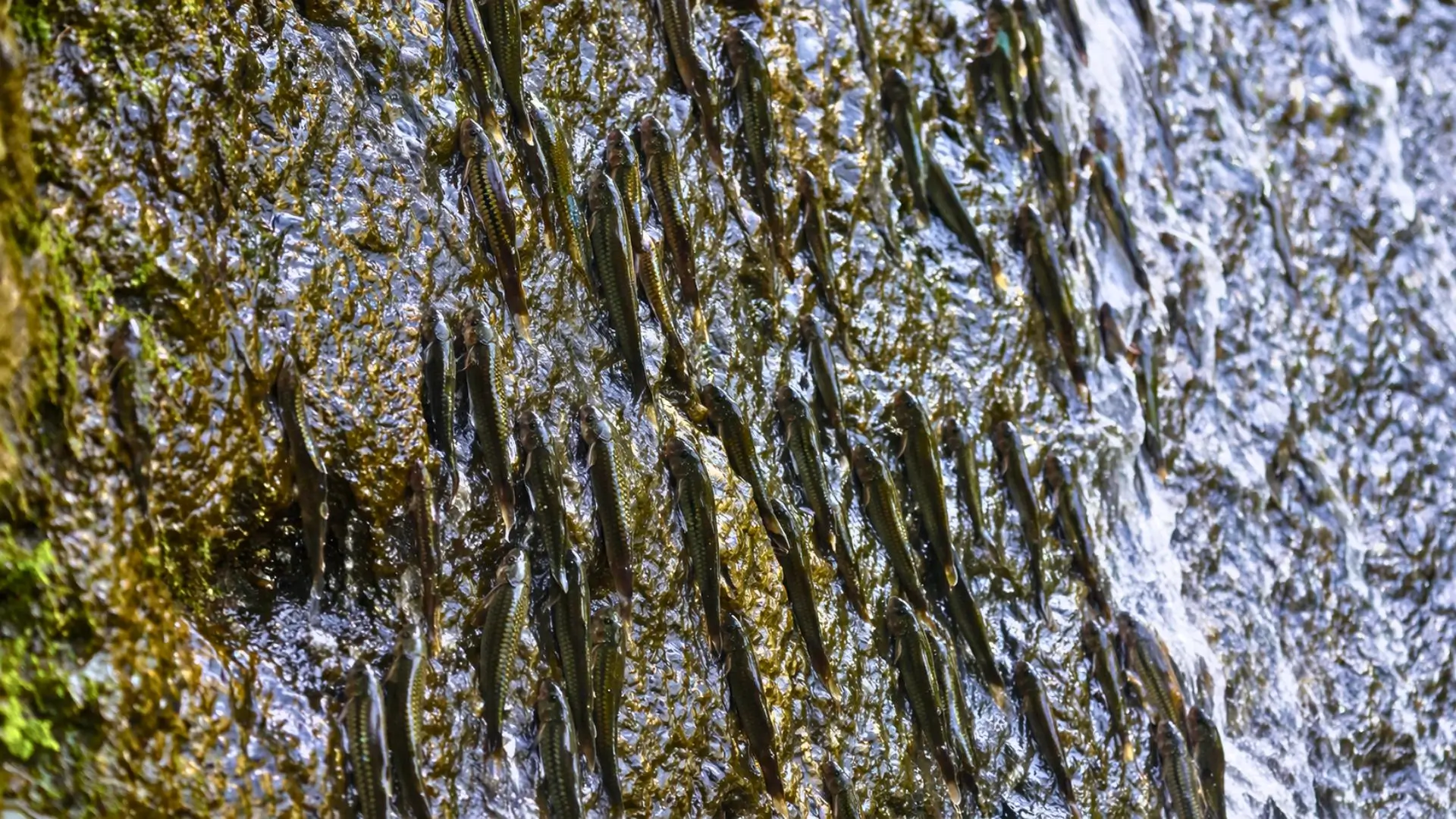
In southern DRC, thousands of Parakneria thysi ascend each year the damp rock face of the Luvilombo Falls. Now, researchers have delivered the first detailed scientific description. The takeaway is clear: video footage, measurements, and an ecological warning.
Behind the Luvilombo Falls, science finally films a 15-meter ascent long deemed improbable
The phenomenon does not come from nowhere. Locals have described it for more than half a century. Yet science had never filmed it properly. Between 2018 and 2020, missions finally yielded a first solid on-site proof.
On-site, researchers observed thousands of individuals pressed close to the wet rock. Then they traced along the spray zone, not the heart of the current. You see the trick: they avoid the strongest water to attempt the vertical ascent without losing grip.
Their secret lies in the fins: fifteen minutes of effort, then repeated pauses on the cliff
These fish do not cling belly-down. They rely on their pectoral and pelvic fins. Under these supports, tiny hooked structures reinforce their grip. Then, a wavelike motion of the body propels the little climbers centimeter by centimeter toward the summit.
First, the figure is striking right away. An individual takes on average nine hours and forty-five minutes to cover 15 meters. Yet it almost never climbs without a pause. The surveys show only fifteen active minutes, interspersed with short rests and long recoveries.
When they reach a flat ledge, many stop together before resuming. This detail alters the way you view the feat. The climb resembles less a sprint and more a relay sequence. Nevertheless, water jets can still trigger brutal falls.
Between April and May, only the lighter ones venture forth, with a subtle peak when the water level drops
The migration begins at the end of the rainy season. Then, at the start of April, the water remains high and climbers are few. Then their numbers rise. It peaks around mid-April, when the flow stabilizes again in the wet zone.
Timing matters as well. Activity increases mainly in the late afternoon, around sunset. Importantly, not all fish depart. Only individuals measuring 3.7 to 4.8 centimeters succeed in this partial migration, because the larger ones bear their weight less well.
Irrigation, nets too fine, knowledge still incomplete: this Congolese marvel also reveals a fragile ecosystem
This feat does not guarantee security. Downstream, extremely fine nets can capture fish gathered before the ascent. And this passage concentrates individuals at the worst moment. You can understand why fishing pressure already concerns researchers.
Another, less visible threat: water can be diverted to irrigate crops during the dry season. In some years, the river dries up completely downstream from the falls. Moreover, this disruption breaks the ecological continuity the species depends on to move.
Thus this dossier tells us more than a mere curiosity about an animal. It underscores how little the Congo Basin has been studied regarding behavior. Finally, the authors suspect other species capable of comparable feats. Protecting this natural corridor could therefore reveal far more.

Contact details
Address:
Farmers Forum,
36, Dominick Street,
Mullingar,
Co. Westmeath,
Ireland
Phone:
+353 (0)44 9310206
Or email us:
For technical issues please check out our FAQ's page or email - [email protected]
For general Queries email - [email protected]
Request to add event to our Calendar - [email protected]
Send us your mart reports - [email protected]
Suggestions and feedbacks - [email protected]
News Items / Press Release - [email protected]
To Advertise on Farmers Forum - [email protected]