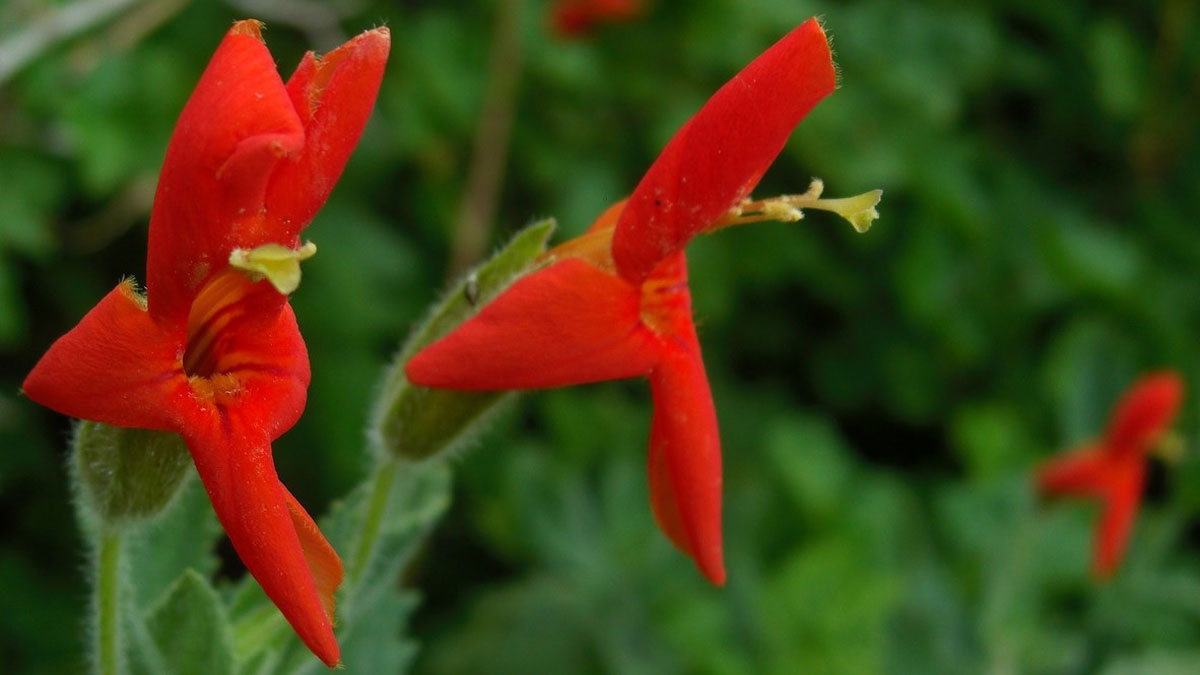
During a record drought on the scale of the last millennium, an American coastal plant defied all forecasts by rapidly adapting and continuing to thrive. Researchers have recently uncovered the secrets of its resilience.
Evolutionary Rescue
Researchers from the University of British Columbia and Cornell University studied 55 populations of the scarlet monkeyflower (Mimulus cardinalis) in Oregon and California for more than a decade. Between 2012 and 2016, a mega-drought struck the region, offering them a rare opportunity to observe the strategies adopted to overcome this extreme environmental stress.
Genetic analyses showed that soon after the onset of this extreme event, certain M. cardinalis populations quickly displayed genetic variations and traits associated with hot, dry environments. As a result, the leaves of their descendants retained more water while continuing to absorb the carbon dioxide necessary for photosynthesis.
“In essence, we found that the populations that recovered are also the ones that evolved the fastest, tackling the drought with the appropriate genetic variation,” write the authors of the new study, published in the journal Science.
The team describes this phenomenon, previously undocumented in nature, as “evolutionary rescue,” with a species evolving in record time to overcome the challenges of a changing environment. According to them, for this to occur, three conditions must be met: climate-driven population decline, rapid genetic evolution, and recovery attributable to this change.

A Reason for Hope
More broadly, such observations provide a reason for hope for organisms studied in the parts of the globe most affected by climate change (heat waves, increased rainfall…).
But as Amy Angert, a researcher at the University of British Columbia and co-author of the new study, notes, many species do not have enough “genetic wiggle room” to allow this to happen.
“The next step will be to determine which species are likely to behave like M. cardinalis, or, conversely, like the Douglas fir or the red cedar,” she concludes.
Earlier this year, experiments had shown that close contact between plants strengthened their resilience.

Contact details
Address:
Farmers Forum,
36, Dominick Street,
Mullingar,
Co. Westmeath,
Ireland
Phone:
+353 (0)44 9310206
Or email us:
For technical issues please check out our FAQ's page or email - [email protected]
For general Queries email - [email protected]
Request to add event to our Calendar - [email protected]
Send us your mart reports - [email protected]
Suggestions and feedbacks - [email protected]
News Items / Press Release - [email protected]
To Advertise on Farmers Forum - [email protected]