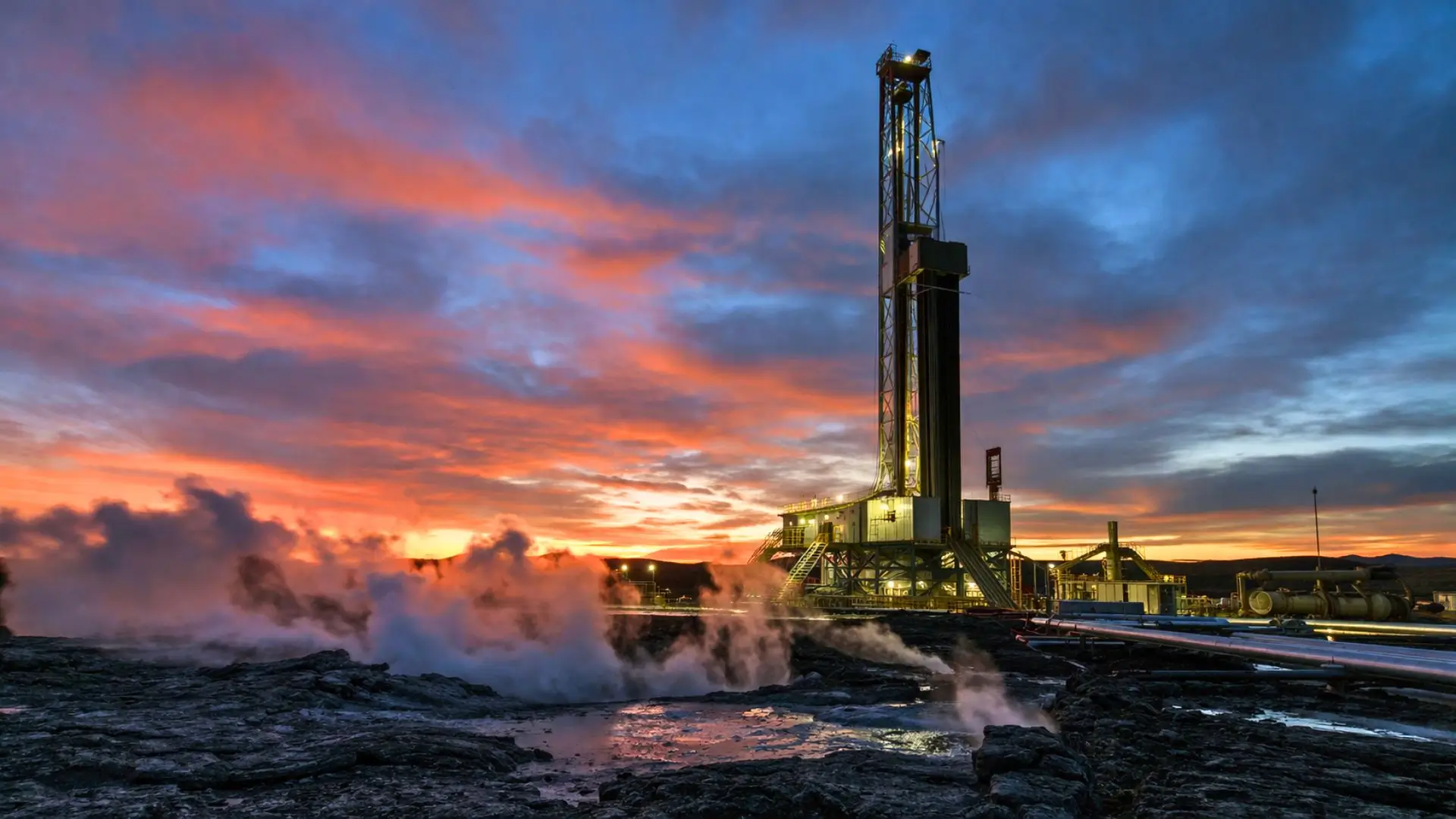
This subterranean phenomenon that turns Earth’s heat into energy available 24/7 and 365 days a year
Geothermal energy involves capturing the natural heat stored beneath the Earth’s surface. This energy does not rely on the sun or the wind. It draws directly from the planet, at depths of roughly 500 to 2,500 meters, and remains continuously available.
This principle rests on the geothermal gradient: the temperature of the subsoil rises by about 3 °C every 100 meters. The deeper one goes into the Earth’s crust, the more intense the heat becomes. This value varies with local geology, but stays sufficiently constant to guarantee predictable production.
The captured heat serves two main purposes: heating buildings and producing electricity. The installations rely on deep drilling, then inject or withdraw fluids depending on the chosen technique. The result: a controllable energy source, with no significant emissions, and renewable on a human timescale.
United States leads, Philippines, Indonesia: how the global geothermal podium was built in 2025
Global Energy Monitor data published in March 2026 place the United States at the top with 3,953 MW. Indonesia follows with 2,742 MW, ahead of the Philippines at 2,034 MW. Together, these three nations account for more than half of the world’s installed geothermal capacity.
Beyond this trio, Turkey (1,726 MW) and New Zealand (1,377 MW) complete a solid top five. Mexico, Kenya and Italy also figure among the leading nations. In total, ten countries concentrate more than 93% of the world’s installed geothermal capacity.
Iceland: the country that heats 90% of its homes with geothermal energy, a model few nations can replicate
Ninth in the global ranking, Iceland arguably exemplifies geothermal potential better than any other nation. Thanks to its intense volcanic activity, this Nordic country heats nearly 90% of its housing with this resource. It also accounts for around 28% of its national electricity production.
France, 27th in the global ranking, shows only 2 MW of installed capacity for geothermal electricity. This modest position is explained by a subsurface less favorable to the temperatures required for electricity production. Nevertheless, France stands out as the second European producer of deep geothermal heat, behind Italy.
Why demand for geothermal energy will accelerate, and what still hinders its deployment worldwide
The rising power of artificial intelligence is driving an unprecedented energy demand. Data centers require a reliable, continuously available supply. Geothermal energy meets this need precisely. It produces energy consistently, whatever the weather.
The International Energy Agency is optimistic. Geothermal could account for about 15% of the growth in global electricity demand by 2050. Moreover, its low carbon footprint makes it a major asset: roughly 38 gCO₂ per kWh.
However, real obstacles limit its expansion. Drilling and installation costs remain high, and corrosion risks pose technical challenges. Most importantly, high-enthalpy geothermal activity remains tied to volcanic zones. This geographic lock mechanically constrains its deployment on a global scale.

Contact details
Address:
Farmers Forum,
36, Dominick Street,
Mullingar,
Co. Westmeath,
Ireland
Phone:
+353 (0)44 9310206
Or email us:
For technical issues please check out our FAQ's page or email - [email protected]
For general Queries email - [email protected]
Request to add event to our Calendar - [email protected]
Send us your mart reports - [email protected]
Suggestions and feedbacks - [email protected]
News Items / Press Release - [email protected]
To Advertise on Farmers Forum - [email protected]