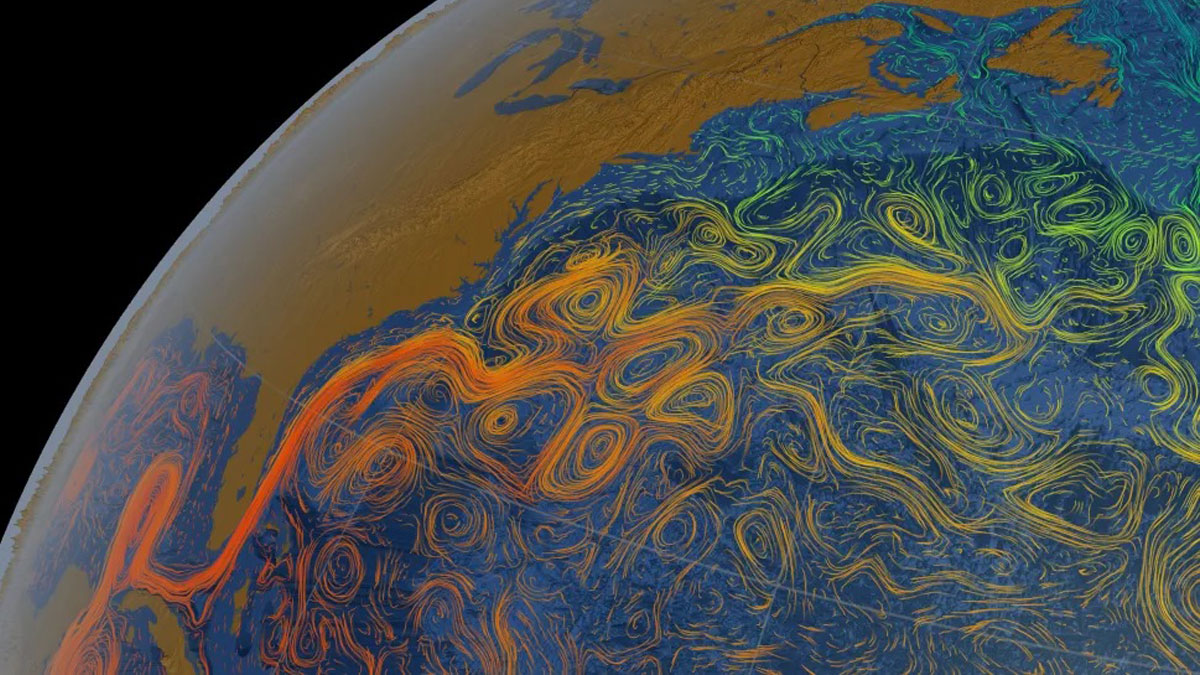
New data indicate that the Gulf Stream, this vital warm current that transports tropical waters toward the north Atlantic, is shifting in that direction, with broad potential implications for global climate.
Crucial Currents
The Gulf Stream forms the upper branch of the Atlantic Meridional Overturning Circulation, or AMOC. Often described as a conveyor belt, this system of ocean currents plays a key role in transporting warm and salty waters from the tropics toward the north. As they approach the pole, these surface waters progressively cool. Becoming denser, they sink into the depths of the ocean and the cycle restarts.
With the rapid warming of the oceans and the accelerated melting of Greenland’s ice—which is warming up to four times faster than the rest of the globe—many researchers fear that the AMOC could slow down significantly in the coming decades. It is estimated that since the 1950s, it has already lost about 15% of its strength.
If its collapse would not trigger the world-spanning ice-age apocalypse depicted in the film The Day After Tomorrow, it would cause a dramatic drop in temperatures in Europe and profound disruptions of weather regimes across the northern hemisphere.
To quantify the Gulf Stream’s influence on the overall dynamics of the AMOC, climatologists at Utrecht University conducted a series of advanced simulations based on the latest available data.

A Significant Shift of the Gulf Stream in the Last Few Decades
Described in the journal Communications Earth & Environment, the highlighted interactions reveal a notable northward shift of the Gulf Stream since the 1990s, presumably due to the slowdown of the AMOC.
Projections indicate that further weakening of the AMOC will push the Gulf Stream even further north. At a key longitude (71.5° West), it was slowly drifting northward by about 133 kilometers over centuries, then suddenly leaping by roughly 219 kilometers in just two years.
Overall, such work reinforces the idea that a pronounced shift of the Gulf Stream signals the proximity of a tipping point for the AMOC. Although the timing of any potential collapse remains debated, monitoring its northern branch, according to the authors, provides a valuable means of quantifying its decline.

Contact details
Address:
Farmers Forum,
36, Dominick Street,
Mullingar,
Co. Westmeath,
Ireland
Phone:
+353 (0)44 9310206
Or email us:
For technical issues please check out our FAQ's page or email - [email protected]
For general Queries email - [email protected]
Request to add event to our Calendar - [email protected]
Send us your mart reports - [email protected]
Suggestions and feedbacks - [email protected]
News Items / Press Release - [email protected]
To Advertise on Farmers Forum - [email protected]