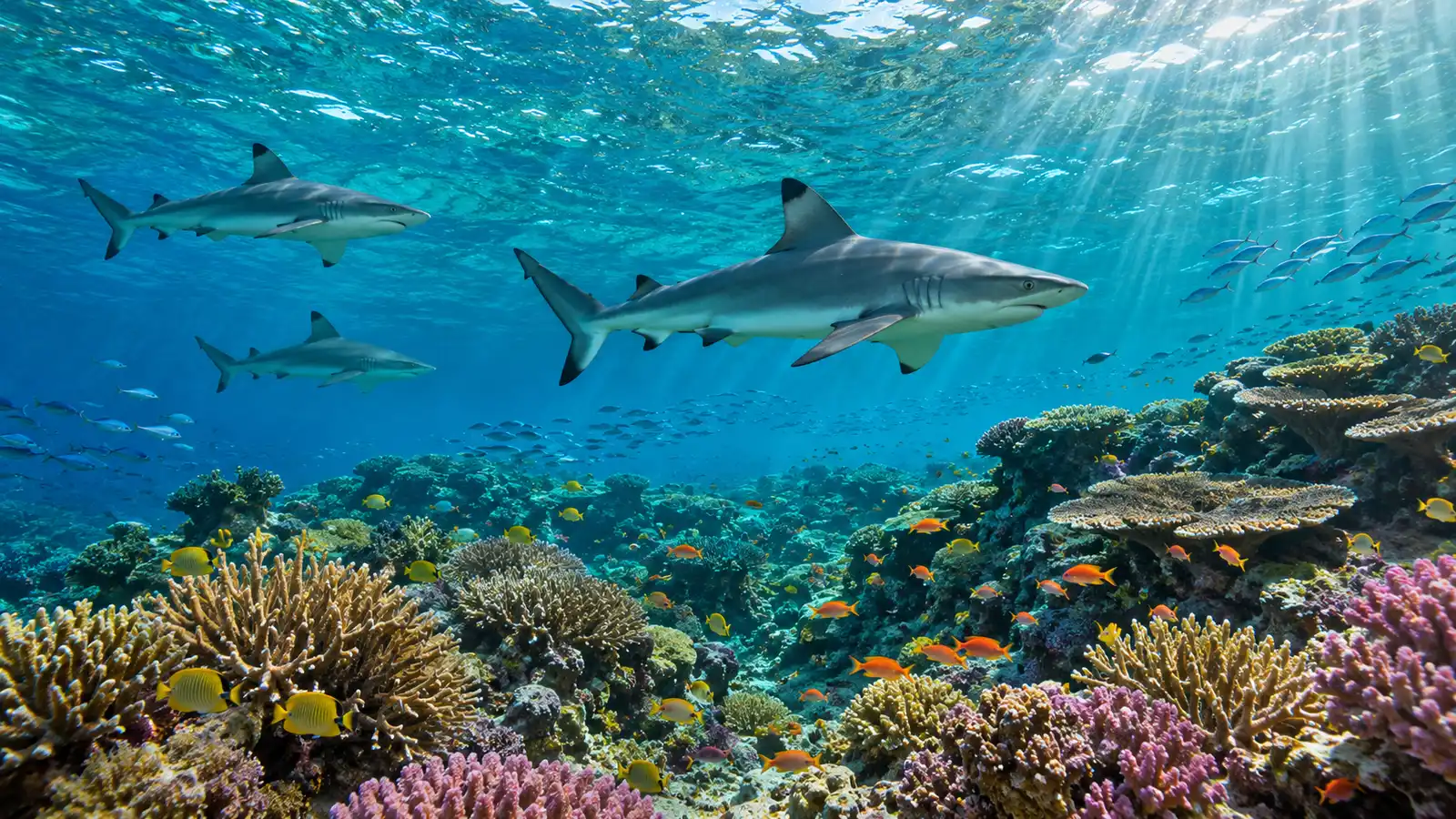
North of the Marshall Islands, two uninhabited atolls offer a rare glimpse into tropical ecosystems that remain largely intact. A study published on November 11, 2026 in Frontiers in Marine Science describes pervasive sharks, thousands of seabirds, and thriving coral reefs. Bikar and Bokak now serve as reference points for measuring future changes.
An expedition conducted in 2023 by Pristine Seas explored Bikar and Bokak, from the Pisonia forest to the depths
The study is led by Alan Friedlander, a researcher with the Pristine Seas program of the National Geographic Society and the University of Hawai‘i’s Institute of Marine Biology. It also involves the Marshall Islands Marine Resources Authority. The surveys were carried out in 2023, following an initial campaign in 2019.
These two atolls lie more than 850 kilometers north of Majuro, the capital. Bikar is about 116 kilometers from Utrik, the nearest inhabited atoll, and Bokak about 385 kilometers. Thus, isolation has limited fishing and human development. The researchers combined land inventories, fish counts, underwater cameras, and deep dives, an integrated approach rarely employed on such remote atolls.
Sharks dominate the biomass of the outer reefs, with 26.8% at Bikar and nearly 34% at Bokak
On the outer slopes, sharks make up the largest share of reef fish biomass. Their proportion reaches 26.8% at Bikar and 33.9% at Bokak. Elsewhere in the Pacific, fishing has often wiped out these apex predators. Moreover, the average biomass of these predators would be about 2.4 times higher at Bokak.
The grey reef shark dominates this assemblage at both sites. In total, divers recorded 266 reef fish taxa, spanning 38 families. Additionally, herbivores occupy a substantial role, a sign of a trophic network still largely intact.
The DeepSea submersible filmed 138 taxa down to 275 meters, including 14 never reported for the Marshall Islands
The team used a submersible capable of descending to 450 meters. Up to 275 meters, it documented 138 taxa of fishes from 43 families. Among them, fourteen appear to be new for the archipelago, to be confirmed by specimens.
Meanwhile, baited cameras deployed to depths of up to 2,000 meters filmed 79 vertebrate taxa. However, some identifications remain provisional, such as a fish of the genus Parapercis. These results show how little-explored the northern deep zones of the archipelago remain.
Seventeen seabird species and 132 turtle nests make these atolls a reference for the sanctuary created in 2025
On land, researchers observed 17 seabird species, of which 15 are nesters. On Bikar, 132 nesting burrows and 71 emergence traces were recorded, mostly of green turtles. By contrast, Bikar also hosts more Polynesian rats and macroalgae.
In 2025, the Marshall Islands established their first national marine sanctuary around the two atolls, covering roughly 48,136 square kilometers. The contrast with Bikini Atoll, marked by American nuclear tests, remains striking. Since then, only repeated campaigns will allow monitoring how warming affects these preserved reefs.

Contact details
Address:
Farmers Forum,
36, Dominick Street,
Mullingar,
Co. Westmeath,
Ireland
Phone:
+353 (0)44 9310206
Or email us:
For technical issues please check out our FAQ's page or email - [email protected]
For general Queries email - [email protected]
Request to add event to our Calendar - [email protected]
Send us your mart reports - [email protected]
Suggestions and feedbacks - [email protected]
News Items / Press Release - [email protected]
To Advertise on Farmers Forum - [email protected]