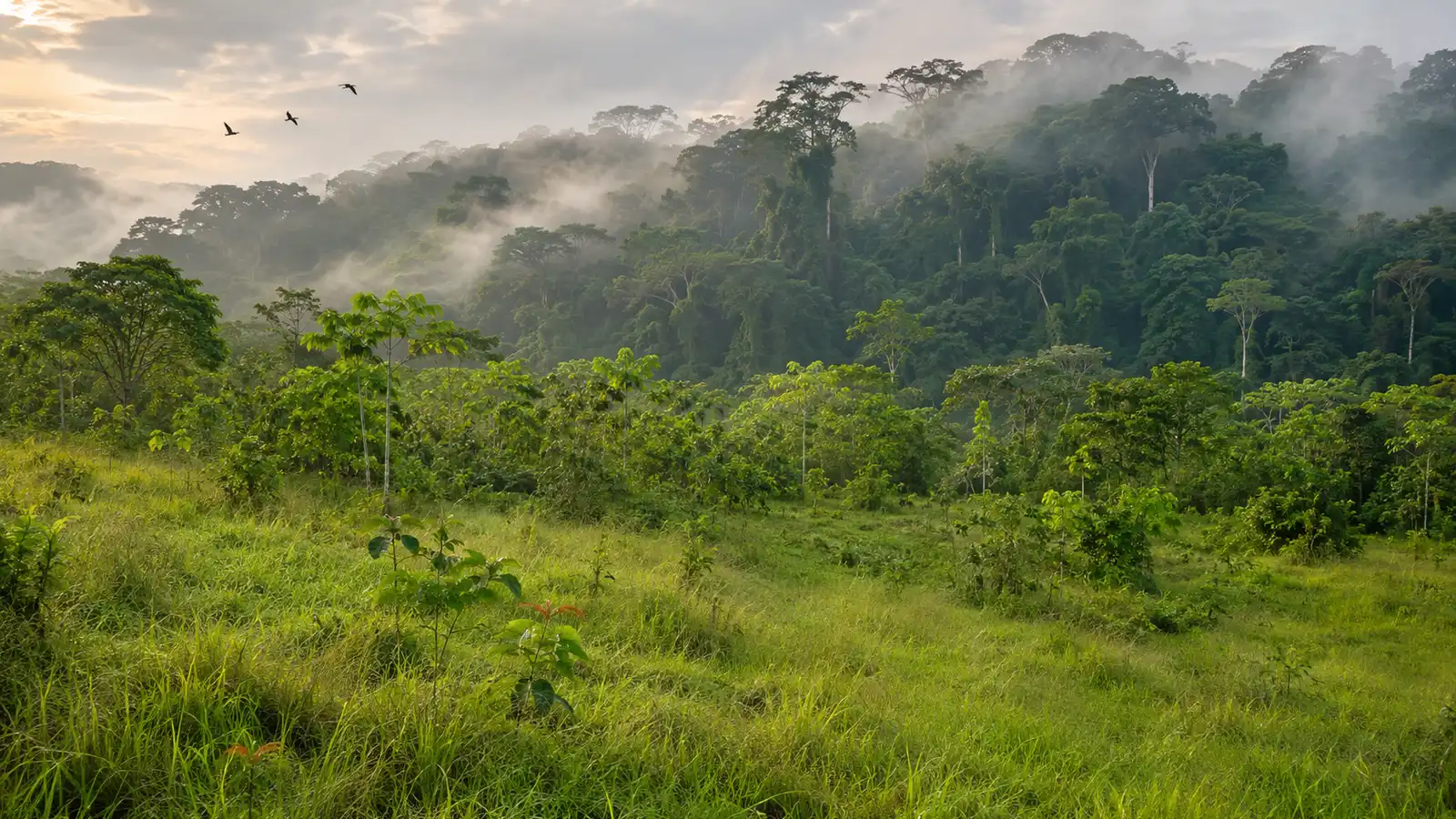
In the equatorial Chocó, plots once cultivated are returning to forest much faster than expected. Published in April 2026 in Nature, a study led by Darmstadt University of Technology shows that a tropical forest recovers most of its biodiversity in a single generation. Yet this rebound does not fully offset the deforestation of ancient forests.
In the northwestern Ecuador, 62 plots were used to compare pastures, cacao groves, and forests of varying ages
The work is part of the Reassembly consortium, funded by the German Research Foundation. Led by PhD student Timo Metz and ecologist Nico Blüthgen, it involved 41 researchers, mostly German and Ecuadorian. Their fieldwork took place in reserves managed by the Ecuadorian organization Jocotoco.
The 62 sites form a complete regeneration gradient. Thus, pastures and cacao groves still in use sit alongside secondary forests of varying ages, derived from former crops, and intact primary forests. This mosaic allows monitoring, on the same territory, what happens once exploitation stops.
Sixteen groups of organisms and more than 8,500 species show a 90% recovery of diversity in three decades
The team inventoried 16 groups, from trees to birds, including insects, fungi, and soil bacteria. In total, more than 8,500 species were recorded. According to the authors, no tropical regeneration study had previously assembled such a volume of field data.
The result is clear. In about thirty years, the global diversity exceeds 90% of the level found in primary forests. Moreover, nearly three-quarters of the species typical of these ancient forests have returned in the same period, confirming a resilience that had thus far been described mainly by theoretical models.
Soil bacteria and leaf-litter fauna lag behind, far behind mobile animals
Not all groups follow the same tempo. Some mobile animals recolonize plots within just a few years, thanks to their strong dispersal capacity. By contrast, litter-dwelling invertebrates and soil bacterial communities rebuild more slowly than the trees themselves.
Yet previous work conducted in Central and South America indicates that tree diversity and biomass already require more than a century to return fully. Hence, the complete composition of an old-growth forest could demand several human generations. A 30-year-old secondary forest thus remains a different ecosystem.
Former cacao plantations regenerate faster than pastures, provided that intact forests remain nearby
The past land-use regime weighs heavily. Abandoned cacao groves rebound more quickly, because the shade trees left on site provide shade and foliage from the outset. In contrast, the highly competitive forage grasses of pastures hinder the establishment of young trees.
Moreover, the fauna acts as a driver of recolonization. Bats, monkeys and birds carry seeds, while dung beetles bury them in the soil. However, this mechanism depends on neighboring intact forests, which serve as reservoirs of species and seeds.
Finally, the researchers remind us that 4 to 6 million hectares of tropical forests disappear each year. Consequently, restoration cannot replace the protection of primary forests, which remain the very condition for biodiversity to return.

Contact details
Address:
Farmers Forum,
36, Dominick Street,
Mullingar,
Co. Westmeath,
Ireland
Phone:
+353 (0)44 9310206
Or email us:
For technical issues please check out our FAQ's page or email - [email protected]
For general Queries email - [email protected]
Request to add event to our Calendar - [email protected]
Send us your mart reports - [email protected]
Suggestions and feedbacks - [email protected]
News Items / Press Release - [email protected]
To Advertise on Farmers Forum - [email protected]