Spectacular announcements of genetically modified wolves and mice are reviving the idea of reviving extinct species. Yet the case of a small rodent from the Indian Ocean shows that genetics cannot rebuild everything. Between targeted manipulations and truly extinct species, the gap remains considerable.
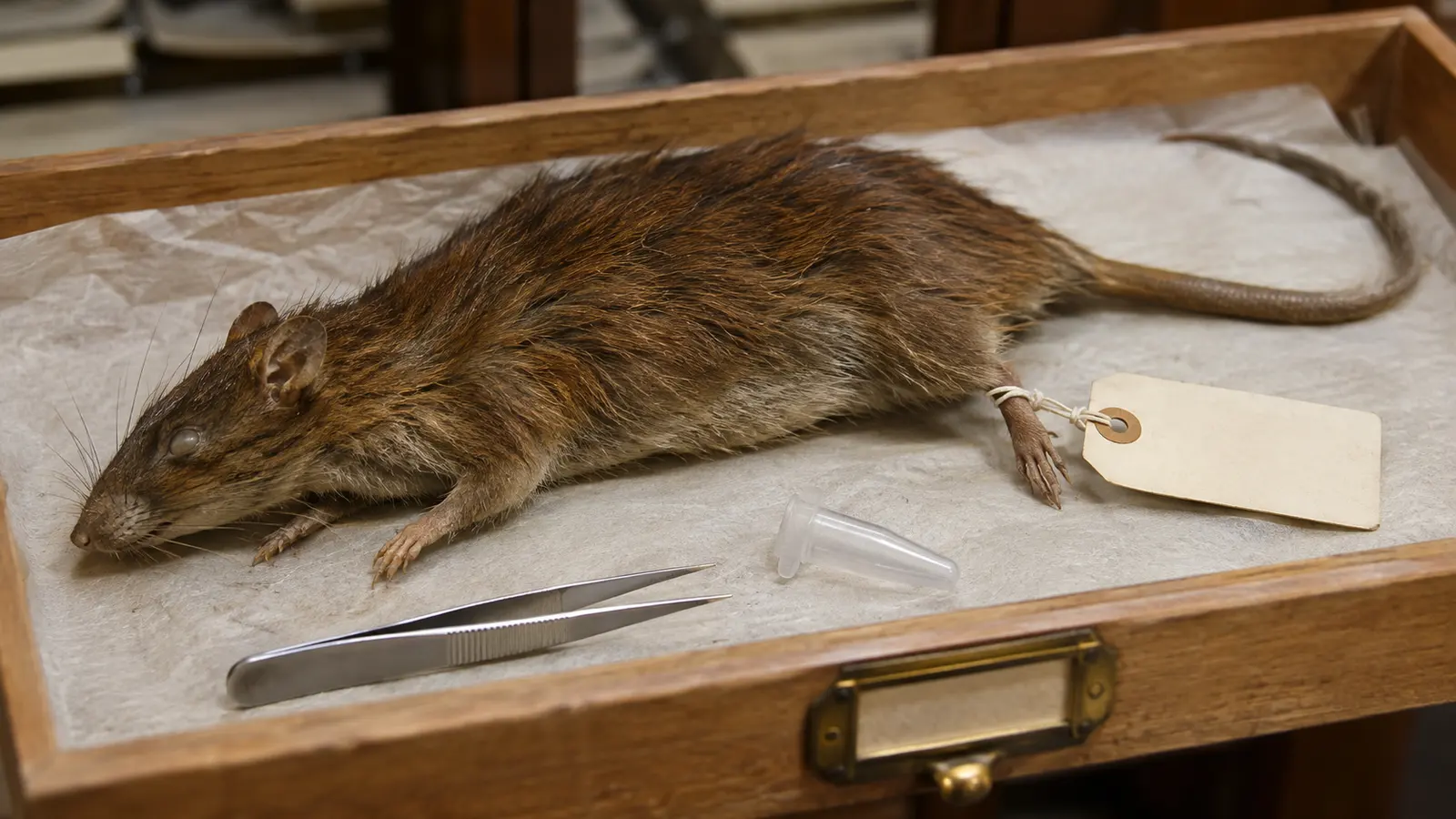
The Christmas Island rat, extinct between 1898 and 1908, has served since 2022 as a case study for geneticists
Rattus macleari lived on Christmas Island, an Australian territory south of Java. It disappeared shortly after the arrival of European ships, probably the victim of introduced diseases spread by black rats. Since then, its only exploitable traces are in museum skins.
In March 2022, the team of Tom Gilbert at the University of Copenhagen published in Current Biology an analysis of its genome. The choice was far from incidental. Indeed, the species would have diverged from the brown rat about 2.6 million years ago, a gap comparable to that between the woolly mammoth and the Asian elephant.
Even when sequenced more than 60 times, about 5% of the genome remains unrecoverable
The researchers sequenced the ancient DNA with an average coverage exceeding 60x, then aligned it to the brown rat genome. The result: nearly 5% of the sequence remains unrecoverable. Thus, 1,661 genes were found to be less than 90%, and 26 are entirely missing.
Moreover, these gaps are not random. Genes involved in the immune response and those related to olfaction are overrepresented. Consequently, a reconstructed rat would likely have a poor sense of smell, and its immune system might not match its native environment.
In January 2026, a new analysis confirms that a read depth of 100x still leaves 3 to 4% of the genome out of reach
A study published in Genome Biology and Evolution, co-authored by researchers from the same network, revisited the Christmas Island rat data. Even at a 100x depth, between 3.38% and 4.03% of the genome remains uncovered. These regions host functional variants.
Moreover, simulations show that the detected false mutations mainly arise from insufficient coverage rather than chemical degradation of the DNA. Furthermore, reliance on a living reference genome introduces a structural bias. Any reconstruction thus remains a hybrid between the extinct species and its living cousin.
Modified wolves across 14 genes and woolly mice illustrate the gap between targeted tweaks and true resurrection
In April 2025, Colossal Biosciences unveiled three wolf pups derived from gray wolf cells, carrying 20 edits spread across 14 genes. The company calls them giant wolves. In March, it had previously unveiled woolly mice, modified on seven genes related to fur and fat metabolism.
The flagship project aims to create Asian elephants endowed with mammoth traits, with a first calf slated for late 2028. However, the most tangible challenge concerns conservation. The same tools could reintroduce genetic diversity into threatened species, such as the Northern white rhino, reduced to two females. Ultimately, no genome can restore learned behaviors, transmitted across generations and lost with the last individual.

Contact details
Address:
Farmers Forum,
36, Dominick Street,
Mullingar,
Co. Westmeath,
Ireland
Phone:
+353 (0)44 9310206
Or email us:
For technical issues please check out our FAQ's page or email - [email protected]
For general Queries email - [email protected]
Request to add event to our Calendar - [email protected]
Send us your mart reports - [email protected]
Suggestions and feedbacks - [email protected]
News Items / Press Release - [email protected]
To Advertise on Farmers Forum - [email protected]