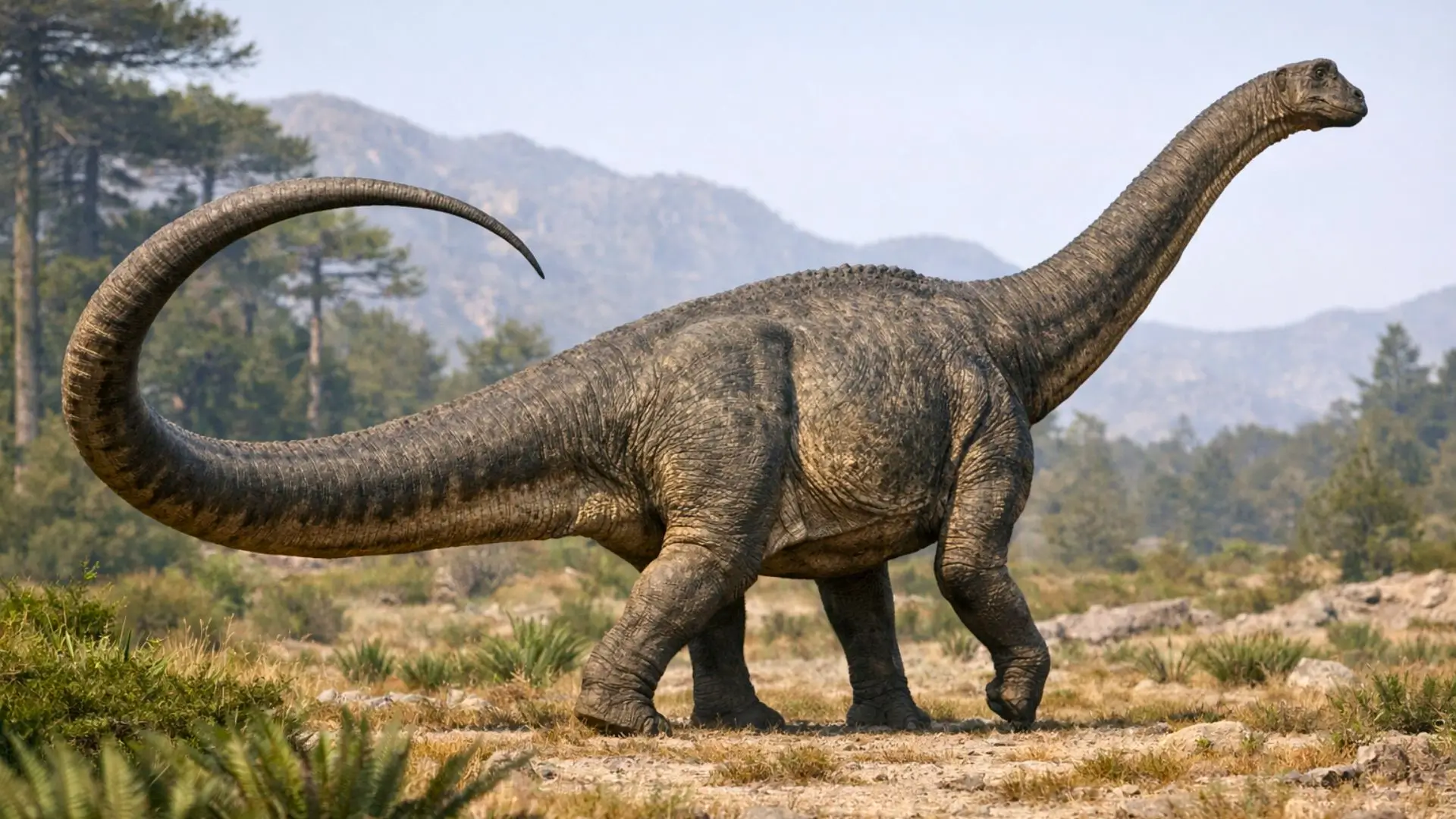
In August 2025, Royal Society Open Science published a study on Giraffatitan that upends a stubborn image. Through 3D reconstructions and meticulous analysis of the vertebrae, the researchers correct an old cliché. They show a mobile, raised tail with potentially versatile uses.
Why the sauropod tail has long been underestimated even as it already guided posture and movement
For a long time, reconstructions reduced the sauropod tail to a a simple counterweight. This reading dominated museums, films, and textbooks. Yet, among living vertebrates, the tail often serves to stabilize, orient, signal, or defend.
That very mismatch is precisely what the team led by Verónica Díez Díaz aimed to test. Instead of repeating an old image, she examined what the bones actually allow. You thus obtain a much more concrete reading of the real movement.
How the team made eighteen fossil tail vertebrae and long-forgotten arches speak to test mobility
The researchers studied eighteen tail vertebrae preserved along with their haemal arches, from a relatively complete tail. This material comes from a Giraffatitan specimen kept in Berlin. The animal lived in the Late Jurassic, in what is now Tanzania.
Next, the team combined muscular reconstruction, 3D modeling, and mobility tests across the vertebrae. They haemal arches–long neglected–reassessed their role. These structures located beneath the vertebrae limit and direct certain movements.
That point matters a lot. Without it, you underestimate how the tail folds downward. With it, the models become more credible. The study also emphasizes rotation centers, decisive for calculating the true range of flexions.
What the models reveal about a lifted and flexible tail, far from the mere pendulum of the pictures
The clearest result lies in this visual correction. Giraffatitan did not drag a fixed tail behind it. The simulations indicate a carried tail and mobile, capable of bending in multiple directions. This mobility alters the overall image of a body in motion.
The authors remain cautious about exact uses. They nevertheless mention functions related to stability, locomotion, and perhaps social interactions. In other words, the tail was not a passive appendage, but a complex functional structure.
Why this study is also changing paleontology, which now tests more credible behaviors
Beyond the Giraffatitan case, the publication shows how paleontology is scaling up. It no longer merely describes bones. It tests movements, compares constraints, and proposes verifiable mechanical scenarios. You are reading a skeleton almost like a living system.
This method also builds on earlier work. In 2020, the same researcher had already reconstructed the tail musculature and estimated a complete tail at about 2.5 tonnes. The 2025 study extends this effort and refines the biomechanical reading of the specimen.
The most interesting point, finally, is what this approach opens up. Other sauropod tails can be tested with the same tools. You are no longer simply looking at a Jurassic giant. You see an animal that adjusts its posture and interacts.

Contact details
Address:
Farmers Forum,
36, Dominick Street,
Mullingar,
Co. Westmeath,
Ireland
Phone:
+353 (0)44 9310206
Or email us:
For technical issues please check out our FAQ's page or email - [email protected]
For general Queries email - [email protected]
Request to add event to our Calendar - [email protected]
Send us your mart reports - [email protected]
Suggestions and feedbacks - [email protected]
News Items / Press Release - [email protected]
To Advertise on Farmers Forum - [email protected]