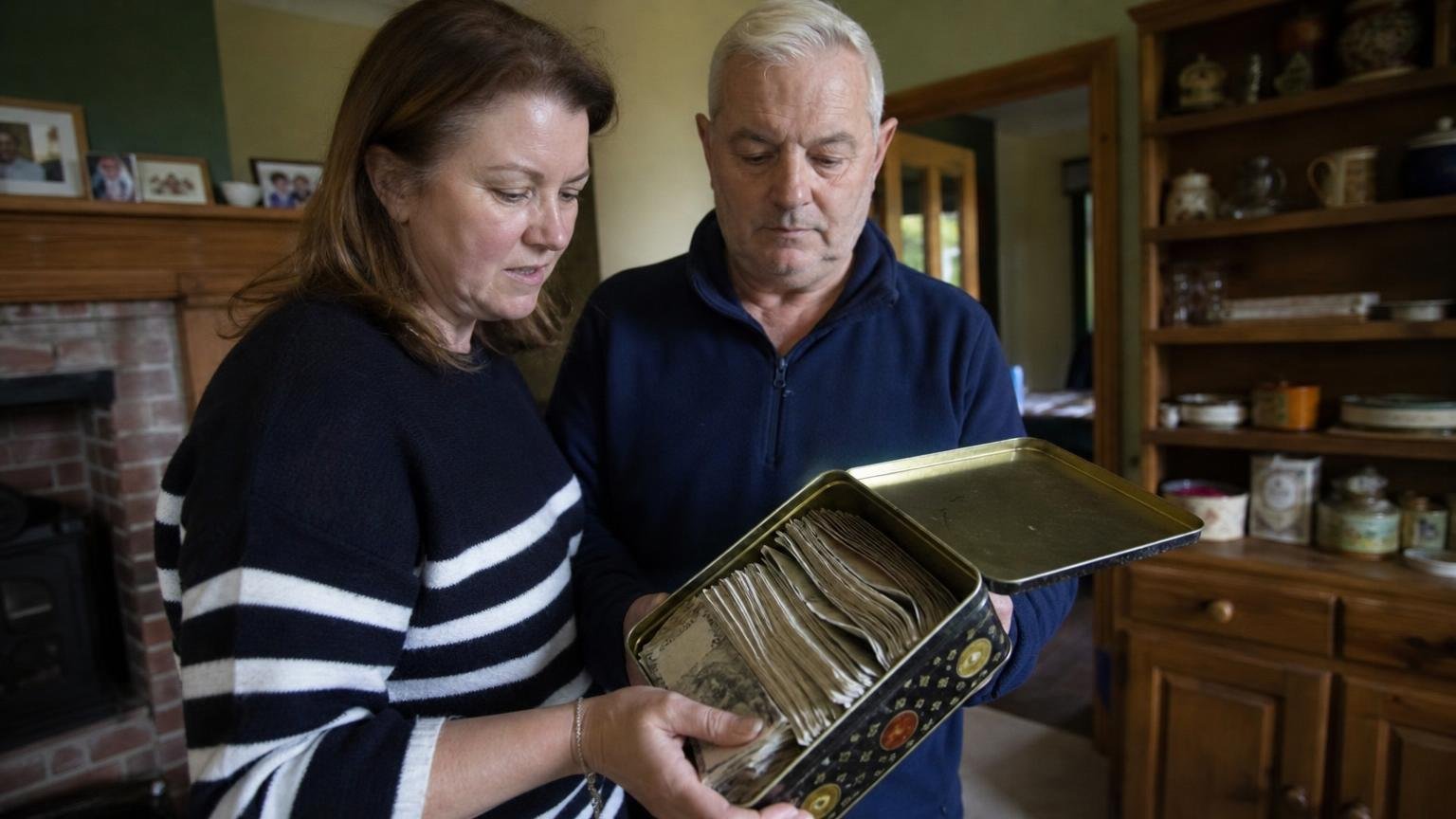
They were emptying a dresser, ready to send it to the skip, when a dull jingle turned into a family legend. Inside a faded biscuit tin, wedged behind a splintered drawer, lay thick wads of green paper that hadn’t seen daylight since the days before the euro. The discovery felt part treasure hunt, part time capsule—and, as it turns out, part payday.
A quiet county, a loud surprise
In rural Tipperary, stories tend to spread with a certain humour. “We nearly tossed the whole thing, tin and all,” laughed one family member as neighbours peeked at the find from a careful distance. The notes, crisp and musty, bore portraits from a different Ireland, where pay packets were counted in pounds and Friday evenings smelled of coal and chip shops.
The punt, remembered in ink and fibre
The Irish pound—or punt—circulated until early 2002, its banknotes weaving art, myth, and national memory. Some carried the elegant Lady Lavery; later series showcased writers and statesmen, the palette shifting from bog greens to ocean blues and stony greys. To hold one now is to feel a country mid-conversation, deciding what to take into a shared future.
Do these old notes still have value?
Short answer: yes. A spokesperson for the Central Bank put it plainly: “Irish pound banknotes can be exchanged for euro, at the fixed rate, with no time limit.” That rate—set when Ireland joined EMU—converts each punt into roughly 1.269738 euro. In other words, a £100 bundle becomes about €126.97, more if the stash runs deep.
What the Central Bank will and won’t accept
The Bank will honour Irish pound banknotes that are genuine and sufficiently intact. Even damaged notes may be redeemed after expert assessment, as long as essential elements are present. Coins are a different story—their exchange window closed years ago—but paper money remains under the Bank’s umbrella indefinitely.
How to turn a biscuit tin into euros
For families who stumble upon old cash, the process is simple but worth doing with care and patience. The Central Bank outlines the steps on its website, and staff can guide you through special cases.
- Gather the banknotes, keep them flat, make an inventory, and contact the Central Bank for the current procedure (in person or by secure post), including any identification and forms that may be required.
“Don’t try to spend them in a corner shop,” joked a local publican, “unless you want a history lesson with your change.”
Counting what can’t be counted
Beyond the arithmetic of fixed rates, these notes carry intangible weight. They were saved for weddings, rainy days, or emigrant homecomings that never quite landed. A biscuit tin whispers of “put it away for later,” of a generation that knew both thrift and hope. You don’t just change currency; you mediate between two eras.
Spotting authenticity without panic
Not everyone has a magnifier or a banker’s eye. Still, a few commonsense checks go a long way: the paper should feel fibrous and alive, the print sharp, the colors stable under oblique light. Watermarks and security threads should be visible where they’re meant to be, not dreamt into the paper. If in doubt, let the Central Bank’s experts carry the burden—that’s precisely what they’re there to do.
“People worry about being embarrassed,” said a retired teller from Clonmel. “But it’s everyday business for the Bank. They’ve seen everything, from attic finds to farm safes.”
Why these stories keep surfacing
Houses hold secrets that busy lives miss. Furniture moves, floors come up, and suddenly the past speaks. Some stashes reflect the Y2K jitters, others the old cash economy of rural Ireland. The shift to plastic and instant payments left shadows in drawers, and every so often the shadows become real again, one biscuit tin at a time.
Practical tips before you post
Keep the notes in a dry, flat folder—no elastic bands, no aggressive cleaning. Photograph the bundles for your records, note denominations, and use tracked or insured post if you’re mailing. If visiting in person, ring ahead, bring identification, and allow time for verification and official receipts. No need for drama; just steady, careful steps.
A windfall measured in more than euros
For the Tipperary family, the real thrill wasn’t only the final figure. It was the sudden bridge to grandparents’ voices, the thought of wages folded into paper and tucked away with quiet intent. “It felt like the house giving something back,” one of them said. The cash will meet utility bills and a small celebratory supper, but part of the pile will be kept as a framed keepsake.
Because sometimes value isn’t just what the Central Bank will honour, but what your own four walls remember—notes that bought coal, fed children, and now pay a last, unexpected dividend to the people who kept the dresser, the tin, and the old stories safe.

Contact details
Address:
Farmers Forum,
36, Dominick Street,
Mullingar,
Co. Westmeath,
Ireland
Phone:
+353 (0)44 9310206
Or email us:
For technical issues please check out our FAQ's page or email - [email protected]
For general Queries email - [email protected]
Request to add event to our Calendar - [email protected]
Send us your mart reports - [email protected]
Suggestions and feedbacks - [email protected]
News Items / Press Release - [email protected]
To Advertise on Farmers Forum - [email protected]