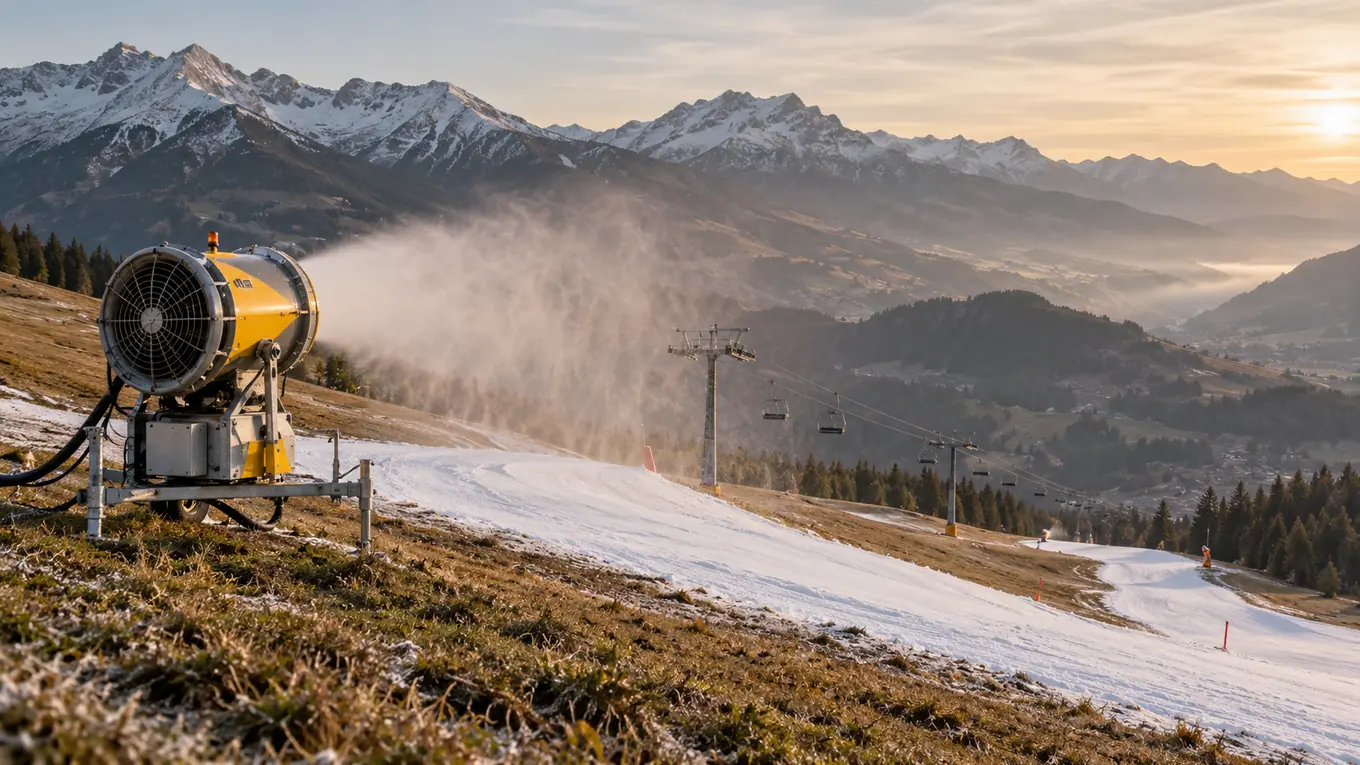
After a September 2026 that was among the warmest ever recorded in France, seasonal trends point toward a mild end of the year. For ski resorts, which rely on artificial snow to open at Christmas, the question becomes urgent. Between physical thresholds, investments, and altitude, here is what the milder spell actually changes.
The Court of Auditors estimated in 2024 that 13.6% of ski resorts’ investments were allocated to snowmaking equipment
In February 2024, the Court of Auditors published a public thematic report titled “Mountain resorts in the face of climate change.” According to its calculations, resorts spent an average of 45 million euros per year over five years on snow production installations. This represents 13.6% of their investments, not counting maintenance, energy, water, and labor.
The report also notes that 39% of the French skiable domain is now covered by snowmaking, up from 19% in 2007. However, the jurisdiction describes this tool as a “relative and transitional” protection, since its effectiveness declines as temperatures rise. Moreover, the industry contested the representativeness of the studied sample, which mainly consisted of small and medium-sized resorts.
With 555 million euros invested in 2025, ski areas are now prioritizing new lifts
The annual barometer conducted with Domaines skiables de France and Atout France puts the 2025 effort at 555 million euros. This amount corresponds to roughly 32% of the sector’s pre-tax revenue. Next, the breakdown reveals a clear shift in priorities.
Indeed, new ski lifts absorb about 281 million euros, nearly half of the total. Expenditure on produced snow slows after several years of growth. However, the installed snowmaking fleet remains substantial, and its profitability still depends on the thermometer.
September 2026 shows +3.1 °C and a rainfall deficit close to 70%, according to Meteo-France’s assessment
The assessment published by Météo-France on October 2 places September 2026 as the second warmest since 1900, with an anomaly of +3.1 °C. Notably, it is the fourth consecutive month in which the deviation from the norm exceeds 3 °C. Moreover, only two Septembers have been less rainy since 1958.
For the October-December quarter, seasonal trends would favor a end-of-year warmer-than-normal across mainland France and Corsica. An excess of rainfall would also be possible in parts of the country, excluding the Southeast. Nevertheless, these forecasts remain probabilistic and do not describe the weather for a given week nor for a specific massif.
Under a humid temperature of -2 °C, snowmakers can still operate at altitude and on cold nights
Producing snow requires spraying fine droplets of water into air cold enough for them to freeze before hitting the ground. According to the Court of Auditors, production begins at a humid temperature of -2 °C and becomes optimal between -5 and -8 °C. Yet, this value takes humidity into account: in dry air, production can start when the thermometer reads close to zero.
Consequently, a broadly mild quarter does not render the snow cannons useless. The cold windows, often nocturnal, and high-altitude areas will still allow production, albeit for shorter periods and at a higher cost. By contrast, low- and mid-altitude resorts remain the most exposed, which renews the debate on diversification beyond skiing.

Contact details
Address:
Farmers Forum,
36, Dominick Street,
Mullingar,
Co. Westmeath,
Ireland
Phone:
+353 (0)44 9310206
Or email us:
For technical issues please check out our FAQ's page or email - [email protected]
For general Queries email - [email protected]
Request to add event to our Calendar - [email protected]
Send us your mart reports - [email protected]
Suggestions and feedbacks - [email protected]
News Items / Press Release - [email protected]
To Advertise on Farmers Forum - [email protected]