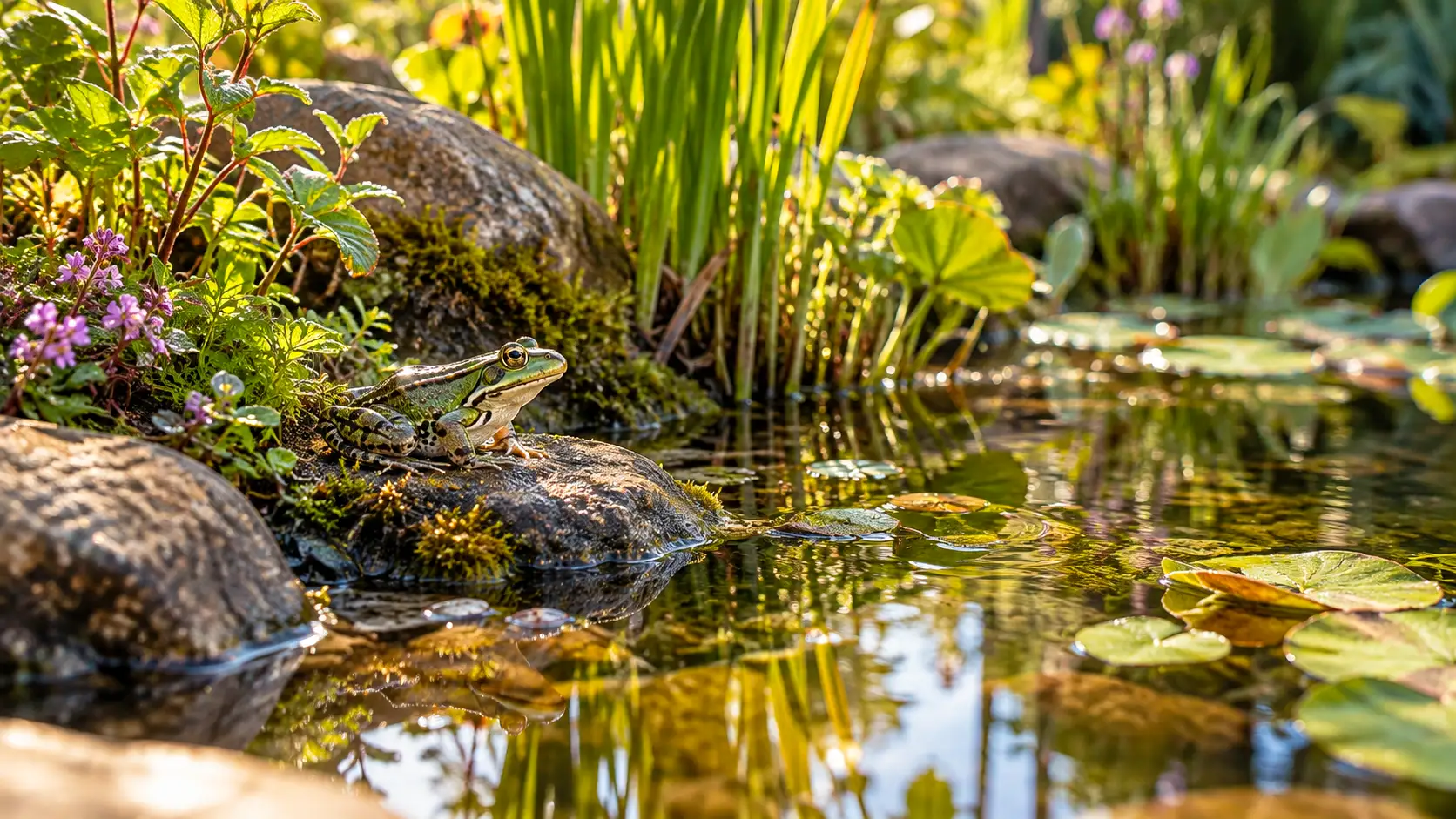
In 2017, Maggie Johnson dug a 3.7-meter pond for a school assignment in Virginia. Nine years later, frogs, toads, butterflies, and hummingbirds visit this small habitat. Her story primarily demonstrates how a simple pond can quickly rebuild local biodiversity.
From a shovel-dug circle to a living refuge, the pond has transformed the family garden in a few years
In the autumn of 2017, Maggie was 14 when she began her project for an agricultural class. She marked out a circle of about 3.7 meters and dug the soil with a shovel. By spring 2018, the family finally filled the pond and shaped its banks.
A few weeks were enough to attract the first American toads, without releasing animals into the water. Then green frogs and gray tree frogs appeared around the basin. Butterflies, hummingbirds, and hawkmoths also frequent the plants installed by the family.
The garden had previously been only a sparse lawn, largely alive with the sound of crickets. Now, wildlife spontaneously colonizes the site and continues to evolve each year. Steven David Johnson, Maggie’s father and a wildlife photographer, documented this transformation in 2026.
Native plants, water, and shelter mattered more than the size or budget of the initial project
The initial setup cost around 160 dollars, including a liner, plants, and gardening tools. Each year afterward, the family adds about 100 dollars of additional plants. In 2025, they spent 600 dollars on a fence intended, among other things, to keep cats away.
Around the water, the Johnsons favor native plants that provide food, shelter, and breeding sites. The garden earned the National Wildlife Federation’s Certified Wildlife Habitat certification. Furthermore, the pond has operated without a filter since its biological balance settled in.
Research on ponds confirms that a small water body can weigh heavily on local biodiversity
This domestic success aligns with a broader scientific finding. In Europe, more than half of ponds have disappeared in recent decades. Some regions have lost up to 90% of these small habitats, according to Marceau Minot’s thesis.
His work follows 20 ponds in Normandy after their creation or restoration. In the first year, dragonflies rapidly colonize these new habitats. However, more specialized species appear as the ponds age, while the surrounding landscape influences their composition.
A study led by Bella Davies provides another benchmark. At a regional scale, ponds hosted the most species among several aquatic habitats compared by European researchers. They also showed strong value for rare species in the available British data.
An isolated pond helps wildlife, but a network of water bodies further strengthens local populations
Marceau Minot’s research also shows that the density of neighboring ponds matters. The more water bodies are connected, the more dragonfly populations can become abundant. Thus, a network of ponds can better withstand perturbations than a single, isolated habitat.
The Johnsons’ garden thus illustrates an accessible, small-scale lever, though it does not prove it works identically everywhere. Creating water, planting locally, and offering shelter open up tangible possibilities. For amphibians in particular, the pond provides the essential breeding ground.

Contact details
Address:
Farmers Forum,
36, Dominick Street,
Mullingar,
Co. Westmeath,
Ireland
Phone:
+353 (0)44 9310206
Or email us:
For technical issues please check out our FAQ's page or email - [email protected]
For general Queries email - [email protected]
Request to add event to our Calendar - [email protected]
Send us your mart reports - [email protected]
Suggestions and feedbacks - [email protected]
News Items / Press Release - [email protected]
To Advertise on Farmers Forum - [email protected]