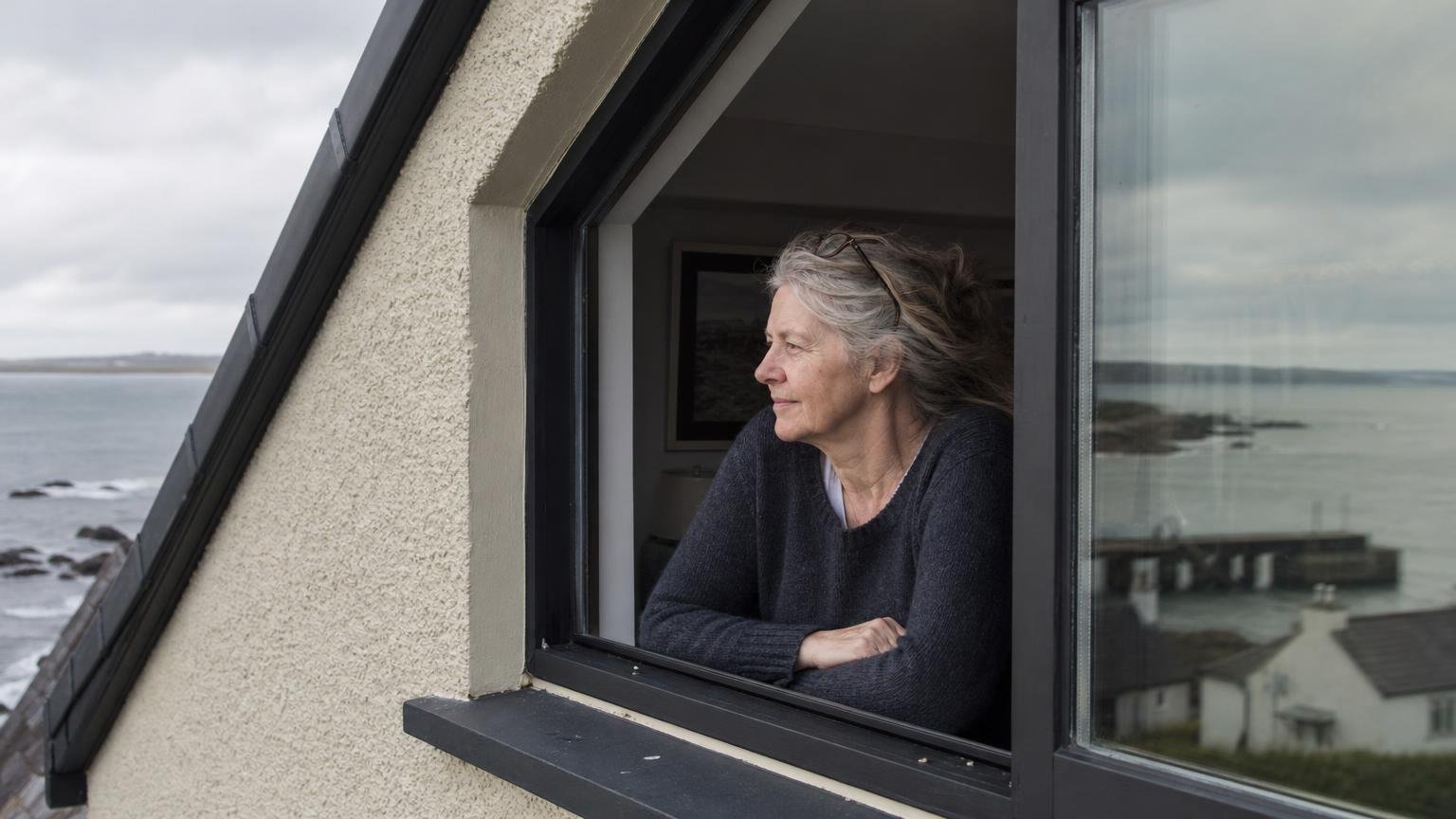
She arrived with a key and a thermos, a short laugh for the agent, and the kind of hunger that doesn’t speak. The road curled up the headland, all peat-sweet and wind-polished, and the cottage sat like a thumbprint on the slope above the pier. She didn’t promise anything to anyone, least of all to the sea.
The Window that Faced the Water
The first morning, she hired a stonemason who knew the weather by smell. Together they planned a gable window where the eaves sloped toward the Atlantic. He measured the wall with chalk and a length of string. She stood back and said, “Make it big enough for dawn to walk through.”
When he cut the stone, it sounded like bread tearing, a rough music carried by gulls. She swept the dust with a rush broom, her wrists a bit shaky, her mouth set in a soft smile. By evening, the frame was ready, the glass still to be fitted.
Teaching the House to Listen
She learned the house the way you learn a neighbor—by carrying small things together. First, she oiled the hinges until they sighed politely. Then she salted the threshold and told it, “No more dragging.” She turned the bed so that moonlight would cross her ankles first, not her forehead.
She labeled jars with chalk: tea, oats, matches, mercy. “I’m not superstitious,” she said, “just a little careful.” The kettle took its time, and so did she. A week later, the rooms had stopped echoing, and her footsteps knew where to land.
Weather as a Teacher
The rain had a habit of arriving sideways, a silver parade that startled the sheep and drew a thin line across the bog. When it cleared, the water lay fizzing under the pier, as if it had been told a joke it couldn’t fully repeat.
She took notes: “Wind from the north, keep fire small. Wind from the west, keep mind open.” The Atlantic wasn’t a view, it was a voice, remaking the grammar of her days. She didn’t answer every sentence. She didn’t need to win.
“I didn’t come here to be brave,” she said, “I came here to be accurate.”
A Month of Quiet
Quiet isn’t the absence of noise, it’s the presence of proportion. In the first week, she found out how long a minute can stretch when you butter bread without thinking about tomorrow. In the second week, her shoulders unbuttoned their old arguments, and sleep arrived like a visitor who finally knows the way.
By the third week, she could hear the boatman’s whistle before it started, the rustle of a letter in the postman’s bag, the small debate of sand under the tide. She kept the radio silent, not out of stubbornness, but because the gulls were telling a story and she wanted each chapter.
“I had to stop defending my life just to live it,” she wrote on a yellow page, the ink wobbling like a dock line in wind.
What She Kept, What She Let Go
She unpacked with a care that felt like prayer. Some things stayed, some things went back to the car.
- The little hammer with a wrapped handle
- A chipped blue bowl that made porridge honest
- Three wool sweaters that forgave the weather
The old television returned to the city with an apology. The makeup bag took a breath, then took a seat on the shelf, then simply vanished into the back of a drawer. Not a renunciation, more a reevaluation.
The Business of the Pier
Below, the pier kept its hours. Men with rope-bent hands lifted crates as if they were talking to them. Dogs made their rounds, suspicious of anyone who stood too still. A widow with a red scarf sold bread that crackled like cinders when you touched the crust.
She tried their names, tasted their steadiness like salt on her fingers. No one asked why she’d come, which felt like a blessing and a skillfully closed door. “You’re here,” said the shopkeeper, “and that’s a good start.” She liked the economy of that, how it clipped the ribbon without fuss.
A Grammar of Objects
In the evenings, she learned the grammar of objects: how a chair sits more kindly when moved an inch to the left, how a book opens to the page that forgives you for not knowing. She mended a sock, not because it mattered, but because the thread wanted a second chance.
She walked the headland with a stick, tapping its shadow on the grass, counting the starlings as they folded the sky into pockets. Sometimes she spoke out loud, to keep her vowels from drying. Mostly she let the air do the talking.
The Window Teaches Back
When the glass finally settled, the room learned a new behavior. Morning came in with a straight back, the sea making its arguments in fluent blue. The rocks offered their catalog of slicks and grooves, a ledger kept by time and salt.
She drank tea with the window, each cup a small ceremony of steam and pause. “This is the right difficulty,” she said, “the kind that sharpens without breaking the edge.” The horizon didn’t promise, it persisted, and that was enough.
When Quiet Begins to Speak
By the end of the month, her handwriting had grown rounder, her lists shorter, her appetite full of greens and the bruise-sweet center of bread. She no longer counted days but weathered moods, trusting the tide to show its math without her help.
“Not escape,” she wrote, “but arrival by another road.” The cottage breathed with her, timber and plaster and light keeping company. She hadn’t become someone else. She had become the person who could hear the room say, Stay, and hear herself answer, I’m here.

Contact details
Address:
Farmers Forum,
36, Dominick Street,
Mullingar,
Co. Westmeath,
Ireland
Phone:
+353 (0)44 9310206
Or email us:
For technical issues please check out our FAQ's page or email - [email protected]
For general Queries email - [email protected]
Request to add event to our Calendar - [email protected]
Send us your mart reports - [email protected]
Suggestions and feedbacks - [email protected]
News Items / Press Release - [email protected]
To Advertise on Farmers Forum - [email protected]