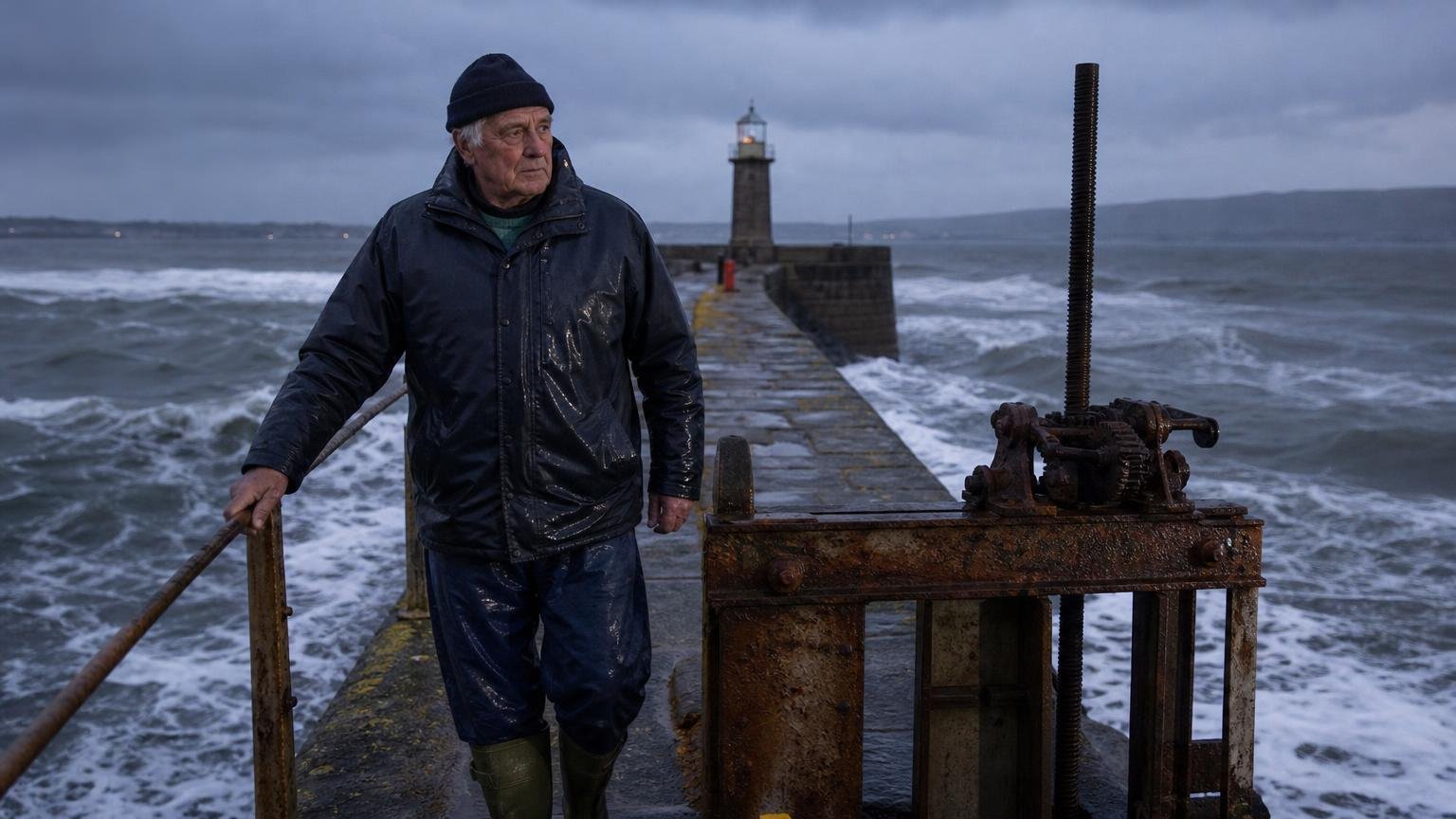
The wind comes first, lean and salted. Then the steps, slow but unbroken, down to the stone pier that has outlived storms and stories. He raises a hand to the spray, tastes the air, and listens longer than most people speak.
Some nights the waves are only restless, other nights they are anxious. He says you can hear a warning ride the undercurrent, a murmur in the black water. You don’t need radar if you have time, and he has had a lifetime.
The nightly ritual
He leaves at dusk, returns at dark. The gates sit at the pier’s throat, iron-boned and barnacled, one hinge stubborn as an old argument. He checks the pins, the bolts, the chain that sags like a tired smile.
He keeps a notebook, oil-stained and soft, with dates that read like a family Bible of weather. “North by east, two degrees colder than memory,” a page says. Another page: “Swell stacking, gulls riding low.”
His lamp is a cheap torch, wrapped in fading tape. He cups the light as if it might shiver, then lets it skim the iron’s skin. He listens for the hollow clink of loose metal, the small truths that only hard things admit.
What the sea says
He doesn’t call it magic. He calls it paying attention. “It’s in the tempo,” he says. “Not just the big crash, but the small breath in between.” He’ll watch how the whitewater lolls, how the dark water lifts, how the pier’s seams darken before rain.
“I learned from men who learned from other men,” he says, “and from women who knew the color of a real storm.” There’s an old superstition about silence before snow, and he respects silence as much as sound.
When the harbor dogs go quiet, when the gulls won’t risk a wing, when the kelp turns nervous against the piles—he tightens the chains. He doesn’t wait for a forecast to bless the obvious.
Why he keeps going
People ask him, at eighty-two, what it gives him to keep watch. He shrugs like a man who has already made a promise. “If you can do a thing, you do it,” he says. “If you can’t, you teach.” The town sleeps easier when the gates are ready. That is sometimes enough.
He remembers the winter a tug tore its line and swung like a hammer. He remembers a doorbell at midnight, a nephew in a bright jacket, a radio shrieking through static. He remembers how the surge found the one weak plank and made a loud lesson of it.
He keeps a small map taped inside his kitchen cabinet, a scrawl of arrows and X’s where waves broke wrong. “Every big storm leaves a bruise you can use,” he says. “You mark it, you don’t forget.”
Inventory of a winter night
- One stubborn hinge humming under the wind
- Five fingers gone numb, still counting the bolts
- A cough of diesel from a late trawler turning home
- The mild perfume of rust and crushed kelp
- A pocket of bread for the pier cat, who trusts no storm
What the town knows
Ask the baker who starts at three, the nurse on the late shift, the taxi that ghosts past the quay: they have seen his small light pacing the edge. “He’s there when the swell gets teeth,” the baker says. “He’s there when the rest of us only worry.”
The council once floated a motion to automate the gates. He nodded and said, “Good,” and still came nightly. Machines are fast, but they don’t remember the year the bolts were replaced with the wrong grade of steel, the weekend the shop was closed.
His daughter begs him to be more careful. The doctor says he should walk less on ice. He laughs gently. “I walk where the pier tells me,” he says, hand on the old rail.
Time, and the work that remains
Age is a slow weight, but work can be a slow blessing. His knees argue with the cold, and his shoulders hold a permanent weather. He solves those problems the way he solves storms: a little earlier, a little steadier, with more listening than talk.
He has taught a handful of younger hands the gate’s temper. He shows them where the frost first tips, where the iron sings, where the pier whispers its first complaint. He tells them, “Don’t chase the crest. Read the run-up.”
“I don’t own this job,” he says. “I’m renting it from the tide.” When the right person is ready, he’ll hand over the keys, but not the habit of listening. That can’t be passed, only caught.
The line he won’t cross
He refuses the hero story. He refuses the easy myth. “I’m not stopping the sea,” he says. “I’m stopping a gate.” Yet on the coldest nights, that small difference is exactly what holds a sleeping street above water.
The lamp goes out, and the dark is honest again. He looks once more at the hinges, at the iron that trusts his careful hands. Somewhere offshore a swell is stacking, practicing its slow argument with the coast.
He turns for home, boots ticking like a tired metronome. The pier keeps its secrets, but he has heard enough for one night. Tomorrow, if the water is restless, he will come a little earlier. And if it is calm, he will still come. He always does.

Contact details
Address:
Farmers Forum,
36, Dominick Street,
Mullingar,
Co. Westmeath,
Ireland
Phone:
+353 (0)44 9310206
Or email us:
For technical issues please check out our FAQ's page or email - [email protected]
For general Queries email - [email protected]
Request to add event to our Calendar - [email protected]
Send us your mart reports - [email protected]
Suggestions and feedbacks - [email protected]
News Items / Press Release - [email protected]
To Advertise on Farmers Forum - [email protected]