
The thick forests of Bolivia harbor a fauna as rich as it is cryptic. Recently, researchers described a new feline species living there, marking the first such discovery in more than a century for these animals.
Pocket Tigers
The American feline genus Leopardus encompasses several small cats, among them the ocelot, the margay, and the tiger cats. The wild nature of their habitats and the nocturnal lifestyles of these creatures have long made identification and classification difficult, and for a long time they were regarded as a single species, named Leopardus tigrinus and listed as vulnerable by the International Union for Conservation of Nature.
It wasn’t until the early 2010s that genetic sequencing of these cat-sized predators, observed across a large portion of South and Central America, was carried out. While their local names and subtle physical differences had hinted at diversity for a long time, this process led to the recognition of the Southern tiger cat (L. guttulus), L. emiliae, and the nebulous tiger cat (L. pardinoides) in addition to L. tigrinus tigrinus.
In a study published in the journal Current Biology, Eduardo Eizirik of the Pontifical Catholic University of Porto Alegre and colleagues analyzed the complete genomes of 38 representatives of the genus Leopardus, including 26 tiger cats spanning the entire known distribution, which extends from Costa Rica to the Andean regions as well as the tropical forests of eastern South America.
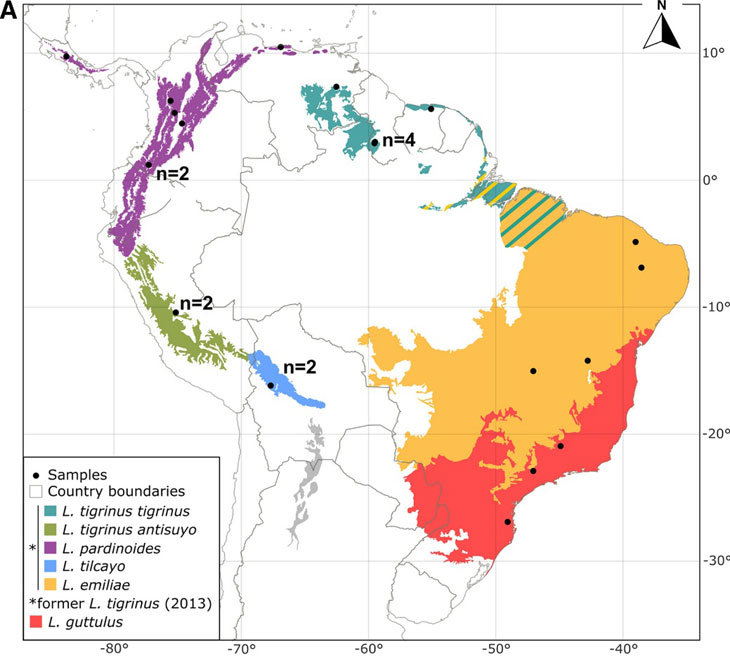
Leopardus tilcayo and L. tigrinus antisuyo
These new sequences led to the identification of a fifth distinct species, evolving in the Bolivian Yungas on the eastern flank of the range. Measuring between 42 and 50 centimeters in length and weighing about 1.5 to 2 kilograms, Leopardus tilcayo diverged from the lineage that includes L. tigrinus tigrinus and L. pardinoides roughly 1.4 million years ago.
The team also found that Peru’s forests harbor a new subspecies, named L. tigrinus antisuyo. Like L. tilcayo, it displays the tiger-cat morphology, but with fur coloring and patterns that are noticeably different.
The density of South American forest environments and the numerous natural barriers that separate them suggest that other feline species remain to be discovered. A better understanding of tiger-cat diversity will, in turn, help guide conservation efforts, as their ancestral habitats are increasingly threatened by agricultural expansion.
Previously, researchers had resolved longstanding mysteries about the evolution of felines.

Contact details
Address:
Farmers Forum,
36, Dominick Street,
Mullingar,
Co. Westmeath,
Ireland
Phone:
+353 (0)44 9310206
Or email us:
For technical issues please check out our FAQ's page or email - [email protected]
For general Queries email - [email protected]
Request to add event to our Calendar - [email protected]
Send us your mart reports - [email protected]
Suggestions and feedbacks - [email protected]
News Items / Press Release - [email protected]
To Advertise on Farmers Forum - [email protected]