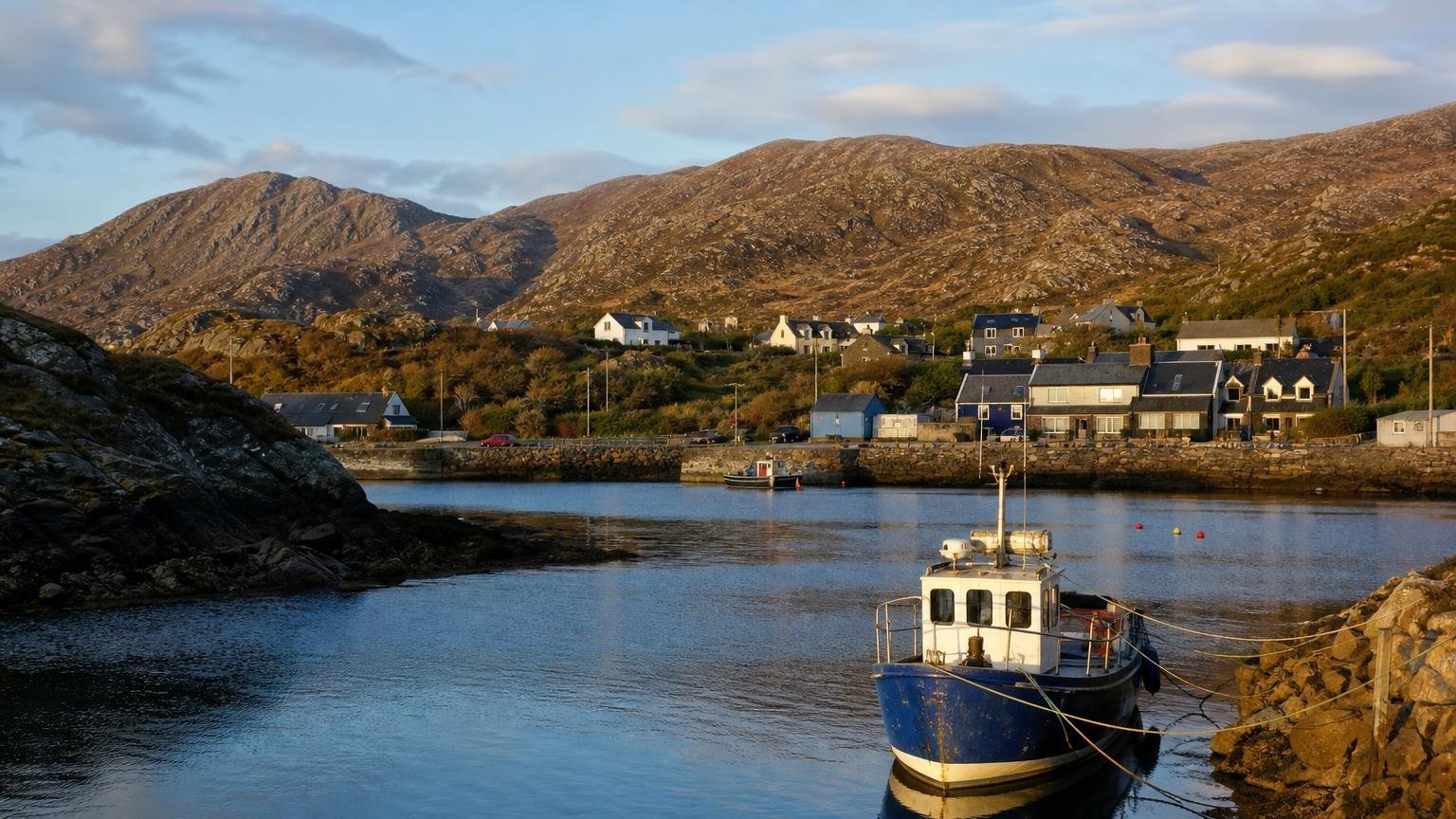
The road narrows, the sea widens, and a small harbour shakes off the last of the buses like a dog after rain. The quayside is quiet, gulls braid the wind, and the Twelve Bens sit on the horizon like folded hands in a long prayer. You step out of the car, and the air tastes of salt, turf smoke, and a promise you didn’t know you were seeking.
Here, everything moves one notch slower, as if the tide keeps time on a wristwatch you can’t see but immediately trust. The colours are low, clean, and startlingly honest—stone, sky, and water in their everyday clothes, ready for the softest kind of theatre.
Getting your bearings
This is a harbour first and a postcard second, a village strung along the quay where boats nose each other like patient ponies. There’s one main street, a few sidestreets that forget to be streets, and a sweep of bay that lets the light show off all day. Across the water, the mountains hunker; at your feet, ropes and lobster pots stage their quiet opera.
People will tell you the neighbouring town gets the crowds, and they’ll say it with a shrug that’s neither envy nor spite. “We get the same sun, just fewer shadows,” a shopkeeper smiles, sliding postcards like playing cards across the counter.
The light that keeps returning
Painters come for the light, and then they never quite leave. It bounces off granite, slides along kelp, and dilates the day into something almost cinematic. “It arrives sideways,” says a man with a paint-splashed cap, “and leaves like a whisper you can still hear.” Mornings are washed in milk, evenings rimmed with copper, and the hours between feel stitched with silver and quiet.
Even on a day that threatens rain, the world turns subtly luminous—boats become painted notes, and the tide composes its own scale against the quay. If you take photographs, you’ll spend more time breathing than clicking, because the view keeps editing itself.
Tides, boats, and the slow grammar of work
Around noon, the harbour is all throat-clearing and boot-steps, a soft industry of repairs and readiness. Nets unfurl like paragraphs, and the day’s plan is written in knots and tides. “Out there, the sea makes the rules,” says a skipper tying a clean bowline, “in here, we just keep them tidy.” You learn that the most important verbs are listen, wait, and mend.
The old Galway hookers sometimes darken the glitter, red sails like exclamation marks against a punctuation of cloud. Even when nothing happens, everything is quietly underway.
Beaches within a breath
A short drive throws you into sand so white it feels borrowed, at Dog’s Bay and Gurteen, twin parentheses of turquoise. The dunes are low and humble, stitched with tough grasses that write their names in the wind. Swim if you’re brave, walk if you’re wise, and bring a towel for both futures. On a good day, the water is glass, and on a better day, it is mercy.
Climb Errisbeg if your legs need a purpose: twenty minutes of effort, a syllabus of views, and the harbour small as a comma in the blue-green page.
Food and talk in low voices
Back in the village, pubs wear their age like a knitted jumper—soft at the elbows, strong at the seams. A bowl of seafood chowder, a plate of brown bread, a pint that arrives like a well-timed answer. “You’ll be staying a second night,” the barman guesses, as if he’s seen the decision form over your shoulder like a cloud. The locals don’t crowd your evening, but they anchor it with nods and weather.
Shops lean small and specific: a maker of drums whose skins thrum like a remembered story, shelves of books that skew west, crafts that smell of wood, wool, and rain.
A day that fits in one pocket
- Morning coffee by the quay, watching ropes steam in the sun; late-morning swim at Gurteen; picnic of tins, cheese, and scandalously ripe tomatoes; an amble up Errisbeg; back for fish and a pint; finish with a harbour walk under a sky that refuses to turn off
Staying the night and leaving gently
Guesthouses keep their promises without raising their voice—whitewashed walls, a clean window, and the slow tick of a clock you didn’t know you missed. Dawn slides across the sill, and the kettle makes its first soft argument for the day. You’ll go, eventually, because the map says you should, but some part of you will stay coiled in a loop of road, a glint of oar, a laugh heard through a half-closed door.
And that’s the quiet magic: no grandeur announced, no coaches idling, just the daily theatre of a working harbour and the kind of light that forgives the hurry you brought and teaches you how to put it down. If you need a reason, you’ll find a dozen; if you need an excuse, the sea will write you one. Either way, the village keeps breathing, and you find that you can, too.

Contact details
Address:
Farmers Forum,
36, Dominick Street,
Mullingar,
Co. Westmeath,
Ireland
Phone:
+353 (0)44 9310206
Or email us:
For technical issues please check out our FAQ's page or email - [email protected]
For general Queries email - [email protected]
Request to add event to our Calendar - [email protected]
Send us your mart reports - [email protected]
Suggestions and feedbacks - [email protected]
News Items / Press Release - [email protected]
To Advertise on Farmers Forum - [email protected]