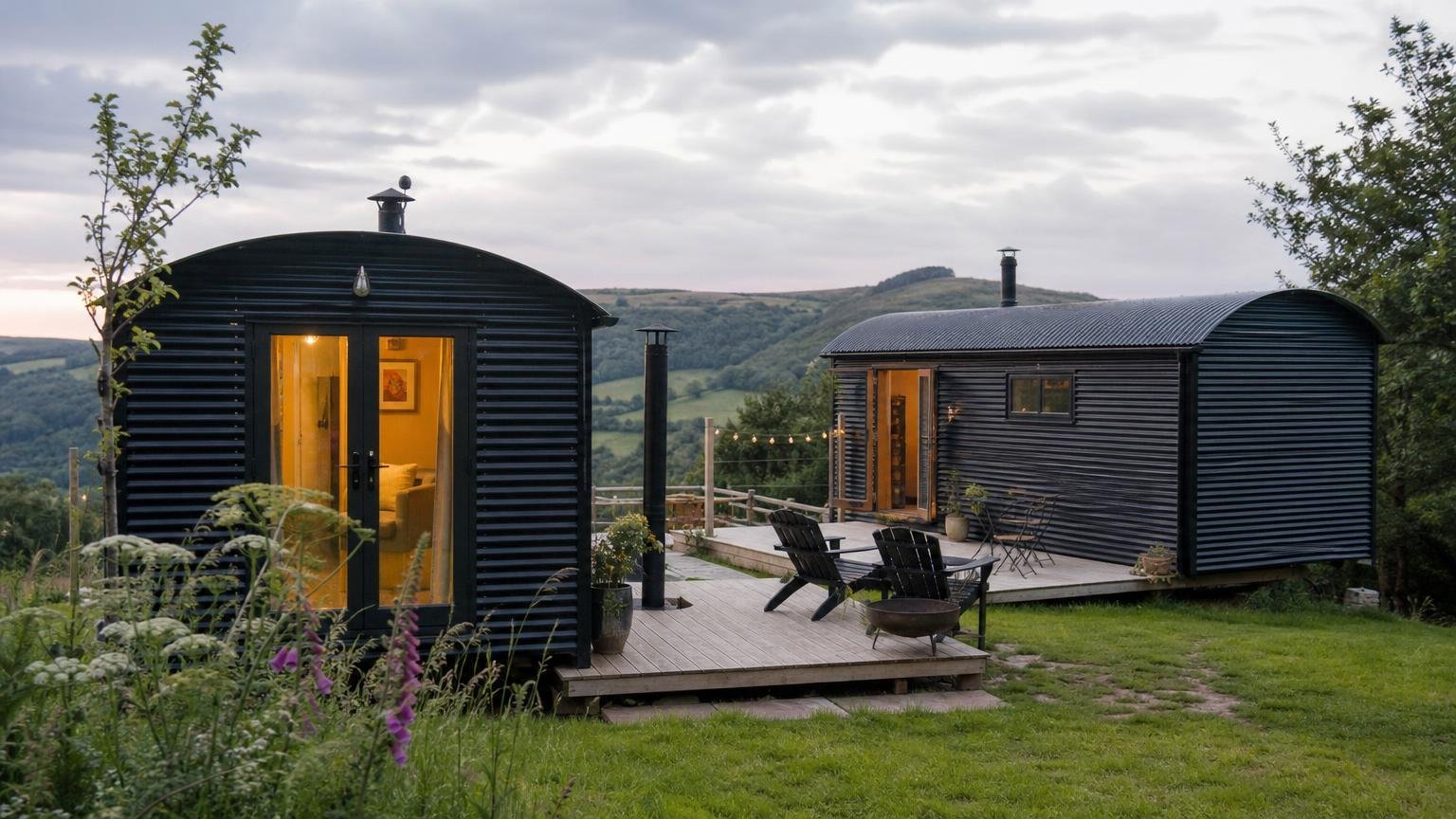
Mist gathers over the Nore, and a kettle chatters on a tiny enamel hob. Two timber huts sit on wheels, their corrugated roofs beading with dew. Between them, a deck catches the first pale sun, a threshold that feels both temporary and deeply rooted. From here, the hills roll toward Inistioge, and the old pace of life slows to a heartbeat you can count by birdsong and the crackle of kindling.
From apartment keys to timber wheels
They were a Dunboyne couple who realised their apartment had become a neatly framed storage unit. “We had a lovely view, but we stared at screens,” says Ciara, tipping tea into a tin mug. “One day we wrote a list of what we actually used—and most of it wasn’t in the flat.”
Selling up felt both reckless and refreshingly clear. Padraig calls it “a surrender to scale.” Less square footage, more open sky. They drove south until the roads narrowed, and a hillside above Woodstock whispered, stay awhile.
The double-hut layout
Two shepherd’s huts, each handmade, sit six steps apart and are joined by a deck that acts like a spine. One hut is for sleeping and reading, a cocoon of wool throws, a window like a porthole cut to the north. The other is for cooking and lingering, with a compact stove, a fold-down table, and clever shelves that pretend to be walls.
“We joke that the deck is the living room,” says Padraig. “In summer it’s a dining hall; in winter it’s a fast dash with a plate of stew.” The connection is tangible—weather threads everything together, and each step makes the day feel chosen.
Money, maths, and muddy boots
The sale covered their debts, and the huts, built by a Kilkenny craftsperson, came in under a year’s rent of their old place. “We did the maths on napkins,” Ciara laughs. “Then we did it again—and left bigger margins for mud and mistakes.”
Costs hid in the ground: pathways, a gravel pad, drainage that respected rain and roots. Boots became their best investment. “You learn what lasts,” says Padraig. “It’s rarely the thing that shines.”
Off-grid without the off-putting
The setup is quiet, smart, and stubborn about waste. Power breathes from solar, heat from a small but hungry stove, and water from a butt that drinks the rain.
- A compact solar array feeds batteries tucked under a bench
- A gravity-fed tank and charcoal filter keep taps gentle but clean
- A well-insulated stove sips logs from a local coop
- A separating toilet keeps maintenance simple and the soil happy
“It isn’t a sacrifice,” says Ciara. “It’s a different rhythm. Things take a little longer, and somehow feel more yours.”
Weather, neighbours, and the long quiet
Storms turn the deck into a drum, and the huts into a choir that creaks in harmony. On blue days, swallows braid the air, and time goes slow as sap. The nearest neighbour is a hedgerow away, quick with a spare spade and a gossip about the road.
Silence here isn’t empty. It’s a textured thing with sheep-bell echoes and the river’s low murmur. “The first week, I kept checking my phone,” says Padraig. “By the third, I kept checking the sky.”
Routines on the ridge
Mornings start with boots, not emails. A walk to the gate, a scan for fox prints, a handful of feed for the neighbour’s hens. Breakfast is slow: oats, honey, and a season of soft fruit. Work happens at a small desk, where signal finds them like a stray cat and stays just long enough.
Evenings belong to the stove and the shared deck, where conversation moves from practical plans to unsafe dreams. “We schedule a weekly worry hour,” Ciara grins. “We sit, we fret, we list solutions, and then we get back to living.”
What they kept—and what they let go
They kept the books, the battered kettle, the quilt Ciara’s mother stitched across three winters. They let go of the duplicate plates, the ‘just in case’ gadgets, the wardrobe of maybes. “Everything we own must either earn its keep or make us smile,” says Padraig. “Preferably both.”
With less to store, they store less anxiety. Drawers open to a clear idea of who they are today, not who they once were or might be someday.
Looking ahead
They talk about a tiny sauna, half-buried in hazel, and a shed that’s more studio than storage. A line of espalier apples along the windward edge. More wildflowers, fewer straight lines. “We don’t need a bigger life,” says Ciara. “Just a deeper one.”
As dusk drops, the deck returns to stage, and the huts to warm wings. The kettle sings its small, certain song. In this place, the future feels handmade, stitched from weather and choice, and anchored to a hillside that is patient, quiet, and entirely enough.

Contact details
Address:
Farmers Forum,
36, Dominick Street,
Mullingar,
Co. Westmeath,
Ireland
Phone:
+353 (0)44 9310206
Or email us:
For technical issues please check out our FAQ's page or email - [email protected]
For general Queries email - [email protected]
Request to add event to our Calendar - [email protected]
Send us your mart reports - [email protected]
Suggestions and feedbacks - [email protected]
News Items / Press Release - [email protected]
To Advertise on Farmers Forum - [email protected]