
When World War I broke out, millions of horses were mobilized. Among them stood Warrior, who would spend four years on the Western Front and survive some of the conflict’s deadliest battles.
Four Years on the Front
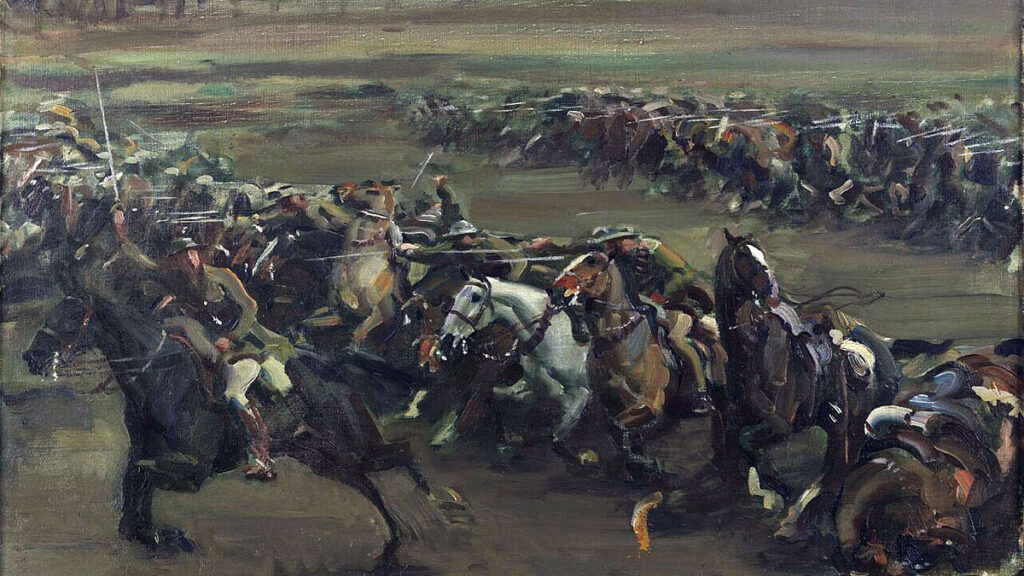
Born in 1908 on the Isle of Wight, Warrior was the mount of British General Jack Seely. When Seely went to the front, his loyal steed accompanied him. He tasted battle for the first time on 11 August 1914, during the First Battle of Ypres in Belgium. At the outset of the war, cavalry was widely used, but machine guns and artillery made these charges particularly perilous.
During the infamous Battle of the Somme, which would claim the lives of more than 300,000 men in 1916, the equine was buried after an artillery shell exploded. If only one of its forelegs remained above the ground, it was alive when the British managed to dig it out. In 1917, it participated in the Battle of Passchendaele, marked by incessant rainfall that turned the theatre of operations into a true swamp where both men and animals struggled to advance.
This same year, the English Thoroughbred also accompanied Seely at the Battle of Cambrai, during which the British deployed hundreds of tanks, and he survived the collapse of a bridge. A few months later, he took part in the assault on the Bois de Moreuil, near Amiens. Pressing forward under heavy German fire, the Allied cavalry were soon forced to dismount. Once again, Warrior emerged unscathed.
He was heavily gassed, and Seely was demobilized a few days later, but not his horse. Put back under the saddle of another officer, he continued serving until the end of the conflict, during which he also escaped two stables fires.
A well-deserved retirement
Sent back to England at the very end of 1918, Warrior returned to the pastures around the Isle of Wight and a much calmer daily life. In the years that followed, he took part in several equestrian competitions, notably distinguishing himself in 1922 by winning the Lightweight Race of the Isle of Wight Point-to-Point.
At the heart of the volume My Horse Warrior, published in 1934 and in which Jack Seely recounts his exploits, he led a peaceful life until his death in 1941, aged 33.
In 2014, “the horse the Germans could not kill” was posthumously awarded the Dickin Medal, a distinction created during World War II to honor animals that have distinguished themselves in armed conflicts.

Contact details
Address:
Farmers Forum,
36, Dominick Street,
Mullingar,
Co. Westmeath,
Ireland
Phone:
+353 (0)44 9310206
Or email us:
For technical issues please check out our FAQ's page or email - [email protected]
For general Queries email - [email protected]
Request to add event to our Calendar - [email protected]
Send us your mart reports - [email protected]
Suggestions and feedbacks - [email protected]
News Items / Press Release - [email protected]
To Advertise on Farmers Forum - [email protected]