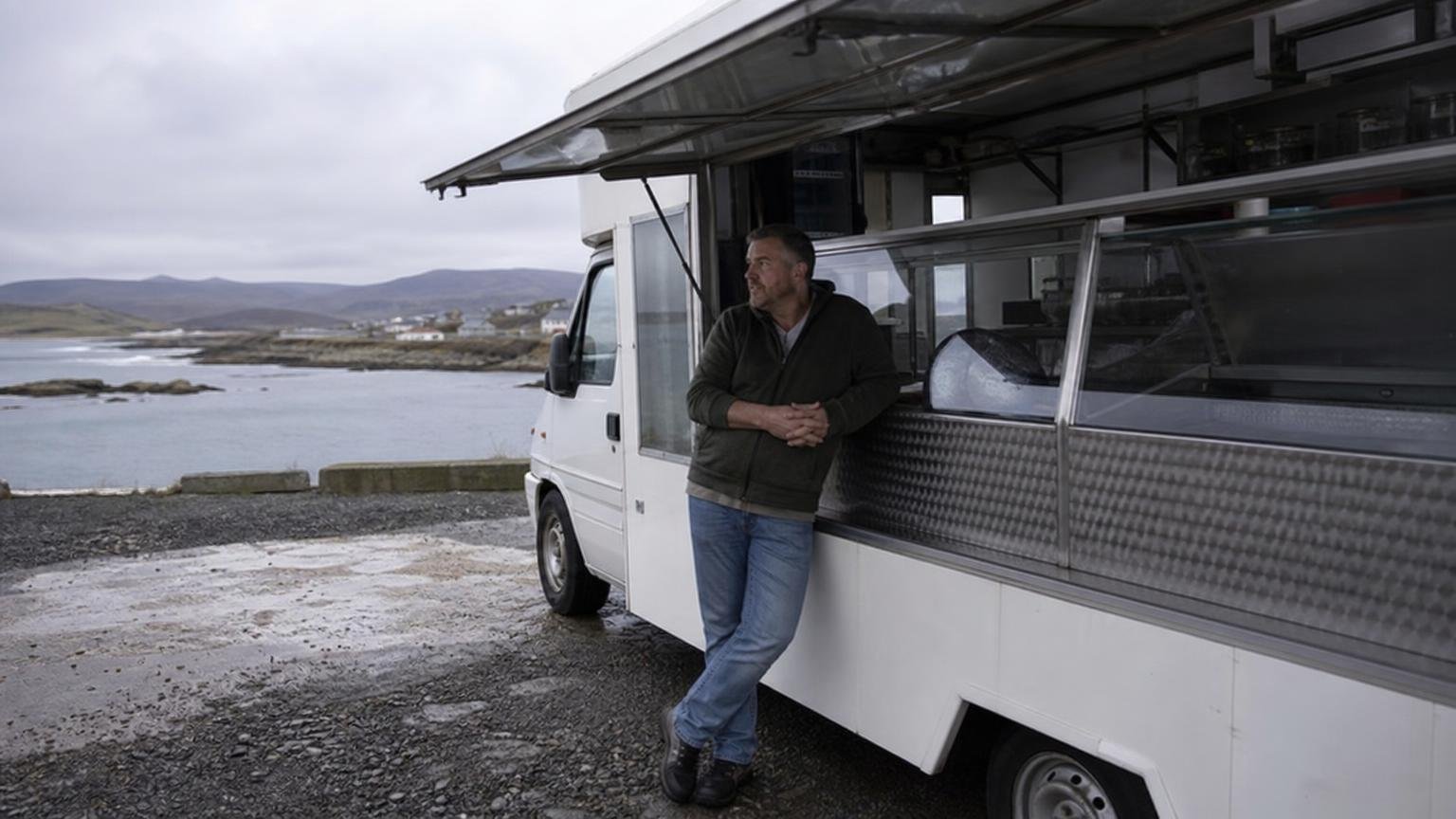
He spotted the van on a drizzly Tuesday, a squat blue box that once smelled like vinegar and sea. The ad was blunt, the price about what you’d pay for a package getaway, and he felt a sudden tug, like a tide grabbing a stray oar. “If not now, when?” he said to the windscreen, and that was that. A handshake, a receipt, and the old fryer’s life began again.
The impulse that didn’t pass
Seán from Dungloe had never dreamed of owning a food truck, but he had dreamed of a different winter. Not the one with fluorescent lights and stale coffee, but the kind where the horizon keeps its promises. “I didn’t buy it to sell chips,” he laughed. “I bought it to turn a small life into a longer one.”
He scrubbed the walls with lemon, ripped the fryers out like old fillings, and bolted a narrow bed where the freezer used to hum. A tin mug, a camp stove, a gale of maps taped to the metal—he set off toward the Atlantic’s long, silver edge.
Learning to move like weather
He follows the coast the way a kite follows wind, never really knowing where he’ll land. Some nights are soft with stars, others bite like wet rope. He parks by dunes that muffle the town’s clatter, cooks a pan of eggs, and falls asleep to the sea’s patient, barnacled whisper.
“The cold woke parts of me that sleep all summer,” he said, cradling a dented thermos. “Out here, the small rituals feel huge. Boil water, watch steam, listen for owls. You get through the night by noticing the next minute.”
The unofficial census of a coast
People keep finding him, drawn by the odd geometry of a chip van with curtains. A postman in a neon jacket, a surfer with salt-woven hair, an elderly couple who once danced every Saturday at the Parish Hall. They knock, ask what he’s cooking, sometimes just stand with their hands in their pockets.
He doesn’t sell a thing. He trades stories for steam, offers tea in enamel cups, and lets silence settle where money would usually sit. “You wouldn’t believe how much the night can hold,” said the surfer, staring at the bruised sky. “You think it’s empty until it starts to talk.”
What a van can teach
An ex-catering vehicle is both brutal and kind. The metal keeps the cold, but it also keeps you honest. Screws back out when the road turns cruel. Windows clatter like a half-remembered song. He learned to thank a spanner, to travel slowly, to park so the wind can’t punch him sideways.
There’s no grand philosophy, just a practical faith in small fixes. Zip ties like rosary beads, duct tape with the authority of a parish priest. He calls it “the gospel of make-do,” and on darker nights it sounds almost like prayer.
Accounts of a sideways economy
The cost was a holiday’s worth of cash, but the return has been a calendar full of sky. He spends less than he ever did, mostly on fuel, gas, and the kind of bread that forgives mistakes. “I thought I needed a different job,” he said. “Turns out I needed a different bill.”
What he’s stopped buying is more telling. Rush-hour hours. Bright plastic promises. Things that talk loudly and say nothing. He notes each saving like a gull marking an updraft: brief, simple, real.
Inside the blue box
On a shelf, he keeps a few anchors that don’t weigh him down:
- A paperback with sand-gritted pages, a pencil-map of bays he’s already met
- A photo of a rain-soaked pitch, boots muddied with younger days
- A harmonica that only knows two songs, both of them a little hopeful
A winter postcard that keeps moving
The coastline in cold months is its own country. Turf smoke threads from cottages, the sea turns heavy as hammered tin, and the birds write elliptical letters you can almost read. He swears you hear different truths in winter—truer ones that don’t bother with ribbons.
“I used to think I needed a bigger place,” he said. “But the van taught me I needed a bigger outside.” He paused, then added, “And smaller noise.”
The kindness of small harbors
Fishermen nod him into out-of-the-way corners, point at safer angles, share a coil of spare line like a benediction. In return, he helps untangle nets, hauls a crate, remembers names. It’s commerce of a slow, antique kind, where gratitude counts more than change.
He has a rule he never breaks: leave a place a little more whole than he found it. A bag of washed-up rope, a cleared patch of crushed maram, a note to say what the night taught him to notice.
Weather as a teacher
Storms are not enemies so much as tutors with rough hands. He watches the barometer’s stubby finger fall and tucks the van behind stubborn gorse. The world shrinks to lamp glow and book spines, and expands again with the first soft drip off the awning’s bent lip.
“There’s a specific silence after a gale,” he said. “Like the sea remembering your name, but not saying it out loud.”
The road still unfolding
When asked how long he’ll keep tracing this cold ribbon, he shrugs, smiling with a face that now belongs to weather. Maybe until the hawthorn flowers, maybe until the axles finally give their thin sigh. Maybe until he forgets the last fluorescent ceiling he ever meant to tolerate.
For now, he follows daylight like a half-wild dog, parks where the map thins to salt, and saves his loudest gratitude for mornings that arrive with mercy. The van smells like strong tea, the kettle rattles like an old tin hymn, and the coast—indifferent, immense—keeps letting him come back.

Contact details
Address:
Farmers Forum,
36, Dominick Street,
Mullingar,
Co. Westmeath,
Ireland
Phone:
+353 (0)44 9310206
Or email us:
For technical issues please check out our FAQ's page or email - [email protected]
For general Queries email - [email protected]
Request to add event to our Calendar - [email protected]
Send us your mart reports - [email protected]
Suggestions and feedbacks - [email protected]
News Items / Press Release - [email protected]
To Advertise on Farmers Forum - [email protected]