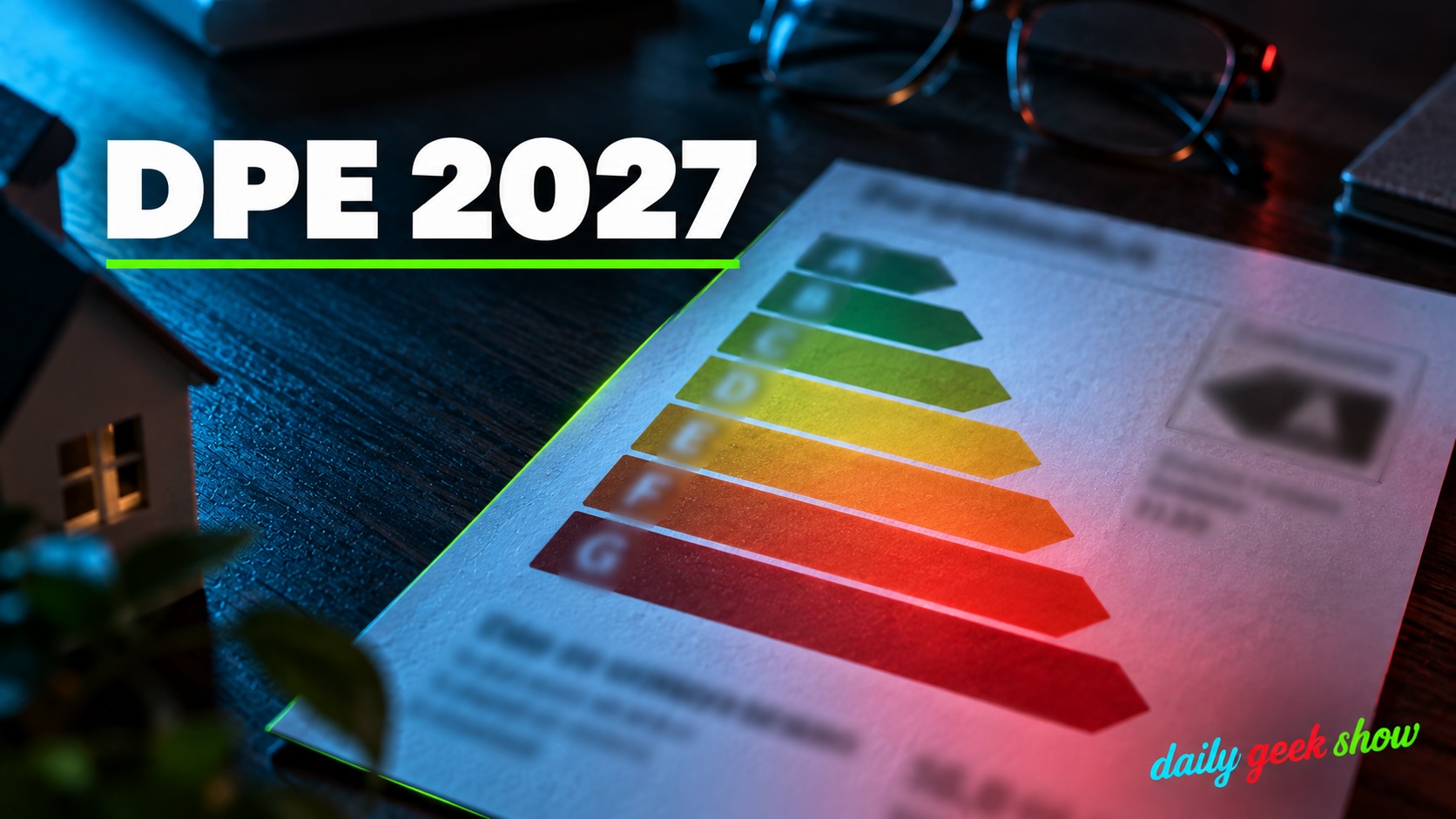
An order dated August 19, 2026, published in the Official Journal a week later, modifies a single line in the calculation of the energy performance diagnosis (DPE). The primary energy coefficient for electricity drops from 1.9 to 1.7 as of January 1, 2027. Three digits, no renovations, and about 300,000 primary residences changing label.
Among them, roughly 200,000 dwellings rated F and 100,000 rated G move up a notch. In the private rental stock, 125,000 properties exit the status of a thermal sieve. The stock of F and G dwellings falls by 10% nationwide and by 14% in the rental sector.
The measure passed almost unnoticed in the midst of August. It concerns every owner heated by electricity, every landlord facing a possible rental ban, and every buyer negotiating on the basis of a letter. We recalculated the figures, established the exact threshold for the shift, the question that interests a property owner is not “how many homes change” but “does mine change,” and we listed what the reform does not change, starting with the bill. This is the direct extension of our comparison of the true cost of heating energies: the DPE and the bill measure two different things, and this reform demonstrates it better than any explanation.
What this coefficient is, in one minute
The DPE does not measure what you consume. It measures the primary energy used to produce what you consume.
For gas, oil, or wood, the coefficient is 1: one kilowatt-hour burned at your home corresponds to one kilowatt-hour drawn at the source, aside from transport losses. For electricity, it used to be 2.3: one kilowatt-hour at the meter implied 2.3 kilowatt-hours of primary energy, mainly due to the thermodynamic efficiency of power plants.
This figure was reduced to 1.9 under a previous reform, and it thus drops to 1.7. The justification lies in the French electricity mix, largely nuclear and renewable, and in European Directive 2023/1791 on energy efficiency, which revised the conversion method.
The arithmetic consequence is simple: the primary energy consumption of an all-electric dwelling drops by 10.5% on paper, without a single watt less being consumed. The radiator is the same, the bill is the same, the insulation is the same. Only the divisor has changed.
Useful clarification: homes heated by gas, oil, or wood do not gain anything. Their coefficient remains at 1. This reform is a transfer of relative advantage between energies, not a general improvement of the stock.
The chart nobody publishes: is your home moving down a class?
The DPE classifies according to primary energy consumption in kilowatt-hours of primary energy per square meter per year. Here are the official thresholds, and the range in which an electrically heated dwelling drops a class on January 1, 2027.
| Class | Consumption (kWhEP/m²/year) | Threshold for moving to the lower class |
|---|---|---|
| A | less than 70 | — |
| B | 70 to 110 | 70 to 78 |
| C | 110 to 180 | 110 to 123 |
| D | 180 to 250 | 180 to 201 |
| E | 250 to 330 | 250 to 279 |
| F | 330 to 420 | 330 to 369 |
| G | more than 420 | 420 to 469 |
How to use it. Take out your DPE, note the value in kWhEP/m²/year shown on the energy label, beneath the letter. If it falls within the right-hand column’s range, your home drops a class on January 1, 2027. If it is above, it does not move.
A few concrete cases, to fix ideas:
| Current value | Current class | Value on January 1 | Class in 2027 |
|---|---|---|---|
| 450 | G | 403 | F |
| 430 | G | 385 | F |
| 400 | F | 358 | F, no change |
| 360 | F | 322 | E |
| 335 | F | 300 | E |
| 300 | E | 268 | E, no change |
| 270 | E | 242 | D |
| 200 | D | 179 | C |
The most surprising finding: a dwelling at 400 kWhEP gains nothing, while a dwelling at 360 gains a letter. The reform does not reward the worst performers; it mechanically shifts the thresholds. A owner at 400 will remain in F and will be affected by the rental ban in 2028; a neighbor at 360 will exit, with a real performance gap of 10%.
One thing not to forget: the DPE retains the worst of the two labels, energy and climate. For a dwelling heated by electricity, the climate label is very favorable, and it is the energy label that governs. For a dwelling with mixed heating, check both before concluding.
Should you redo a diagnosis?
No, and that is the good news of the file. Valid DPEs can be accompanied by a free attestation of label change, generated by ADEME. No new diagnostician to bring in, no 150 to 250 euros to shell out.
Three implications to keep in mind despite everything.
Wait until January. Having a DPE done in October or November 2026 means paying for a document that will be outdated in its letter three months later. If a sale or a rental is not urgent, delaying the diagnosis by a few weeks is worth it.
Check validity. The attestation applies to DPEs that are still valid. A DPE performed under an earlier method and expired will not be requalified: it will need to be redone, and will already incorporate the new coefficient from the start.
Do not sign a letter that will change. For a sale agreement or a lease signed at the end of the year, the mentioned letter will be the old one. It’s not illegal, but it weighs in negotiations, and an informed buyer knows it.
What it changes for renting
This is the point that triggered reaction. The rental prohibition schedule is indexed to the letters.
| Class | Rental status |
|---|---|
| G | Prohibited for rent since January 1, 2025 |
| F | Prohibition starting in 2028 |
| E | Prohibition announced for 2034 |
A rental dwelling moving from G to F thus becomes rentable again, and a dwelling moving from F to E gains six years of postponement. Of the 125,000 rental properties affected, the impact is immediate and considerable for their owners.
The public consultation on the proposed order collected 110 contributions, of which 78 were unfavorable and 29 favorable. The main reproach from opponents is summed up in one sentence: the reform reduces enforcement pressure for renovations without improving a single dwelling.
The argument is grounded in facts. However, a parallel factual objection can be made: the coefficient of 2.3 and then 1.9 penalized electric heating relative to its physical reality in a decarbonized mix and pushed owners toward equipment replacements that did not reduce their bill or their emissions. The two criticisms can be true at the same time. One thing is certain: the letter has never been a measure of comfort or expense.
The trap no one has highlighted: gaining a letter can cost subsidies
Here is the most counterintuitive point of the reform, and it does not appear in any of the summaries we have read.
Several renovation assistance schemes reserve or extend access to the most poorly classified dwellings. Since September 1, 2026, six renewal measures have left the MaPrimeRénov’ pathway, including biomass heating, thermodynamic water heaters, and solar thermal for F and G classified dwellings, which alone retain access until December 31, 2027.
An owner of an F-class dwelling that shifts to E on January 1 therefore loses this window. They did nothing; their dwelling did not change, and a grant that was accessible at the end of 2026 is no longer available at the start of 2027.
The practical consequence is clear for anyone planning work: if your dwelling is currently rated F or G and you plan an eligible measure, examine the calendar now rather than in spring. Three months separate the current situation from the new grid.
Buying or selling between now and January
Three months separate the market from the new grid, and this period has its own rules.
On the seller’s side. If the dwelling is electrically heated and located in a switching zone, waiting until January improves the label shown in the listing without spending a single euro. The price gap between two neighboring classes is not negligible in the French market, and it is more pronounced for the lower letters, where the letter triggers a renovation consideration rather than a simple preference. A property at 360 kWhEP listed for sale in February would show as E; the same property listed in November would show as F.
On the buyer’s side. The opposite is true, and it is a card to play before year-end. A dwelling currently shown as F, with a kWhEP value between 330 and 369, will move to E without works. The buyer who has done the calculation knows that the discount tied to the letter will shrink, and can decide to either accelerate the purchase or negotiate based on actual performance rather than the label.
In both cases, the data to request is not the letter but the numeric value. An advertisement that shows “Class F” without the kilowatt-hour figure is unusable for this reasoning, and a seller who refuses to disclose it even though it appears on the diagnosis deserves scrutiny.
The special case of condominiums
For an apartment in a collective building, two diagnostics coexist and often blend in conversations.
The individual DPE for the unit is the one that appears in a sales or rental listing, and it is the one that triggers or not the rental ban. It is affected by the reform if the heating is electric, which is common in condominiums built from the 1960s to the 1980s equipped with convectors, precisely the most represented category among dwellings reclassified.
The building’s collective DPE, meanwhile, is the responsibility of the condo and follows its own obligatory schedule depending on the building’s size. A building heated collectively with gas will not gain anything from the reform, even if some units have electric backups.
Practical consequence for a condo owner: if the heating is individual and electric, the January shift directly concerns you and no one in the condo needs to act on your behalf. If the heating is collective with gas or oil, the reform is irrelevant and the works voted in the assembly remain the only lever.
What the reform absolutely does not change
Five points to keep in mind before celebrating a letter.
The bill. No kilowatt-hours saved. A dwelling moving from F to E consumes exactly the same amount on January 2 as on December 31, and costs exactly the same to heat.
Losses. The walls, the windows, thermal bridges, the roof. Nothing is treated. A poorly insulated dwelling remains poorly insulated, with the same air currents and the same inertia.
Summer comfort. This is the most serious caveat, and it particularly concerns small urban units heated by electricity, which make up the bulk of rankings changed. Studios and one-bedroom units in attics, poorly insulated, facing south, exit the thermal sieve status without any degree of comfort improving in August.
The climate label. It is calculated based on greenhouse gas emissions and is not affected. A gas-heated dwelling blocked by its climate label remains blocked by it.
The resale value. A letter improves, a savvy buyer will ask for the kWhEP value and the details of the losses. The devaluation tied to poor performance does not disappear because an administrative threshold has moved.
What remains to be done, reform or not
The hierarchy of actions is not altered by a coefficient. It remains, in order of profitability for a dwelling heated by electricity:
The insulation of lost attic spaces remains the most cost-effective building upgrade and the cheapest per square meter. Sealing air leaks helps reduce drafts. The regulation, which remains the best cost-to-benefit measure, our dossier on connected thermostats quantifies gains according to the starting point. Replacing old convection heaters, which does not change the thermal efficiency but changes regulation and comfort, as detailed in our piece on so-called economical radiators.
And for a fully electric dwelling, tariff arbitration often weighs more than a letter: the threshold for switching to off-peak hours and the real value of Tempo are quantified in our comparison of electricity options. A owner who gains a letter on January 1 and remains on an unsuitable tariff will have improved their DPE but not their bill.
Finally, on-site generation remains an option, whose profitability depends more on daytime consumption profiles than on installed capacity; our piece on plug-and-play solar kits details when the calculation holds and when it does not.
Frequently asked questions
What exactly changes in the DPE on January 1, 2027?
The primary energy conversion coefficient for electricity changes from 1.9 to 1.7, by an order dated August 19, 2026 and published in the Official Journal on August 26. The primary energy consumption of a dwelling heated by electricity decreases mechanically by 10.5% on the diagnostic, with no modification to the building itself.
How many homes will change class?
About 300,000 primary residences, including roughly 200,000 currently classified F and 100,000 classified G. In the private rental stock, about 125,000 properties exit the thermal sieve status. The stock of F and G falls by 10% nationwide, and by 14% in the rental sector.
How can I tell if my dwelling gains a class?
Note the value in kWhEP/m²/year on your DPE. A dwelling heated by electricity drops a class if its value falls within 330 to 369 (F to E), 420 to 469 (G to F), 250 to 279 (E to D), or 180 to 201 (D to C). If it is outside these ranges, it does not move.
Should you redo a DPE to benefit from the new calculation?
No. Diagnostics that remain valid can receive a free attestation of label change, generated by ADEME. However, a DPE that has expired must be redone and will then automatically incorporate the new coefficient.
Does a dwelling heated by gas also gain a class?
No. The primary energy coefficient for gas, fuel oil, and wood remains fixed at 1 and is not modified. The reform concerns electricity only. It shifts the relative advantage between energies, it does not improve the overall ranking of the stock.
Will my bill go down?
No, not a single euro. The DPE measures conventional primary energy, not what is billed. The dwelling uses the same amount, the insulation is the same, the losses are the same. Only the letter changes.

What we take away
For a landlord facing a rental ban, the reform is a real breath of relief, and it would be foolish to complain: 125,000 rental dwellings exit a legal dead end on January 1. The simple move is to note the kWhEP value on the existing diagnosis, compare it with the table thresholds, and request the ADEME attestation at the start of January.
For a tenant, it changes nothing. The letter improves, the dwelling does not, the bill does not either. And if renovations are planned with a grant reserved for F and G classes, the window closes on December 31.
There remains one question this dossier does not resolve, because no one can decide it today: does a recalibrated indicator maintain its function as a signal when it is redefined three times in five years? Property owners, buyers and tenants have learned to read a letter. Three successive revisions of the calculation method teach them mainly to be wary, which may be the right reaction, but certainly not the objective sought.

Contact details
Address:
Farmers Forum,
36, Dominick Street,
Mullingar,
Co. Westmeath,
Ireland
Phone:
+353 (0)44 9310206
Or email us:
For technical issues please check out our FAQ's page or email - [email protected]
For general Queries email - [email protected]
Request to add event to our Calendar - [email protected]
Send us your mart reports - [email protected]
Suggestions and feedbacks - [email protected]
News Items / Press Release - [email protected]
To Advertise on Farmers Forum - [email protected]