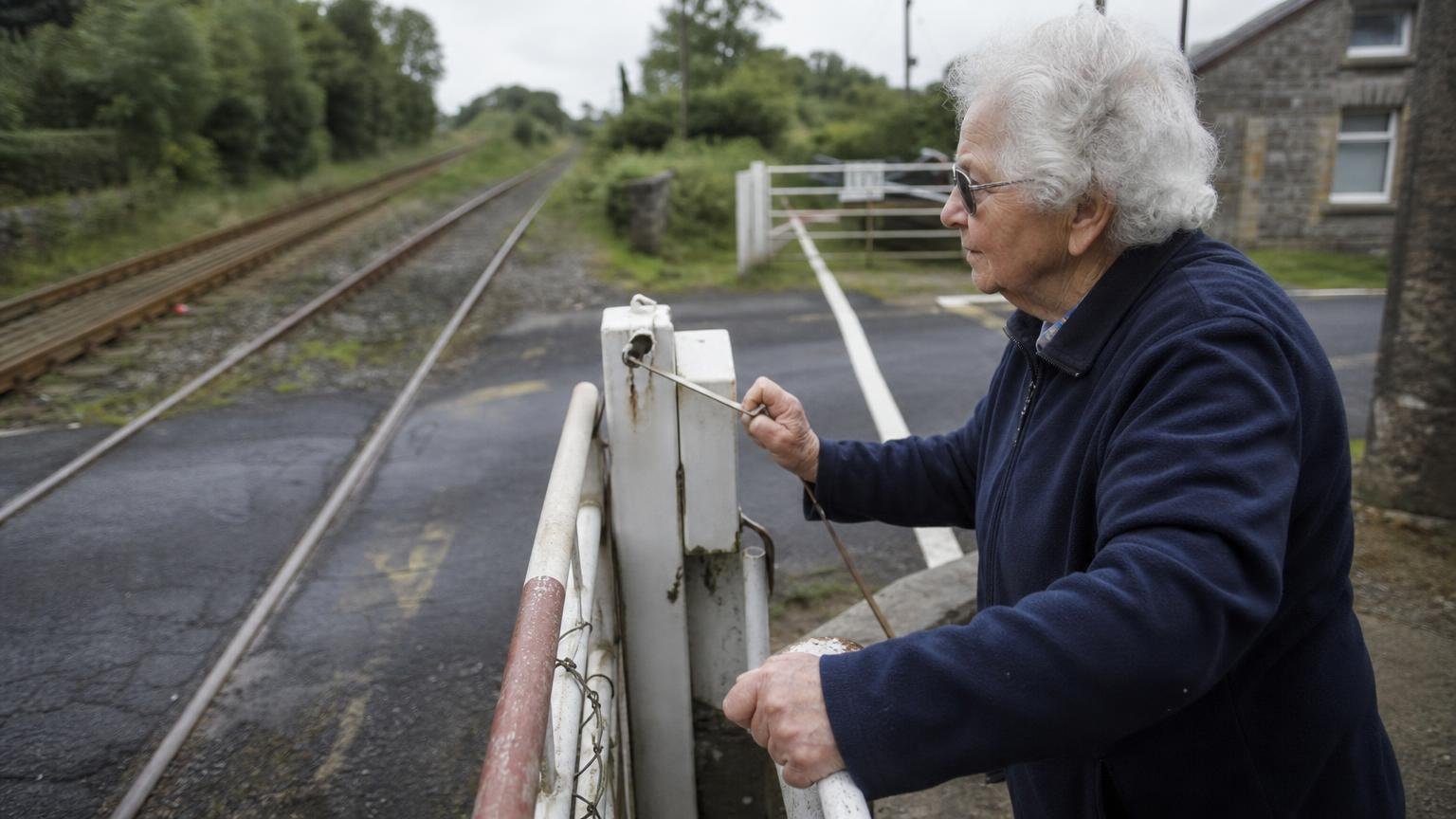
The hinges creak before the sun, and the road outside Attymon yawns into another quiet morning. At ninety-two, Nuala Keeley steps from her small cottage, scarf tied neat, boots clean as a bell, and reaches for what she still calls the “big keys.” The gates, iron-backed and whitewashed, swing like patient shoulders as she draws them wide, the same way she has since the world was younger and the rails still sang.
“Muscle memory is a kind of prayer,” she says, steady hands on the latch, a grin that knows mischief and weather. “You do a thing so long, it does you back.”
The rhythm of a vanished timetable
Nuala keeps an old schedule inside a biscuit tin, the ink browned and the corners blown like leaf tips. Trains once came like seasons: the morning mail, the cattle wagons, the commuter with boots still wet from the lane. Now the track is a seam of rust and nettles, quiet as a sleeping harp.
She still marks two moments each day: morning open, evening close, the ceremony of motion taught by the stationmaster’s whistle and her father’s raised brow. “You’re keeping more than gates,” he told her once, “you’re keeping time.”
A life measured in crossings
Her first memory is of her father’s cap and the thick gloves he wore, the signal box peppered with levers in colours that tasted like boiled sweets. She learned to read a sky’s mood the way others read a map, and to judge a wheel’s distance by a hum in the sleeper.
When her father fell ill, the duty became her living, a small post with shy wages, and the pride of a uniform badge polished with saliva and the corner of her apron. Through snow that stacked like folded sheets, and summers that smelled of tar and foxglove, she swung the gates to let the world pass.
The community she shepherds
There are no locomotives, but there are neighbours on bicycles, a farmer with sheep, a school bus with laughter like shaken silver. People slow their engines and wave at her porch, where the enamel mug rests warming her fingers between tasks.
“It isn’t about need,” says Declan, who runs the shop. “It’s about the thread she keeps, that quiet stitch between yesterday and today.” Children bring her postcards with drawn trains, wheels big as full moons, and she tucks them near the biscuit tin, the museum of a private nation.
Why she keeps going
“Stopping is a big thing,” Nuala says, “and big things are easy to avoid if you keep to small ones.” She likes the click of the padlock’s tongue, the soft give of oiled metal, the idea that an old responsibility can still fit like a well-worn cardigan.
“It makes the road feel right,” she adds. “If the gates stayed shut, it would be a sad sort of signal. People would see that and think, well then, something is truly over.”
The mechanics of memory
The gates don’t tend themselves, and neither does memory. Nuala keeps a tin of grease and a scrap of sandpaper, a stub of chalk for notes, and a habit of checking twice. Each step is its own bead on the rosary of her day:
- Wipe the hinges with a clean rag, listen for the smallest scratch of fatigue.
- Test the latch for bite, feel if the bolt seats honest.
- Walk the verge for broken glass, nettles, or a fox’s quick visit.
- Open wide, lock back, and nod to the empty, dignified track.
- Close again at dusk, say the simple thanks some people say in church.
“Things last if you speak to them,” she says, patting the paint, white with a lick of green where the hedge kisses in storms. “Not with words, with hands.”
Echoes under the heather
Along the ballast, thrift and heather make small, brave flags of pink. On still evenings, a wind comes low over the bog and the air seems to hold a note, as if some far engine has given a private whistle no one else can quite hear.
Nuala doesn’t chase the ghost of that sound; she lets it find her porch, lets it braid with the kettle’s easy song. “They went where they had to go,” she says of the trains, “and I stayed where I was useful.”
What remains when the whistle fades
In a world that updates by swipe, her small act resets a different clock. It says order can be gentle, that care can be local, that history can be kept not in glass but in motion. Two gates, two times a day, and a promise kept without any drama.
Before bed, she sets the big keys on the dresser, beside a photograph of her father’s hands, knuckles like pebbles, veins like tributaries on a brown map. “I’ll go on while I’m able,” she says, voice bright as a dropped spoon. “When I can’t, someone will know what the hinges mean.”
Outside, the road lies ready, and the old line keeps its shy, steadfast silence. Morning will come, and with it that first, honest creak, the gate opening to let the day step through.

Contact details
Address:
Farmers Forum,
36, Dominick Street,
Mullingar,
Co. Westmeath,
Ireland
Phone:
+353 (0)44 9310206
Or email us:
For technical issues please check out our FAQ's page or email - [email protected]
For general Queries email - [email protected]
Request to add event to our Calendar - [email protected]
Send us your mart reports - [email protected]
Suggestions and feedbacks - [email protected]
News Items / Press Release - [email protected]
To Advertise on Farmers Forum - [email protected]