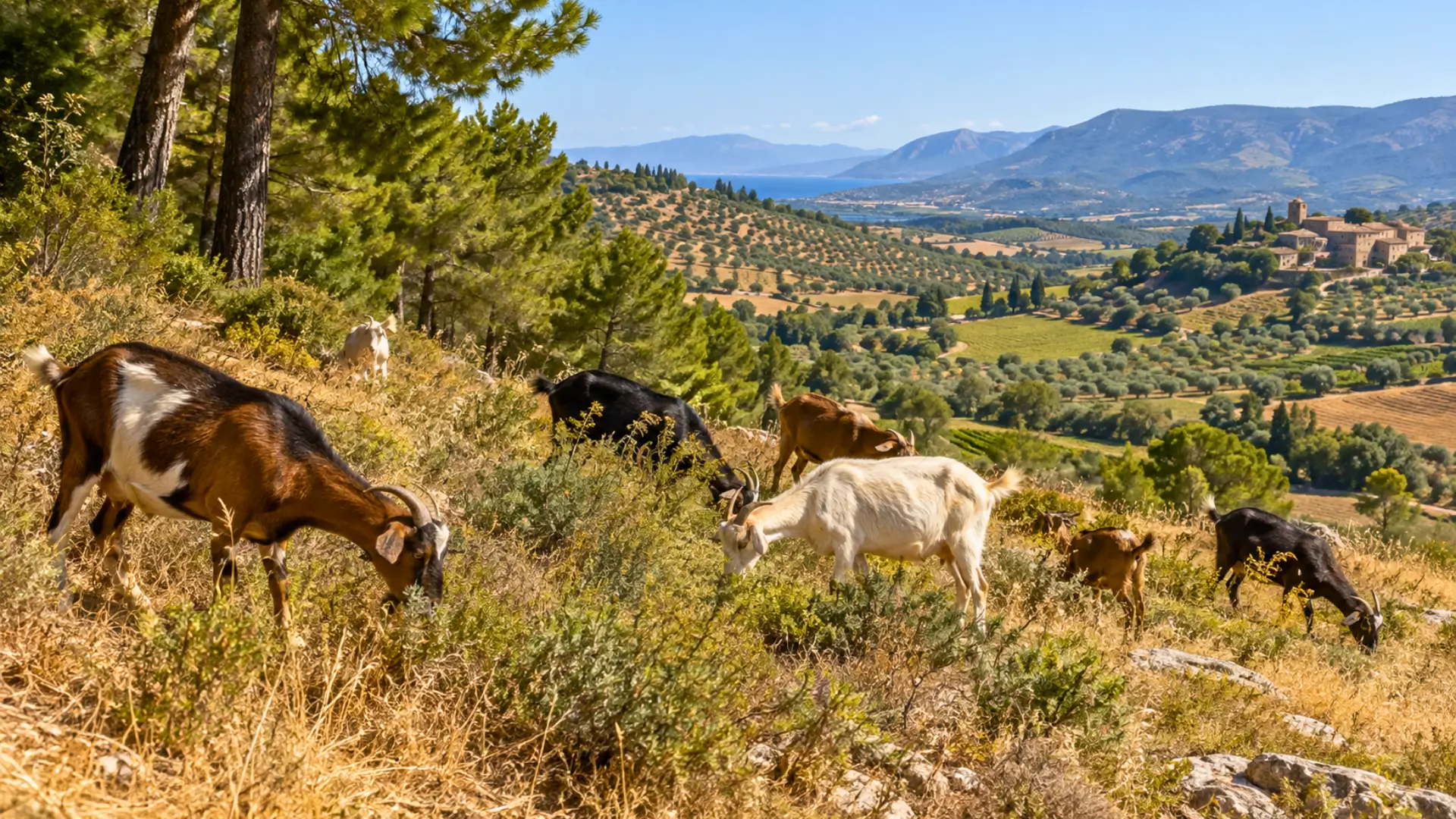
And what if, in the face of colossal wildfires, the answer lay in a landscape we once deemed outdated? An international study suggests that well-managed pastures, cultivated fields, and forests could become true barriers against increasingly hard-to-control Mediterranean blazes.
The real fuel of megafires can accumulate for years, often without making a sound
A megafire does not emerge solely from a spark and a scorching season. It also needs vegetative fuel, which can build up over many years. Scrub, dry grasses and young trees gradually form a nearly continuous mat. With heat, drought and wind, this landscape becomes an expressway for flames.
This situation has worsened with the abandonment of many rural lands. Once, herds, crops and human activity kept spaces open. Now, vegetation is gradually reclaiming the terrain. Consequently, researchers observe more homogeneous landscapes, where the fire meets fewer natural obstacles and rapidly intensifies.
According to the European Commission, 620 000 hectares had already burned in the European Union as of 25 August 2026. This figure stood about twice the average observed between 2006 and 2025. Furthermore, France, Spain and Italy are among the countries most affected.
Ten Mediterranean regions reveal another way to keep flames at bay
Published in August 2026 in the scientific journal iScience, a study examined ten Mediterranean initiatives. The universities of Göttingen and Kassel coordinated these efforts. Their idea may seem counterintuitive: you need to alter the landscape long before the first flames arrive, rather than waiting for the fire to start.
Some initiatives thus use the extensive grazing. Goats, sheep and cattle consume part of the inflammable biomass. Moreover, other projects combine agriculture, silviculture and controlled burns. They also maintain open spaces. Finally, the most promising approaches bring together farmers, scientists, residents, associations and fire services.
Goats, vineyards and olive trees could sketch livelier firebreaks
The image is striking: a goat grazing on scrub can help prevent a wildfire. Yet this is not about turning every forest into a giant pasture. The idea is to create a mosaic of landscapes, where woodlands, grasslands, crops and grazed zones alternate. This pattern breaks the continuity of the fuel.
Crops can also play a role. Well-maintained vineyards or olive groves harbor less inflammable vegetation than some abandoned lands. The European Commission likewise highlights their potential value. Indeed, these plots can slow a fire when integrated into a broader landscape strategy.
Grazing is already the subject of European experiments. Projects backed by the LIFE program notably involve using animals in exposed sectors. Their aim is to reduce the grasses and shrubs available to fuel fires. In the Mediterranean basin, up to 500 000 hectares of forests can burn in certain years. This gives the method an unexpectedly modern relevance.
Preventing fires ultimately requires reviving entire rural landscapes
This strategy changes the way we imagine fighting fires. Canadair aircraft, firefighters and firebreaks remain essential. However, they typically intervene after the crisis has begun. Researchers therefore propose acting months or years earlier to restore landscapes capable of naturally slowing the flames.
A major challenge remains: these landscapes must be maintained sustainably. They require both farmers, herders, funding and local coordination. Thus, the struggle against megafires intersects a broader question: the future of rural territories. Would protecting the Mediterranean forests ultimately start by bringing life back around them?

Contact details
Address:
Farmers Forum,
36, Dominick Street,
Mullingar,
Co. Westmeath,
Ireland
Phone:
+353 (0)44 9310206
Or email us:
For technical issues please check out our FAQ's page or email - [email protected]
For general Queries email - [email protected]
Request to add event to our Calendar - [email protected]
Send us your mart reports - [email protected]
Suggestions and feedbacks - [email protected]
News Items / Press Release - [email protected]
To Advertise on Farmers Forum - [email protected]