
The evolutionary trajectory of many organisms can be partly traced through the vestiges they leave behind. In the horse, the most intriguing traces are observed at the level of the limbs.
Vestigial Structures
While modern equids are monodactyl—bearing a single complete and weight-bearing toe per limb—a 2018 study suggested that relics of their five-toed distant ancestors linger in horses. Two years later, research published in the Proceedings of the Royal Society B: Biological Sciences provided the first solid evidence that five digital condensations indeed appear during the embryonic development of the horse.
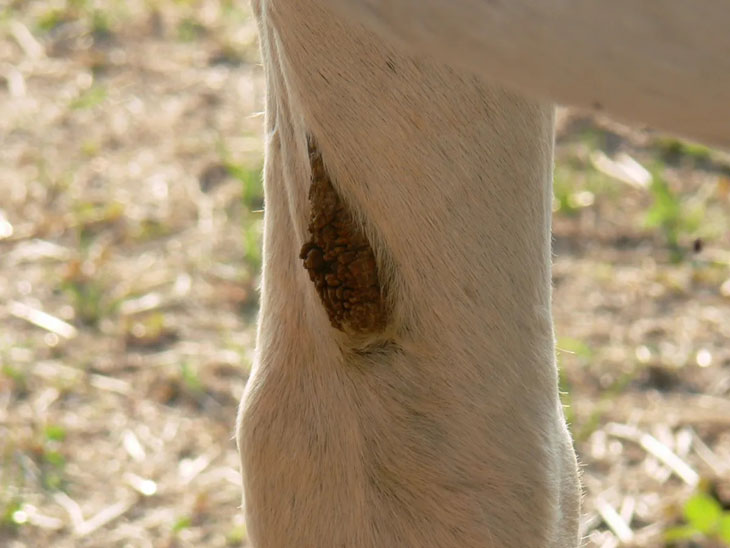
These are not the only vestigial structures documented in these animals. Able to develop above the knee on the forelimbs and beneath the hock on the hind limbs, keratinous outgrowths (the main constituent of our nails and hair) are often presented as “chestnuts.” Quite harmless, these crusty nodules can detach naturally once they reach maturity.
Although several theories have been proposed over the years regarding their function, they could be remnants of a scent gland present in their prehistoric ancestors and still present among certain modern ungulates, such as deer. Until the twentieth century, a widespread (and rather far-fetched) belief held that these structures helped horses see in the dark.
Because of their shape and texture, which resemble human fingerprints, the chestnuts are sometimes used for equine identification.
Ergots
Other similar structures on the legs of modern horses are the ergots, which are calloused protrusions located at the back of the fetlock. Contrary to what their position might imply, the fetlock anatomically corresponds to the joint at the base of our toes rather than to the ankle.
For some researchers, ergots would be direct digital vestiges, while others view them more as ancestral plantar cushions.
They tend to be more common in horses with “feathers,” which does not refer to mythical wings like those of Pegasus, but rather describes the hair fringes seen at the base of the legs of certain breeds, such as the Shire, the largest horse alive today.

Contact details
Address:
Farmers Forum,
36, Dominick Street,
Mullingar,
Co. Westmeath,
Ireland
Phone:
+353 (0)44 9310206
Or email us:
For technical issues please check out our FAQ's page or email - [email protected]
For general Queries email - [email protected]
Request to add event to our Calendar - [email protected]
Send us your mart reports - [email protected]
Suggestions and feedbacks - [email protected]
News Items / Press Release - [email protected]
To Advertise on Farmers Forum - [email protected]