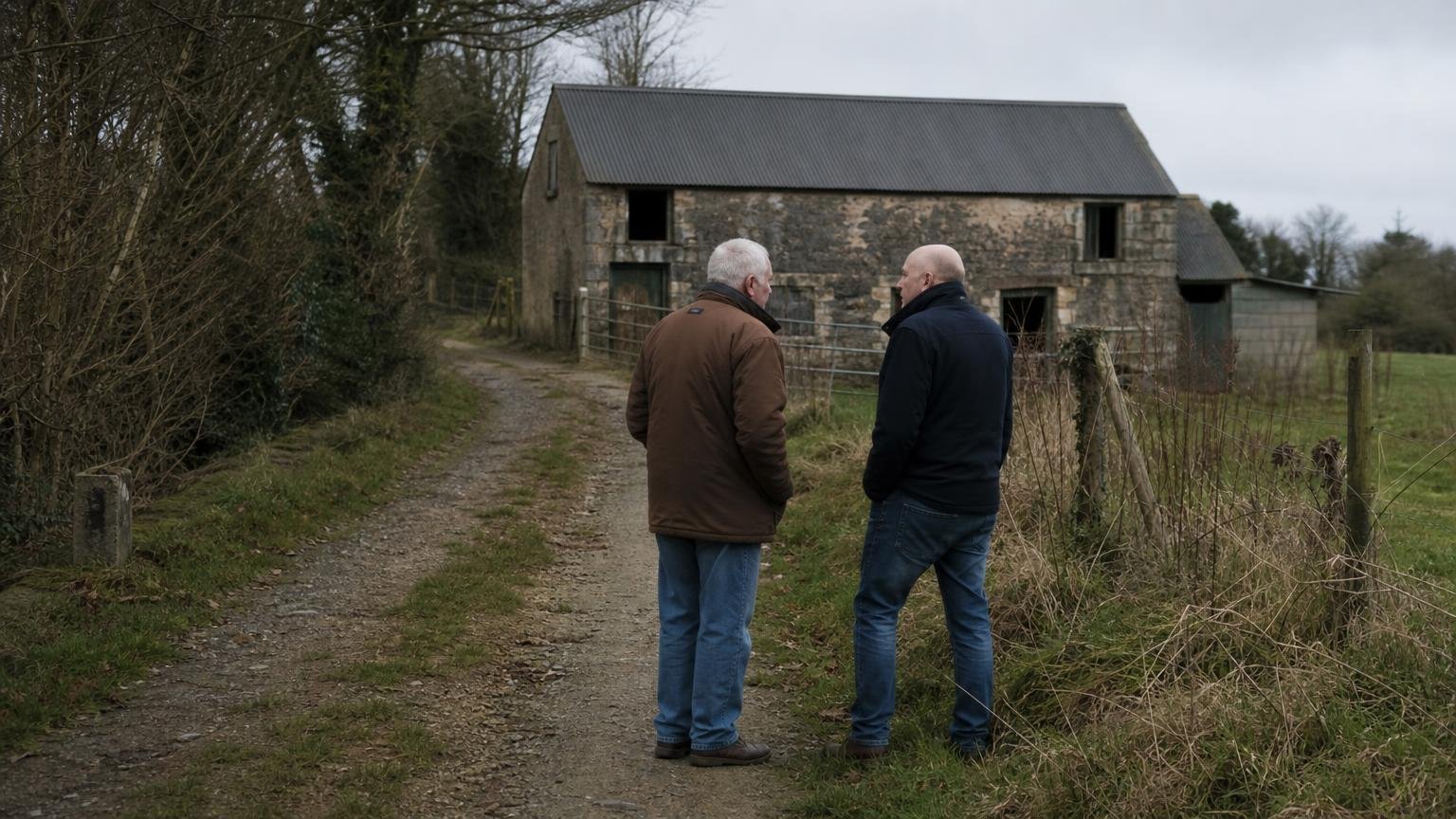
The lane is narrow, hedge-high, and quiet. On damp mornings in Cavan, the verges shine emerald, and the calls of crows hang low over the fields. For years, a vacant farm sat between two houses, its gate rusting, its barn leaning like an old sailor, its pastures tufted with docks and ragwort.
When an auctioneer’s sign went up, the lane felt a tremor. The parcel was tidy on paper, but real life is rarely square, and both neighbours felt something more than curiosity. They felt the edge of a future they might not recognize, a story that could skip their names entirely.
A boundary becomes a bond
Tom Flynn lives to the west, Nora Keegan to the east. They share a ditch, a postman, and a fondness for evening silence. “We’ve seen too many places snap into holiday shapes,” Tom said, rubbing a palm over a flake of red paint on the farm gate. “We wanted the fields to keep their accent, not learn a new one overnight.”
What lay between them was more than acres. It was the old right-of-way, the ash tree with the hollow big enough for a boot, the spring that keeps running even in July. “It felt wrong to let a life we know be decided by someone we don’t,” Nora said. “So we made a plan that was half courage, half common sense.”
The auction and the handshake
They didn’t have a war chest, or a shelf of neat binders. They had savings with scars from school fees and a tractor repair that should have been the last. They spoke to the bank with a straight story and to each other with a long one.
On auction day, Tom wore his good boots, Nora her lucky scarf. “We stood apart so we wouldn’t look like a crowd,” Tom laughed later. “But we were one mind.” The bids rose with a rhythm that felt like a drum, then staggered, then stopped. The hammer fell, and the air went thin.
Out in the yard, the handshake was short and quiet. The relief was a weight, but a friendly one, like a dog that has finally come home. “We didn’t feel rich,” Nora said, “we felt responsible.”
Paperwork, fences, and the fences in the mind
The hard part can be the easy part if you’ve done it before. They hadn’t. There were maps that didn’t quite agree, boundaries that behaved like rivers, and a shed that sat a whisper over an old line. Solicitors drew careful arrows, surveyors tapped with cautious boots.
They made a co-ownership deed, not marriage, not contract, something between. It set out who fixes what, who grazes when, and how to break a tie when neither wants to blink. They wrote a clause about “never selling to a flipper,” and they both underlined the word never.
“Neighbours aren’t born partners,” Nora said. “We had to talk like we meant the next decade, not just the weekend.” Tom nodded. “We also left space for change,” he added. “Because land teaches you more slowly than you expect.”
What the land asked for
The first weeks were a listening, boots sinking into moss, eyes counting the drains, ears tuned to where the wind catches. Ivy was eating the old byre, and nettles were patrolling the yard. But under the rough was a spine of good ground.
They met in the half-fallen hayloft and walked it in squares. The plan they settled on is as plain as bread and as flexible as a reed:
- Graze light and rotational, patch the hedges with native thorn, keep the spring clean and fenced, and turn the barn into a shared workshop with one warm corner for tea.
“Not every acre has to earn its keep in cash,” Tom said. “Some pay back in birds.” Nora smiled. “And some pay back in pure peace,” she added.
The rhythm returns
News moved along the lane like weather. People slowed their cars, leaned on windows, shared stories about who milked here before the war and who taught a collie that once saved a lost calf. Offers arrived that weren’t really offers: help with a digger, spare posts, a bag of seed that might still be viable.
Work settled into rituals. Tuesdays were for the hedge, Fridays for the gate, Sundays for doing almost nothing. In the evening, they left the lane darker, switching off the barn light so bats could find their line. “We’re not restoring a museum,” Nora said. “We’re keeping a place useful, which is the most respectful thing we can do.”
A different kind of wealth
It will never be a calendar farm, with glossy calves and silo silhouettes. It will be a patch of ordinary Ireland held by two people who live within the length of a shout. “Ownership can be a wall,” Tom said. “We wanted it to be a bridge.”
There are still bills with teeth, weeks when the weather goes all the wrong ways, and moments when a shared decision takes an hour too long. But there is also the small miracle of hearing a corncrake where last summer there was only the rattle of a loose sheet.
The gate still sticks, the ash still leans, and the spring still makes its soft music. What’s different is the quiet certainty that the field between two homes now answers to both of them, and to a future that sounds a lot like the past spoken in the present tense.

Contact details
Address:
Farmers Forum,
36, Dominick Street,
Mullingar,
Co. Westmeath,
Ireland
Phone:
+353 (0)44 9310206
Or email us:
For technical issues please check out our FAQ's page or email - [email protected]
For general Queries email - [email protected]
Request to add event to our Calendar - [email protected]
Send us your mart reports - [email protected]
Suggestions and feedbacks - [email protected]
News Items / Press Release - [email protected]
To Advertise on Farmers Forum - [email protected]