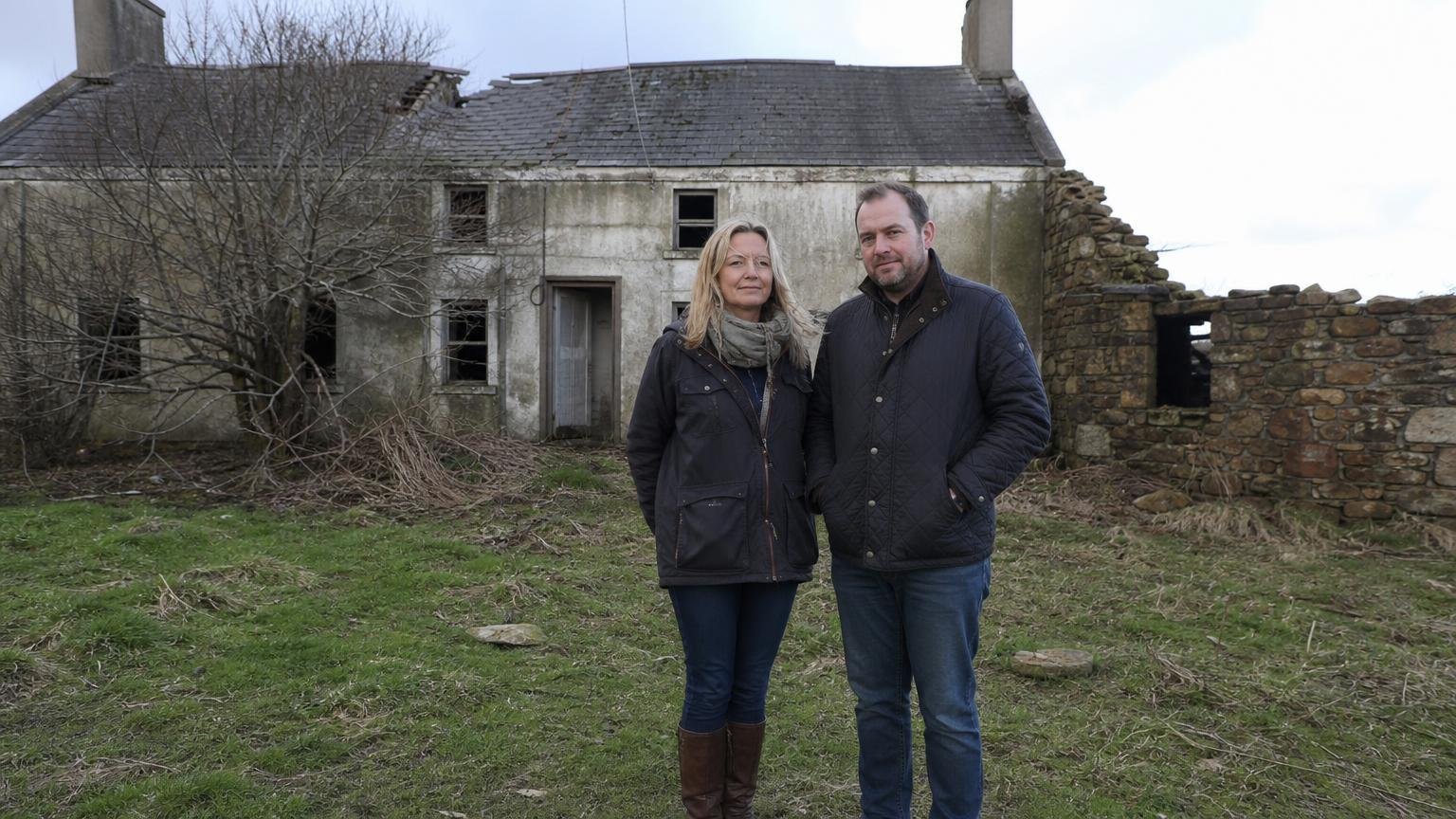
They raised their paddle on a whim, and a roomful of bidders laughed at the audacity of a number. Minutes later, the gavel fell, and a crumbling farmhouse in rural Tyrone belonged to two people who had never stepped past its gate.
What followed wasn’t a fairytale, nor a disaster, but something stranger—a collision of luck, grit, and place. “We wanted a challenge,” one of them said, “but not necessarily one that smelled like damp forever and ever amen.”
The bid that changed everything
The auction was crowded, noisy, and brisk, the kind of sale where hedgerows are catalogued like heirlooms and roofs get described as “characterful” with a knowing smile. Lot 14 flashed on the screen, three blurry photos and a cryptic line about “access to be clarified.”
A starting price hovered low, ridiculous even, and someone in the back made a joke. The pair shrugged, lifted the paddle, and said a number small enough to be a story. The room chucked, then paused, then looked around for a counter.
No one bit. The hammer landed. “It sounded like a door slamming on sense,” the auctioneer recalled with a crooked grin.
Who buys a farmhouse for pocket change?
Back home in Coalisland, they drove out the next morning with a flask of tea and the kind of optimism that keeps you from checking the weather twice. The lane was narrow, nettled, and gloriously stubborn, the sort of approach that suggests the building beyond has strong opinions.
They found it: a stone box with a leaning soul, every window squinting, the roof patched like a sailor’s jacket. But the light was beautiful, thin and silver, and a robin kept landing on the broken lintel as if auditioning for the deed.
“It wasn’t love at first sight,” one admitted. “It was more like love at fifth or sixth try.”
The catch, always the catch
The contract, when they finally read it with their heart rate back under control, contained more footnotes than a doctoral thesis. Access rights were murky, drainage was a riddle, and heritage rules hummed softly in the background.
And the building? Damp, spectacularly so, a tapestry of rot threaded through handsome beams. A tree had grown into the gable like a polite intruder, tapping at the stones with patient fingers.
They made a list, because lists feel like power, even when they’re just scaffolding for a future storm:
- Fix the roof, map the drains, decode the deeds, be kind to the hedges, and learn to love the word “survey.”
Restoring a ghost
They brought in a builder who spoke in sentences you could lean on, and an engineer who preferred numbers to prayers but allowed for a little both. “It’s not falling down,” he said, “it’s practicing gravity.”
Weekend by weekend, they stripped back the moss, lifted rotten floors, and salvaged every board with even a suggestion of memory. Under the grime, a flagstone kitchen emerged, cool and calm, as if the house had held its breath a very long time.
They argued about paint—cream versus a pale sage—and lost entire mornings to the choreography of light across a repaired sill. Sometimes the work was only sweeping and listening, letting the past say its piece before the future found its voice.
The math behind the romance
Everyone asked the same question: what’s the catch financially when your purchase price barely buys a night out in Dublin? The answer was simple and not at all cheap.
Permits, surveys, structural work, joinery, electrics, septic logic—the bills arrived like polite soldiers in clean boots. But each line item made something safer, stronger, more true, and the couple learned to breathe between the invoices like swimmers counting strokes.
“Value isn’t what you pay,” the builder muttered, “it’s what you can stand to finish.”
Neighbors, nettles, and necessary luck
A farmer up the road turned up with a spade and a story about the last family who called the lane their own. Another neighbor knocked with jars of jam and the kind of gossip that sets a place gently back on its feet.
They traded labor for advice, scones for scaffolding, and by midsummer the lane bloomed in a way that made strangers slow. It wasn’t pretty yet, not quite, but it had a direction, and sometimes that’s the only beauty a project can promise.
What the house taught them
Houses are mirrors with habits, and this one reflected a pair stubborn enough to learn patience. It taught them to sit with ambiguity, to measure twice, to stop resenting rain and start appreciating what lime mortar can quietly do.
They learned that “sight unseen” is a dare disguised as a phrase, but also a reminder that faith isn’t the opposite of due diligence. Faith is what keeps you sanding at twilight, imagining dinner by the stove that doesn’t exist yet.
The ripple effect
By autumn, a single downstairs room was habitable in the most elastic sense of the word. A kettle sang, a dog slept, and a radio whispered news into air that used to be home to only bats and weather.
They still laugh about that improbable bid, though less at the price and more at the timing. “We needed a problem big enough to organize our days,” one said. “This place made the calendar, and we signed our names.”
For anyone tempted
Before you chase a bargain so reckless it becomes a legend, ask the questions they wish they had asked a little earlier:
- Who owns the access, what does the ground hide, which regulations apply, and how many storms until the roof stops singing?
And then, if the answers don’t scare you more than they should, carry a flask, bring a notebook, and let the first visit be mostly your ears. If the house asks for a chance, answer with work, not wishes, and let the place show you how it wants to be kept.
One day, if you’ve kept faith with lime and ledger and small mercies, you’ll stand in a doorway that was once a hole and feel the room breathe like something finally returning to its name. You’ll boil water for tea and notice the light settle on the new sill, generous and clear, as if the house has learned how to live with you, and you with it.

Contact details
Address:
Farmers Forum,
36, Dominick Street,
Mullingar,
Co. Westmeath,
Ireland
Phone:
+353 (0)44 9310206
Or email us:
For technical issues please check out our FAQ's page or email - [email protected]
For general Queries email - [email protected]
Request to add event to our Calendar - [email protected]
Send us your mart reports - [email protected]
Suggestions and feedbacks - [email protected]
News Items / Press Release - [email protected]
To Advertise on Farmers Forum - [email protected]