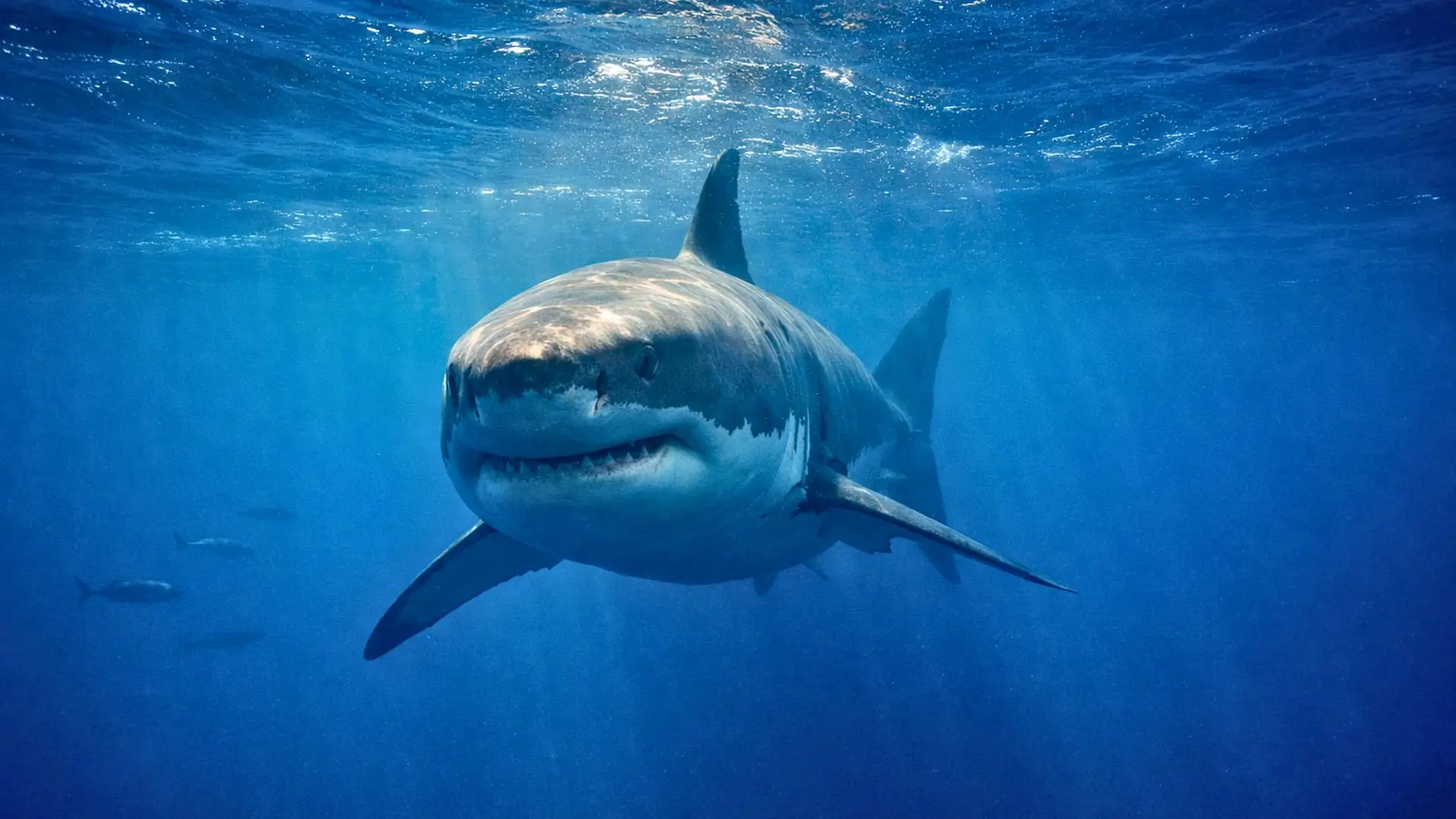
The great white shark has not disappeared from the Mediterranean. Yet it now glides under the scientists’ radar. Between environmental DNA, recent clues in Spain, and an Adriatic signal, the race is accelerating. It aims to protect a population on the brink of tipping.
In the Mediterranean, the great white shark still survives, but its extreme rarity hinders any monitoring
For a long time present throughout the basin, the great white shark is now declining sharply. The IUCN currently classifies it as Critically Endangered in the Mediterranean. Bycatch and fishing pressure have subsequently driven its abundance down to alarming levels.
The real puzzle then arises. Unlike along the coasts where the species clusters near seals, the Mediterranean offers no obvious gathering point. As a result, teams seek a diffuse presence, mobile, seasonal, and often invisible to the naked eye.
In the Sicilian Channel, four DNA traces have renewed the search for a nearly elusive predator
To locate it, Francesco Ferretti’s team scaled up their approach. They collected seawater samples, installed cameras, and used bait. This method combines direct observation with environmental DNA, capable of revealing an animal that is absent from view.
Between 2021 and 2023, expeditions focused on four sites in the Sicilian Channel. The researchers collected 159 water samples there. They then deployed hours of baited video to monitor the species crossing this area.
The results are modest, but meaningful. The scientists did not see a living great white shark. However, they detected its DNA at four sites. This repeated signal makes the Sicilian Channel one of the most credible refuges for the population.
From Croatia to Spain, recent clues rekindle the hypothesis of key zones across the basin
Work is no longer limited to the Sicilian Channel. In 2025, a study showed that a juvenile great white shark captured in Croatia in 2023 had deceived the initial measurements. This case reopens the idea of a nursery zone in the Adriatic.
Early 2026, another study confirmed a presence still very rare in the Spanish waters of the Mediterranean. For biologists, these scattered signals sketch a clear picture. The species persists, but survives as a ghost population.
Protecting the species now requires sustainable monitoring, local cooperation and genuinely enforceable rules at sea
The next step is no longer just about searching. These sharks must be tracked over several years, seasons compared, and areas cross-referenced. Moreover, distribution models are already being used to target sectors where sustainable monitoring can truly work.
This strategy also passes through the fishermen. When they report a catch, release a living animal, or transmit a usable photo, they become essential. However, this cooperation requires simple rules, training, and a credible economic framework to prevent illegal sales.
The final message remains stark. Researchers now know where to look, but they still lack direct observations. In the meantime, every lethal capture weighs more in an already tiny population. Finally, saving this predator also means defending the marine balance that you cannot see.

Contact details
Address:
Farmers Forum,
36, Dominick Street,
Mullingar,
Co. Westmeath,
Ireland
Phone:
+353 (0)44 9310206
Or email us:
For technical issues please check out our FAQ's page or email - [email protected]
For general Queries email - [email protected]
Request to add event to our Calendar - [email protected]
Send us your mart reports - [email protected]
Suggestions and feedbacks - [email protected]
News Items / Press Release - [email protected]
To Advertise on Farmers Forum - [email protected]