
The market for mosquito-trap stations has exploded, but the evidence is far from it
Between a €550 unit and a €1,700 unit, the price gap exceeds €1,100. The technology gap, meanwhile, boils down to three elements: an olfactory attractant, CO₂, and an intake/suction fan. All market stations rely on this same trio. What changes is the CO₂ flow rate, the precision of control, the manufacturing quality, and, to a large extent, the marketing budget.
This second part of the dossier reviews all brands available in France in 2026: Qista, Biogents, Wiliv, Ma Boîte à Moustique, Mosquito Magnet, Thermacell, with observed prices, consumable costs over a full season, published field-test results, and cases where purchasing makes no sense. The first part, devoted to natural and free solutions, remains the prerequisite: no station makes up for a garden full of larval breeding sites.
What ANSES Says Before You Reach for Your Card
A mandatory starting point, and rarely cited by sellers. ANSES has issued an opinion on the effectiveness of trapping adult mosquitoes as part of vector control. Its conclusions are nuanced, and deserve reading before any purchase.
What the agency validates: some traps can contribute to significantly reducing populations of mosquitoes of the Aedes genus, over periods from several weeks to several years, under strict conditions — regular maintenance, sufficient trap density across the area, and combination with elimination of larval breeding sites.
What the agency does not validate: effectiveness in reducing viral transmission is not demonstrated. The effectiveness of most commercially marketed models is not documented. And above all, ANSES considers claims of “zero nuisance” to be abusive due to lack of scientific proof. It recommends requiring market authorization for these devices — an authorization that no consumer-grade trap currently holds.
Practical takeaway: a well-chosen and well-placed station reduces nuisance. It does not eliminate it. The models promising 90% fewer mosquitoes refer to results obtained under optimal conditions, often with several traps deployed at neighborhood scale, not in a single garden.
How a CO₂ Mosquito Trap Really Works
The female mosquito locates its target in three steps. At long range, she detects the plume of CO₂ exhaled by a mammal up to about 30 meters away. At medium range, she sharpens the signal with sweat compounds: lactic acid, ammonia, fatty acids. At short range, she uses body heat and vision.
A trap reproduces the first two signals. It emits CO₂, usually from a food-grade gas bottle, and an olfactory lure that mimics human skin odor. The mosquito approaches, enters the suction stream of a fan, and gets trapped in a net where it dehydrates in a few hours.
Two consequences that product sheets gloss over. First, a trap attracts mosquitoes: if poorly placed, it draws more toward your terrace. It is set 5 to 10 meters from the living area, between the garden and you, never beside the table. Second, the effect is not immediate: expect three to six weeks to observe a reduction in nuisance, the time needed to break a full reproduction cycle.
The Big CO₂ Trap Comparison Available in France
| Model | Observed price | Advertised area | CO₂ | Noise | Control | Manufacturing |
|---|---|---|---|---|---|---|
| Biogents AERO TRAP PLUS | 429 to 449 € | 700 m² | Bottle 425 g / 5 kg / 10 kg | 37 dB at 5 m | Bluetooth, MyBiogents app | Germany |
| Qista One XS | 548,80 € (PPC 598,80 €) | Radius 60 m | Qista CO₂ bottle | 48,6 dB at 8 m | Bluetooth + app | France (Aix-en-Provence) |
| Mosquito Magnet Pioneer | 799 € | Up to 3 000 m² | Generated by butane catalysis | Not disclosed | None | United States / Favex distribution |
| Wiliv Willo | 849 to 878 € | 300 m² | 5 kg bottle | 35 dB at 3 m | Bluetooth, Wiliv app | France |
| Qista One | 988,69 € | Radius 60 m | Qista CO₂ bottle | 45 dB at 10 m | WiFi + web app | France |
| Ma Boîte à Moustique | 1 260 to 1 448 € | 750 m² | 10 kg bottle, flow 0.2 or 0.4 L/min | Not disclosed | Bluetooth, rain and heat sensors | 100% France |
| Qista BAM Visio+ (pro / collectivités) | 1 296 € HT et + | Radius 60 m | 10 kg bottle | ~55 dB | WiFi, capture counting | France |
| Mosquito Magnet Executive | 1 699 € | Large surfaces | Catalysis of butane | Not disclosed | LCD screen, battery operation | United States |
A note on advertised areas: all correspond to measurements on flat, open ground, with no wind. A hedge, a wall, or a slope reduces the real range by half or more. The “up to 11,300 m²” displayed by Qista corresponds to a perfect 60-meter radius disk, something no private garden matches.
The Brands, One by One
Qista — the most visible French brand
Developed by Techno Bam in Aix-en-Provence, Qista is the brand that has put the word “station” into the French vocabulary, with deployments in municipalities and tourist sites. Its MosqiVortex suction system is patented, and the brand claims “nearly 90% nuisance reduction.”
The Qista One XS at €548.80 is the entry point: 55 × 19.5 × 39 cm, 4.27 kg, 14.9 W consumption, 230 V power, Bluetooth control, 2-year warranty, parts made in France. It’s the most compact station in the comparison, and the easiest to visually integrate on a terrace.
The Qista One at €988.69 steps up the range: 82.5 × 52 × 32.3 cm for 16 kg, WiFi instead of Bluetooth — a real advantage for controlling the unit without being beside it — and a silent mode. The announced noise is 45 dB at 10 meters.
The watch-out point is consumables: the olfactory lure cartridges (the “Qartouches”) and the CO₂ are proprietary, which locks in supply and makes operating costs less predictable than Biogents’. An independent comparison also notes a higher noise level and pricier attractants than the competition on the Visio+ professional model.
→ Qista One XS on the official site · Qista One — not sold on Amazon.
Biogents — the scientific benchmark, and the best value for money
Biogents is a German company born from the University of Regensburg’s research, active since 2002, with more than 200,000 traps sold. It is the only brand in the comparison whose effectiveness rests on scientific publications: Englbrecht et al. (2015) measured an 87% reduction in bite pressure from Aedes albopictus on equipped sites. Honest caveat often omitted: this result was obtained with seven to eight traps deployed at the scale of a neighborhood, not with a single trap in a garden.
The 2026 range was refreshed on March 31 with two models:
- AERO TRAP, €199 (observed €139.90), 300 m², without CO₂, Biogents SWEETSCENT attractant only. The brand positions it as the most effective CO₂-free trap on the market.
- AERO TRAP PLUS, €449 (observed €429), 700 m², with integrated CO₂ kit. Biogents claims up to five times more captures with CO₂ activated.
A field test published over nine cumulative weeks provides measured figures rather than advertised ones: more than 800 mosquitoes captured in total, about 10 to 15 per day without CO₂, about 20 per day with. The doubling is real, the claimed fivefold factor is not in an isolated garden. Measured electricity consumption is 3.8 to 4.4 W depending on the model—three to four times less than a Qista One XS—and the noise measured at 37 dB at 5 meters.
The previous model, the BG-Mosquitaire at €184 (often found around €139 to €150), remains distributed and works very well. Its flaw is aesthetics: it’s a fabric bag stretched over a frame, light-years from the design of a Qista.
Finally, the BG-GAT at €69.90 for a pack of two is not a station but a passive ponding trap, without electricity. It does not capture blood-seeking females; it captures those coming to lay eggs and thus breaks the reproduction cycle. It’s a supplement, not a substitute, but at this price, it’s the best entry point on the market.
→ BG-Mosquitaire + CO₂ kit on Amazon · BG-Mosquitaire alone · BG-GAT2, pack of 2 · Biogents France shop for the AERO TRAP.
Wiliv Willo — French design
The Willo is the most refined in terms of industrial design: epoxy metal body, 74.7 × 39.7 × 22.7 cm, 11 kg, programmable LED lighting, 35 dB at 3 meters—the most discreet model in the comparison. Made in France, 2-year warranty, Bluetooth control via the Wiliv app.
The trade-off lies in autonomy. The Willo runs on 5 kg CO₂ bottles only, equating to two to three weeks of autonomy for six to eight hours a day. Attractant refills last fifteen days. Over a five-month season, that means many trips to the wine shop and many refills.
Another limit: 300 m² advertised coverage for €849-878, versus 700 m² for an AERO TRAP PLUS at €429. Here you pay for French manufacturing and design, not for performance.
→ Willo at Protecthome · Wiliv range at Antimoustic — not distributed on Amazon.
Ma Boîte à Moustique — the most documented in real-world conditions
This is the unit for which we have the best field data, thanks to a nine-week consecutive test. The numbers speak for themselves: 3,327 mosquitoes captured in nine weeks, i.e., 52 per day on average, including about 75% tiger mosquitoes. The ramp-up is clear between weeks without CO₂ (183 then 239 captures) and weeks with CO₂ at 0.2 or 0.4 L/min (up to 520 captures in a week).
Technically, the unit is 100% made in France, houses two vertical fans, four nets, rain and heat detectors that automatically adjust the flow, and integrates the 10 kg bottle into the cabinet. The stated autonomy is seven weeks per bottle, the best in the comparison.
The tester’s notes, and they count: the suction cones get dirty every two to three days and require regular cleaning; control is Bluetooth only, not WiFi, which forces stepping outside to adjust settings; CO₂ flow rates could have been higher; and there is no fine scheduling. The price, between €1,260 and €1,448, places the unit out of reach for most private gardens.
→ Ma Boîte à Moustique at Protecthome · official brand site — not distributed on Amazon.
Mosquito Magnet — the American veteran, for very large spaces
Mosquito Magnet operates differently from all the others: the unit does not consume CO₂ from a bottle; it produces it by catalyzing a standard butane bottle. Direct consequence: no need to source food-grade CO₂, a camping gas bottle suffices.
The Pioneer at €799 claims up to 3,000 m² of coverage—the widest in the comparison—and uses the attractants R-Octenol and Atrakta Lurex. The Executive at €1,699 adds an LCD screen and, importantly, battery operation, which makes it the only model installable far from any electrical outlet: along a field, at a campsite, a rental, or a farm operation.
The downsides are well known: no connectivity, no remote control, a large footprint, and a line that has shrunk; the older Defender, Liberty, Independence, and Patriot models are no longer produced, which raises questions about parts availability in the medium term. Last point: R-Octenol appears more effective on Culex and mosquitoes from wetlands than on tiger mosquitoes, which are not its primary target.
→ Mosquito Magnet Pioneer on Amazon · Executive on battery · Atrakta refills.
The Real Seasonal Cost — the calculation no one makes
The purchase price is only half the story. A CO₂ trap consumes attractant, gas, and electricity, five to seven months a year. Here is the estimate for a full season from April to October, under regular use.
| Model | Attractant / season | CO₂ / season | Electricity | Estimated annual cost |
|---|---|---|---|---|
| Biogents AERO TRAP (without CO₂) | €52.90 (6-month pack) | — | ~4 W, about €4 | ~€57 |
| Biogents BG-GAT (passive) | Water + tablet, a few € | — | None | ~€10 |
| Biogents AERO TRAP PLUS | €52.90 | 5 kg bottle: €85 deposit then €29.50 refill — 3 to 4 refills | ~4.5 W, ~€5 | ~€150 to €180 |
| Qista One XS | Qista proprietary lure cartridges | Qista proprietary CO₂ | 14.9 W, ~€15 | ~€200 to €300 |
| Wiliv Willo | 15-day refills: 10 to 12 refills | 5 kg bottle every 2-3 weeks | ~€10 | ~€250 to €350 |
| Ma Boîte à Moustique | ~€20 every 2 months, i.e., ~€70 | 10 kg bottle every 7 weeks, 4 refills | ~€15 | ~€250 to €300 |
| Mosquito Magnet Pioneer | R-Octenol / Atrakta: ~€60 to €100 | Commercial butane: ~€60 to €80 | ~€10 | ~€150 to €200 |
Over three years, a Qista One XS comes to roughly €1,200 to €1,450 all-inclusive, an AERO TRAP PLUS around €900, and a simple AERO TRAP without CO₂ around €310. This is the calculation to consider before comparing purchase prices.
One last logistical detail, never mentioned in product sheets: finding exchangeable food-grade CO₂ bottles is not easy everywhere. In rural areas, that could mean thirty kilometers to the nearest wine shop or authorized distributor, five to six times per season. The Mosquito Magnet, which runs on supermarket butane, has a real practical advantage here.
CO₂-free technical solutions
Zone Repellence: Thermacell
A wholly different approach. Thermacell does not trap anything: the device heats a pad impregnated with metofluthrin, a synthetic pyrethroid, and creates a repellent zone of 20 to 29 m² around it. The effect is almost immediate, with no smoke or noticeable odor.
It is the best answer for a punctual, mobile need: a meal on the terrace, an evening by the pool, a bivouac, a fishing session. It has nothing to do with fighting a population; the unit reduces the number of mosquitoes, Thermacell keeps them at bay for two hours.
Limitations: wind ruins the effect, protection ends at the boundary of the zone, and refills must be bought continuously. It remains essentially an airborne insecticide, requiring outdoor use away from young children.
→ Thermacell Protect 29 m², rechargeable · Patio 20 m² diffuser · 48 h refills.
Indoor Traps
For a bedroom or living room, compact suction traps honestly work well for small volumes. The Biogents BG-Home combines attractant and UV light for about 40 m². The Hexa Favex Hexasafe, around €60, plays in the same category. They are nighttime comfort devices, far from a garden station.
→ Biogents BG-Home on Amazon.
What to avoid in the “high-tech” section
Photocatalysis traps sold for €30–€80 promise to generate CO₂ from a titanium dioxide coating exposed to UV. The reaction is real in the laboratory; the amounts produced are minuscule compared to what a human exhales. In practice, these devices mostly catch gnats.
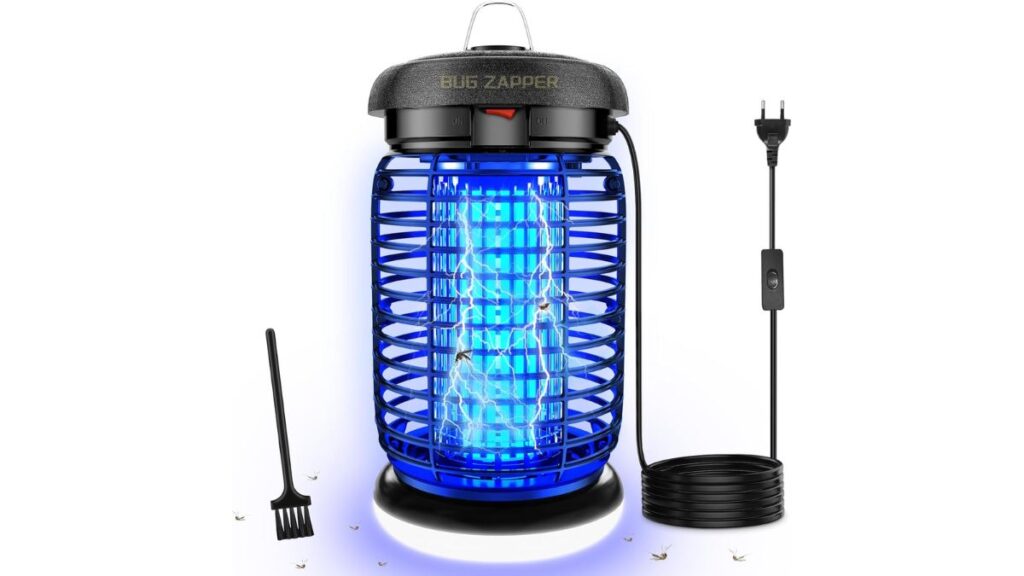
UV discharge lamps—the blue “murder-insects” devices—do not attract mosquitoes, which are not phototactic, but they wipe out moths and beneficial garden insects. Ultrasonic boxes and bracelets appear on the explicit list of products with no proven efficacy by the DGCCRF.
Which trap for which garden, which region
| Your situation | Recommendation | Budget |
|---|---|---|
| City garden or townhouse < 300 m², Île-de-France, first approach | BG-GAT in a pack of 2, then AERO TRAP if insufficient | 70 to 200 € |
| Garden 300 to 700 m², high pressure, long season (PACA, Occitanie) | AERO TRAP PLUS — best efficiency/price in the comparison | 429 € + ~€150/year |
| Visible terrace, aesthetic requirement, compact garden | Qista One XS or Wiliv Willo | 549 to 878 € |
| Large property > 1 500 m², no design constraints | Mosquito Magnet Pioneer | 799 € + ~€180/year |
| Land without electricity, farm, isolated gîte | Mosquito Magnet Executive (battery) | 1 699 € |
| Open budget, desire data on captures and control | Ma Boîte à Moustique | 1 260 to 1 448 € |
| Camargue, Mediterranean coast, salt marshes | No trap. Aedes caspius travel several kilometers: nets, repellents, occasional Thermacell | 50 to 150 € |
| Rhine valley, flood-prone Loire or Saône valleys | No trap. Aedes vexans flies several kilometers; nuisance comes in waves after floods | 50 to 150 € |
| Breton, Normandy, North — nocturnal Culex nuisance | First use mosquito nets; a trap is rarely justified at this pressure level | <€< 100 |
| Occasional need: meals, pool, camping | Thermacell | €40 to €90 |
| Overseas, active arbovirus zone | Personal protection and impregnated nets prioritized, per ARS guidelines | Variable |
Installing a Trap Correctly — the Five Rules
- 5 to 10 meters from the living area, never next to the table. The trap attracts mosquitoes: it should intercept them before you, not bring them toward you.
- In shade and sheltered from wind. Direct sun degrades the attractant in a few days and wind disperses the CO₂ plume that underpins the attraction strategy.
- Close to mosquitoes’ resting zones: dense hedges, woodland, damp spots, north-facing walls. That’s where they spend the day.
- Operating continuously, not only in the evening. The tiger mosquito bites during the day, with peaks in the morning and late afternoon. A trap left on from 7 p.m. to 11 p.m. misses most of the active population.
- Properly maintained. Nets emptied weekly, suction cones cleaned regularly every two to three days on some models, attractants replaced on schedule. ANSES makes regular maintenance an explicit condition of effectiveness, and it’s the first failure point seen among disappointed users.
Who It’s a Good Buy For, and Who Should Avoid It
The ideal profile. A garden owner of 300 to 1,000 m² in an urban or peri-urban area infested by tiger mosquitoes, who has already eliminated larval breeding sites on their property, who accepts weekly maintenance and an operating cost of €150–€300 per year, and who aims for a reduction in nuisance rather than elimination.
The profile that can work with caveats. A resident of a development where neighbors do not participate. A single trap will work, but it will spend its time catching mosquitoes produced by others. The yield will be lower, and the investment is mainly justified if nuisance makes the garden unusable. Deploying several traps across an entire development drastically changes the math—that’s the only scenario in which Biogents’ 87% was measured.
The profile for whom it’s a bad choice. Anyone living in marsh or floodplain mosquito zones. In Camargue, the Petite Camargue, the Rhine delta, or the Loire’s floodplains, biting mosquitoes are born kilometers away and arrive by the thousands, carried by the wind. A €1,000 unit would conscientiously capture only a few hundred individuals out of tens of thousands. It’s money wasted. The answer in these territories is collective and falls to public mosquito-control operators.
Frequently Asked Questions
Is a mosquito trap really effective?
Partially. ANSES recognizes that some traps can significantly reduce populations of Aedes, provided there is regular maintenance, a sufficient number of traps, and parallel elimination of larval breeding sites. The agency, however, deems claims of “zero nuisance” to be misleading and notes that no evidence shows an effect on viral transmission.
What is the best mosquito trap in 2026?
The Biogents AERO TRAP PLUS, €429–€449 for 700 m², offers the best efficiency-to-price: it’s the only brand backed by a published scientific study, with the lowest electricity consumption in the comparison and non-proprietary consumables. Qista, Willo, and Ma Boîte à Moustique justify themselves on design, French manufacturing, and control.
How much does a mosquito trap cost per year in consumables?
From €57 per year for a Biogents AERO TRAP without CO₂ to about €350 for a Wiliv Willo, including attractant, CO₂ refills, and electricity. Expect €150–€180 per year for an AERO TRAP PLUS and €200–€300 for a Qista One XS. This operating budget often exceeds the purchase price over three years.
Should you choose a trap with CO₂ or without CO₂?
CO₂ roughly doubles the captures in real conditions, from around 10–15 to 20 mosquitoes per day in field tests, but adds €100–€250 of annual consumables and a bottle re-supply constraint. For a small garden well cleared of larval breeding sites, a non-CO₂ trap is usually sufficient.
How long does it take to see the effect of a mosquito trap?
Count on three to six weeks. A trap captures adult females before they lay eggs: the effect becomes noticeable once a full reproductive cycle has been broken. A nuisance drop in the first week is exceptional or weather-related.
Where should you place a mosquito trap in a garden?
5 to 10 meters from the living zone, in shade, wind-protected, and preferably near the mosquitoes’ resting areas: dense hedges, undergrowth, damp spots. Placing it next to the table lures mosquitoes toward the guests rather than intercepting them upstream.
Does a mosquito trap work against marsh mosquitoes?
No. Aedes caspius, detritus, and vexans disperse over several kilometers, up to fifty with the wind. A garden trap captures nothing from such a flux. In Camargue, along the Mediterranean coast, or in floodplain valleys, physical protection and repellents remain the only individual responses.
Verdict and Scores
| Criterion | Score | Justification | |
|---|---|---|---|
| Real effectiveness of CO₂ traps | 3.5 / 5 | Captures are real up to 52 mosquitoes per day on one model and nuisance reduction is noticeable after a few weeks. But ANSES validates no eradication promises, and the 87% results were achieved at neighborhood scale, not in a garden. | |
| Market value-for-money | 2.5 / 5 | A €1,100 gap between entry and high end for the same technology. Biogents lifts the category; models above €1,000 mainly charge for design and local manufacturing. | |
| Operating cost | 2 / 5 | The real downside. From €57 to €350 per year, with sometimes proprietary consumables and unpredictable CO₂ bottle logistics at purchase. | |
| Ease of use | 3 / 5 | Setup is simple, but maintenance is burdensome: nets to empty weekly, suction cones to clean every 2–3 days on some models. Bluetooth apps require stepping outside for any adjustment. | |
| Durability and reliability | 3.5 / 5 | Two-year warranties across brands, French manufacturing at Qista, Wiliv, Ma Boîte à Moustique, academic research at Biogents. The discontinuation of several Mosquito Magnet lines raises questions about spare parts availability. |
Recommended if you live in an urban or peri-urban area infested by tiger mosquitoes, you have already removed larval habitats, your garden is between 300 and 1,000 m², and you accept weekly maintenance for a nuisance reduction of around 50–70% at most. In this scenario, a Biogents AERO TRAP PLUS at €429 remains the most rational market choice in 2026, and a BG-GAT at €70 is the best real-world test before spending more.
Not recommended if you live in marsh or floodplain zones, if you expect results in a few days, if no one will empty the nets each week, or if you hope a single device will compensate for a garden full of water-filled cups. In these four cases, money is better spent on mosquito nets and a good repellent—the topic of the first part of this dossier.
There remains a market reality that isn’t openly stated: in Île-de-France, in 2026, no individual solution makes a garden completely mosquito-free. The best results come from stacking layers: larval-grotten sites removed, larvicide on what cannot be emptied, nets on openings, a well-placed trap, and a repellent for evenings. Each measure alone disappoints. Put together, they make a usable terrace.

Contact details
Address:
Farmers Forum,
36, Dominick Street,
Mullingar,
Co. Westmeath,
Ireland
Phone:
+353 (0)44 9310206
Or email us:
For technical issues please check out our FAQ's page or email - [email protected]
For general Queries email - [email protected]
Request to add event to our Calendar - [email protected]
Send us your mart reports - [email protected]
Suggestions and feedbacks - [email protected]
News Items / Press Release - [email protected]
To Advertise on Farmers Forum - [email protected]