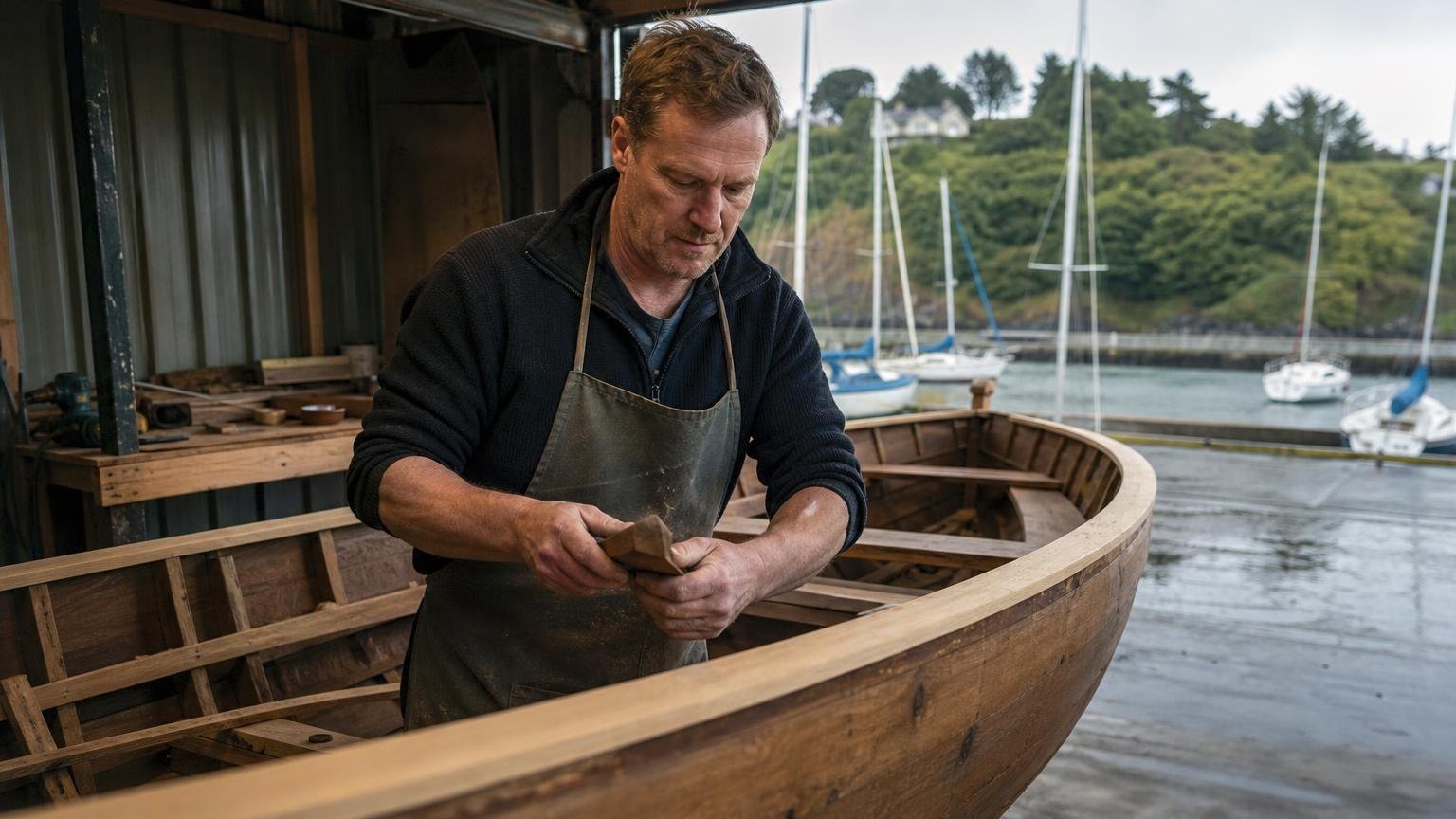
He traded spreadsheets for steam-bent oak, and the change still feels like a small miracle. At forty-four, he quit a quiet office in Dungarvan and found himself cradling planks under a grey Irish sky, listening to gulls and the steady lap of the tide. Now his world is a shed on the quay, a place of sawdust, salt air, and the kind of work that leaves your hands stained but your mind clear.
He calls himself a beginner every day, though customers bring him thermoses and gossip like old friends. “I don’t miss Monday meetings,” he jokes, “but I do miss lunch that doesn’t taste like pine tar.” Then he smiles, because the smell of pine tar is now a homecoming.
The Leap at Forty-Four
The decision arrived quietly, like fog rolling over the bay. One January morning he added up columns, stared at the sum, and realised the deficit was time. “I wasn’t afraid of failing,” he says, “but I was afraid of not trying.”
He sold the suit that fit like a calculation and bought a plane that fit like faith. Night classes in Waterford, weekends with a mentor who taught him to read grain the way auditors read footnotes. “You’re not just shaping wood,” the mentor said, “you’re shaping patience.”
Learning the Grain and the Tide
Boats taught him a language older than invoices. Oak bends only when heat and timing are right; larch sings under the spokeshave if your wrist learns its music. He learned to let the tide set his hours, to clamp at the turn of light when the air is kind to glue.
He keeps a small list in his pocket, creased and oily, to remind himself how to proceed:
- Measure twice with humility, cut once with courage
“Every curve is a conversation,” he says. “The hull tells you where it wants to go, and you listen with your fingertips.”
A Shed That Breathes Salt
The shed is a lean-to of corrugated iron, patched with old campaign posters and hinged by pure stubbornness. Inside, a kettle wheezes on a Primus, and a battered radio murmurs trad tunes through static and sawdust.
Racks of larch, coils of hemp, tins of linseed and Stockholm tar line the wall like a small pharmacy for wood. Planes sleep in order, chisels in a roll of cracked leather. “Everything has a home,” he says, “except the cat, who claims the warmest offcut.”
On clear days the door stands open and the bay throws in a briny breeze. On rough ones the roof ticks with rain, and he works by the lamp, steady, patient, unhurried as a tide returning.
Clients, Community, and Craft
His first commission was a dinghy for a teacher who’d just retired. They christened it with tea and biscuits, the Irish way, and he watched it float like a promise finally kept. Word spread along the quay, across counters of hardware shops, through the quicksilver routes of pubs.
Now he builds and mends: a clinker pram, a gaff-rigged daysailer, the ribs of a currach that had cracked in a storm. “You make a boat and you meet a family,” he says. “You mend a plank and you repair a little piece of memory.”
He prices work with old accountant habits—clear estimates, fair terms, small margins, and a ledger that’s still neat as prayer. But he insists on time, because wood keeps its own calendar. “You can rush paper, not fibres,” he says, tapping a board like a barometer.
What Numbers Still Teach
Spreadsheets didn’t abandon him; they simply changed purpose. He tracks moisture and weight, lead times and glue ratios, keeping charts that look like weather to anyone else. “Numbers are anchors,” he says. “They hold you while you learn to sail.”
He budgets for mistakes, as any honest craftsperson must. When a scarf joint didn’t marry, he absorbed the cost and cut another, mumbling sums under his breath until the curve felt true. “Good accounting is ethics,” he tells apprentices. “Good building is the same.”
Winds for the Future
He dreams of a fleet of small Irish boats stitched to the shoreline like beads on a string, each one carrying a whisper of the past into a patient future. He wants to teach teenagers to plane a fair line, to square a transom without squaring their joy.
There’s a waiting list now, pencilled on the door, names smudged by rain and grit. He moves through them like a tide, steady, certain, grateful. “I thought this would be hard,” he says, running a thumb along a newly oiled gunwale, “and it is. But the hard parts are the parts that shine.”
At dusk he sweeps the floor, hangs the clamps like sleeping birds, and steps onto the quay with resin on his cuffs. The bay is pewter, the gulls are loud, the air tastes of salt and slow decisions done right.
He locks the door, pockets the key, and turns toward home, shoulders looser than any office evening. Tomorrow there will be more planes to sharpen, more ribs to steam, more chances to earn a small hard beauty from stubborn Irish wood.
And if the weather holds, he’ll launch a little boat by noon, watch it find its water, and feel that quiet old sum resolve again: cost on one side, meaning on the other, balanced like a keel on a still bay.

Contact details
Address:
Farmers Forum,
36, Dominick Street,
Mullingar,
Co. Westmeath,
Ireland
Phone:
+353 (0)44 9310206
Or email us:
For technical issues please check out our FAQ's page or email - [email protected]
For general Queries email - [email protected]
Request to add event to our Calendar - [email protected]
Send us your mart reports - [email protected]
Suggestions and feedbacks - [email protected]
News Items / Press Release - [email protected]
To Advertise on Farmers Forum - [email protected]