
A little over one and a half centuries ago, the renowned British naturalist Charles Darwin proposed that certain members of a plant group comprising about 450 species were carnivorous. Recent experiments have now confirmed this.
An hypothesis dating back to the 19th century
To be officially regarded as a carnivorous plant, a species must possess adaptations that allow it to attract, capture, and digest its prey, and then absorb the resulting nutrients. At the heart of a multitude of studies stands the famous Venus flytrap, Dionaea muscipula.
In 1875, sixteen years after he had detailed his theory of natural selection in his work On the Origin of Species, Darwin spoke of his fascination with two species of the genus Saxifraga, known for trapping insects and observed in the Arctic and Alpine regions of the Northern Hemisphere, as well as in the Andes.
Although humanity had not yet proven it in his lifetime, it is now established thanks to the work of Doug Soltis, from the University of Florida, and his colleagues. Published in Nature Communications, these studies focused on the species Saxifraga candelabrum, growing on the slopes of Mount Wufeng in Yunnan Province, China.
“Showing that Darwin had been right once again is both a lesson in humility and an incredible source of satisfaction,” the researcher exclaimed. “I like to think that he would have been thrilled by this discovery.”
Solid evidence of carnivory
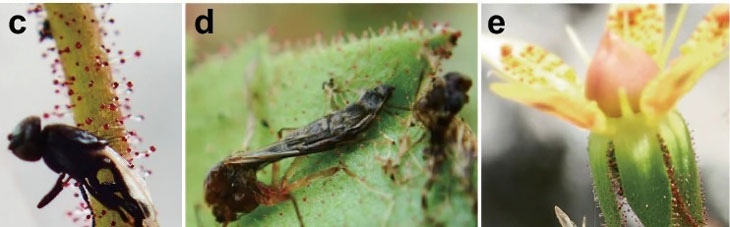
Over the past decades, botanists had reported that the sticky bristles covering the leaves of Saxifraga candelabrum trapped only small insects. “Mature plants carried on average more than 70 insects stuck to their surface, mainly species of midges,” explains Hang Sun, co-author of the new study.
The team set out to verify whether the secretions produced by the plant’s ciliated structures contained digestive enzymes capable of breaking down the prey, which indeed proved to be the case. In a subsequent step, isotopic tracers allowed them to confirm that the plant absorbed nutrients derived from the digestion of the insects.
Finally, genetic sequencing showed that Saxifraga shared with Drosera spatulata and Roridula gorgonias a set of genes involved in attracting prey, their digestion, and the assimilation of nutrients. “These genomic data confirm that S. candelabrum is a true carnivorous plant,” concludes Sun.
Earlier, researchers had shown that a small African plant, typically herbivorous in its diet, could become carnivorous.

Contact details
Address:
Farmers Forum,
36, Dominick Street,
Mullingar,
Co. Westmeath,
Ireland
Phone:
+353 (0)44 9310206
Or email us:
For technical issues please check out our FAQ's page or email - [email protected]
For general Queries email - [email protected]
Request to add event to our Calendar - [email protected]
Send us your mart reports - [email protected]
Suggestions and feedbacks - [email protected]
News Items / Press Release - [email protected]
To Advertise on Farmers Forum - [email protected]