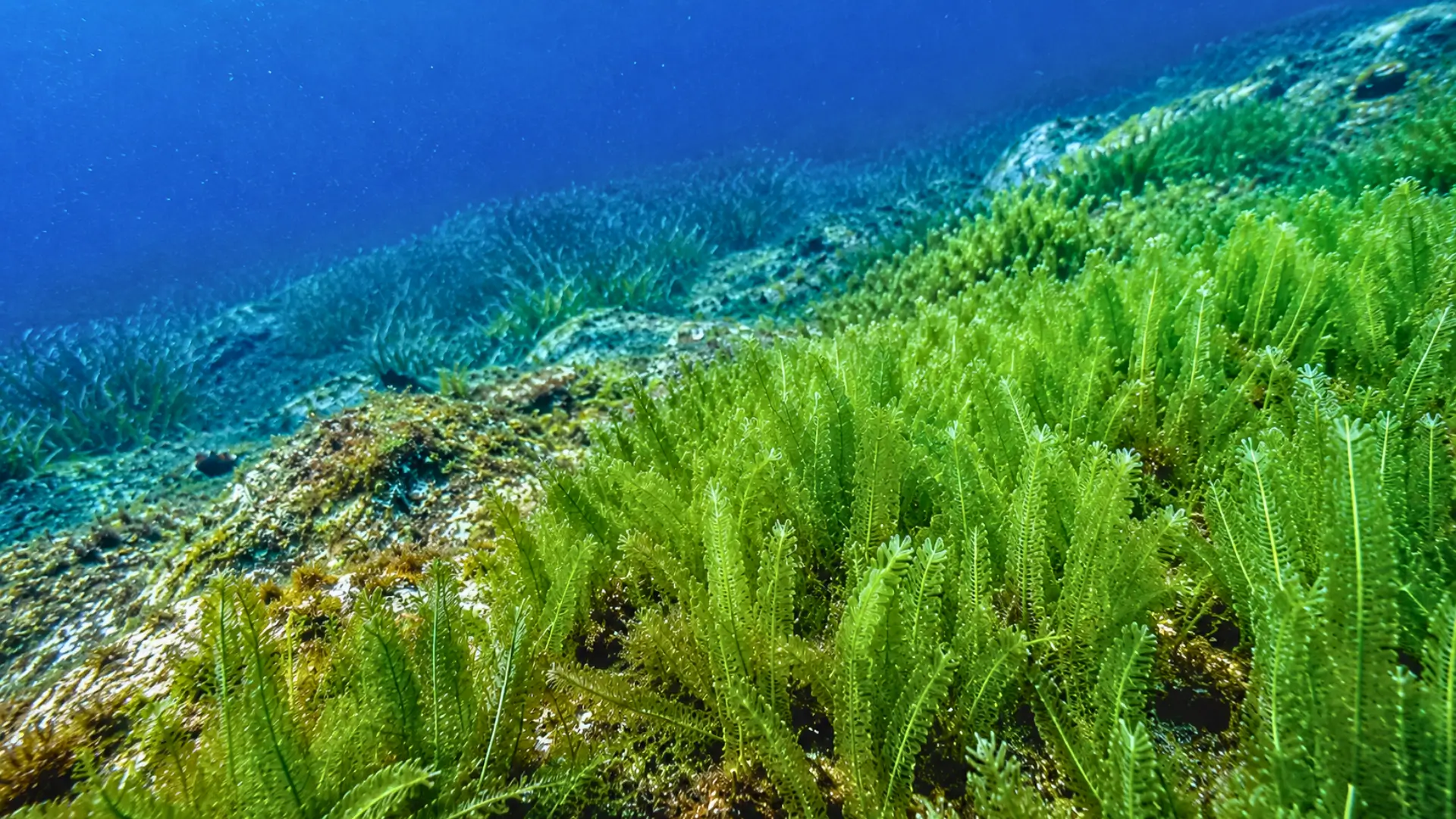
Could a tiny patch of green algae spotted near Monaco in 1984 really become a Mediterranean invasion? In just a few years, Caulerpa taxifolia spread across thousands of hectares, disrupted local herbivores, and offered scientists a spectacular ecological case study.
In 1984, a strange green patch appears right at the foot of the Monaco Oceanographic Museum
It all began almost quietly. In 1984, near the Monaco Oceanographic Museum, divers spotted a tropical alga on roughly one square meter of seabed. Caulerpa taxifolia already lives in aquariums, where its vivid green and rapid growth make it a popular decorative plant.
The investigation then took a scientific turn. Molecular analyses revealed a direct link between the Mediterranean population and aquarium strains cultivated in Western Europe. The hypothesis of an accidental release near Monaco became plausible, even if no one observed precisely the algae’s entry into the sea.
A simple alga becomes, in a few years, a formidable machine for colonizing the seabed
The key lies in its ability to reproduce. Caulerpa taxifolia regrows from small fragments, which facilitates its spread. Currents, anchors, and human activities readily transport these pieces, which then give rise to new carpets. The pace of its advance surprised scientists with its speed.
By the end of 2000, surveys estimated about 131 square kilometers of seabed colonized, spread across more than a hundred sites and nearly 191 kilometers of Mediterranean coastline. France, Italy, Spain, Croatia and Tunisia then observed the arrival of its green fronds. The media spoke of a “killer alga.” The term exaggerates, but the impact remained real: a tiny introduction became, in a few years, a major Mediterranean phenomenon.
Its most effective weapon isn’t its growth rate, but what it contains
In a marine ecosystem, an abundant alga typically serves as food for many herbivores. Caulerpa taxifolia changes the rule. It produces, notably, caulerpenyne, a compound that deters several species from consuming it. Urchins, for example, graze it very little.
Without grazing pressure, the alga quickly occupies the available space. It then competes with local species. Researchers study mainly its effects on the Posidonia oceanica meadows, essential to Mediterranean biodiversity. Results vary by area, complicating the overall assessment of its impact.
For years, teams tried to curb its spread. They uprooted colonies, tested physical methods and sometimes chemical ones. But every fragment left behind triggers regrowth. On a large scale, complete eradication becomes almost impossible, even if some early interventions succeed locally.
The unexpected retreat of a biological invasion long deemed uncontrollable
A surprising change then unsettles researchers. After a peak around 2007, several areas show a sharp decline in the invasive alga. The exact causes remain debated, between environmental conditions, biological competition, and the fragility of certain populations.
The story does not end there. The Mediterranean remains vulnerable to exotic species. Other Caulerpa species continue to be under active surveillance. In 2025, reports still appear along the French Mediterranean coast, evidence that the phenomenon continues to evolve.
This story reminds us of a simple yet disturbing reality: a tiny introduction can transform an ecosystem for decades. In a sea subjected to warming and increasing human exchanges, the question remains open. Which species will write the next silent invasion beneath the surface?

Contact details
Address:
Farmers Forum,
36, Dominick Street,
Mullingar,
Co. Westmeath,
Ireland
Phone:
+353 (0)44 9310206
Or email us:
For technical issues please check out our FAQ's page or email - [email protected]
For general Queries email - [email protected]
Request to add event to our Calendar - [email protected]
Send us your mart reports - [email protected]
Suggestions and feedbacks - [email protected]
News Items / Press Release - [email protected]
To Advertise on Farmers Forum - [email protected]