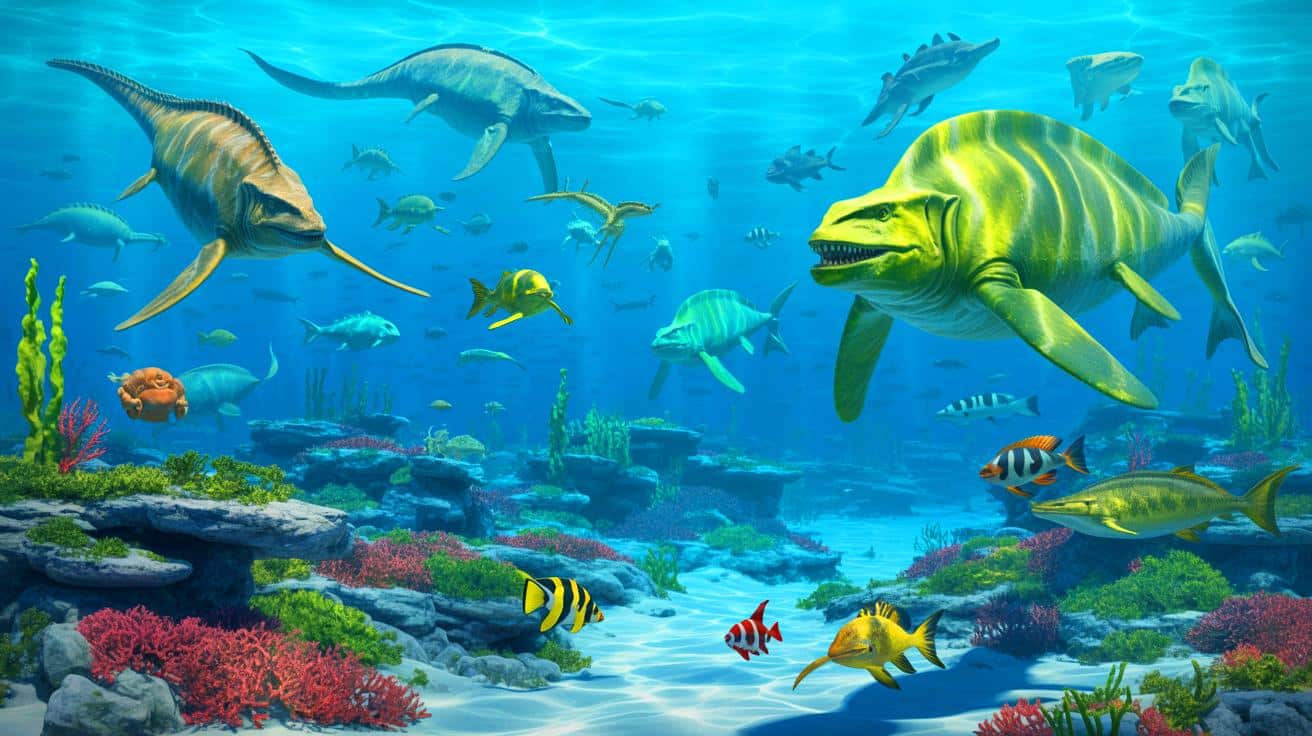
The recent study of a fossil layer found in the cliffs of Spitzberg has revealed fascinating insights into the regenerative capacity of marine ecosystems following a mass extinction. This discovery, dated to 249 million years ago, challenges existing assumptions about how quickly marine life could rebound after the end-Permian biological crisis. Paleontologists have illuminated a rapid renaissance process, offering new perspectives on a crucial period in Earth’s history. This article explores the implications of these findings and their significance for our understanding of biological crises.
A biodiversity in a hostile environment
During the Early Triassic, the high latitudes of Spitzberg were bathed in cold waters, creating an environment unfriendly to faunal diversity. However, excavations revealed surprising biodiversity, with varied predators occupying different ecological niches. The excavation methodology, strictly organized, allowed the preservation of fragile clues such as fish scales and coprolites. These clues were essential for reconstructing the trophic relationships of this ancient ecosystem.
Among the major discoveries, there is evidence of ichthyosaurs of varying sizes, some exceeding 5 meters, cohabiting with archosauromorphs and various amphibian species. This coexistence reveals an ecological complexity unsuspected for that era. The data show that these marine predators occupied diverse ecological roles, challenging the established theories about the simplicity of post-crisis ecosystems.
For 3,800 years, a discovery reveals a terrifying change in the mountains: scientific revolution underway
Implications for understanding biological crises
The precise dating of the Spitzberg fossil site, located only 3 million years after the Permian-Triassic extinction, challenges traditional models that suggested marine recovery over a much longer period. This finding suggests a rapid reconstruction of marine ecosystems, prompting scientists to reassess the adaptability of marine vertebrates to new environments.
The Spitzberg site, among the most diverse of the Early Triassic, indicates that marine reptiles may have originated earlier than expected. This concentration of fossils in a single geological level provides unprecedented insight into recolonization mechanisms after an environmental crisis. Understanding these dynamics can help us anticipate ecological responses to perturbations currently facing the world.
“The truth is being kept from us”: this mystery about Venus’s crowns will shock you (and it’s closer than you think)
To go further: what was the Permian-Triassic extinction?
The Permian-Triassic extinction, behind us 252 million years ago, remains the most devastating biological crisis in Earth’s history. About 95% of marine species and 70% of terrestrial vertebrates disappeared. The main identified cause is intense volcanic activity in Siberia, releasing greenhouse gases and triggering a warming climate. This phenomenon caused drastic changes in the oceans, notably through acidification and deoxygenation.
The coral reefs suffered particularly, and many invertebrate lineages disappeared. Although ecosystem recovery took millions of years, the recent Spitzberg discoveries show that the revival of marine life began much faster than previously thought.
Do tomatoes really come from America? “Impossible!” exclaims a French historian in astonishment
The role of current discoveries in our understanding
The research conducted at Spitzberg offers a valuable glimpse into the resilience capacities of marine ecosystems after a biological catastrophe. By reevaluating the speed and nature of post-crisis recovery, scientists can refine predictive models for contemporary ecosystems facing similar threats. This enhanced understanding of resilience mechanisms could inform conservation and ecological restoration strategies in the context of current climate change.
By studying these past events, we can better grasp the environmental challenges our planet faces today. How might these lessons from geological history influence our future actions to protect marine and terrestrial biodiversity?

Contact details
Address:
Farmers Forum,
36, Dominick Street,
Mullingar,
Co. Westmeath,
Ireland
Phone:
+353 (0)44 9310206
Or email us:
For technical issues please check out our FAQ's page or email - [email protected]
For general Queries email - [email protected]
Request to add event to our Calendar - [email protected]
Send us your mart reports - [email protected]
Suggestions and feedbacks - [email protected]
News Items / Press Release - [email protected]
To Advertise on Farmers Forum - [email protected]