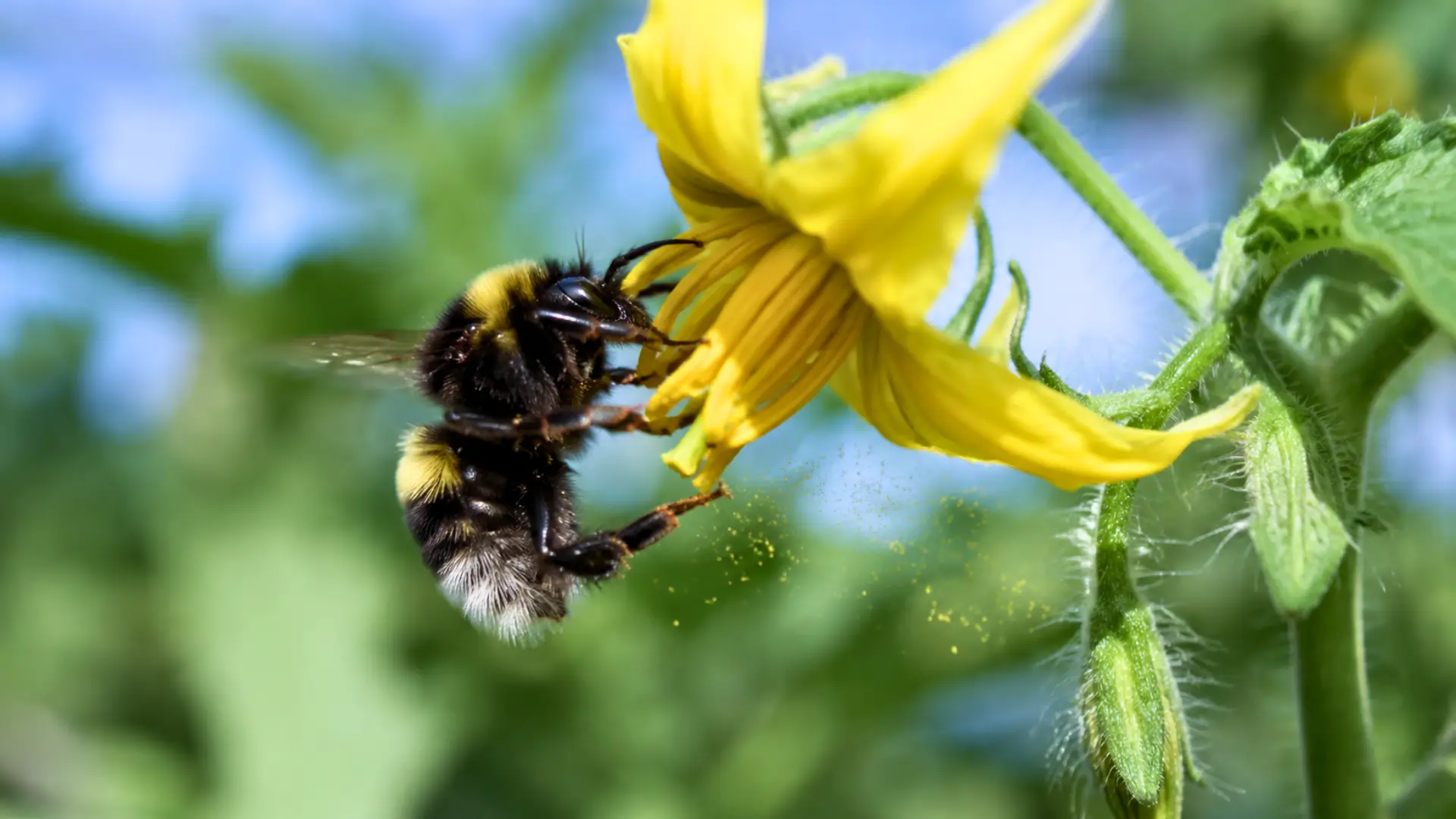
A bee perched on a flower does not always buzz off to depart. In certain plants, it turns its thorax into a true biological vibrator to dislodge pollen that is almost locked in. But how can mere fractions of a second of vibration open this plant’s vault?
Some flowers hide their pollen behind a lock that not all bees can unlock
In a typical flower, pollen might seem readily accessible. Yet, in a portion of flowering plants, the anthers resemble tiny salt shakers: pollen can escape only through microscopic pores. Shaking them becomes far more effective than merely brushing against them. Botanists refer to these as poricidal anthers.
That is where buzz pollination, or floral sonication, comes into play. Some bees seize the stamens and shake them violently. More surprisingly still, not all bees are capable of doing this. The domestic honey bee, Apis mellifera, does not practice this technique, unlike bumblebees and various solitary bees.
Clinging to the anther, the bee suddenly turns its thorax into a powerful vibrator
The scene lasts only a few moments. The bee bites or grips the anther with its mandibles, positions itself against the flower, and then activates its flight muscles without beating its wings in the usual way. Its thorax begins to tremble rapidly, directly transferring mechanical energy to the pollen-laden stamens.
These floral vibrations can reach several hundred hertz. Measurements across 27 species observed frequencies below 400 Hz, typically higher than those associated with flight. But frequency alone does not govern everything: displacement, speed, acceleration, and the duration of the buzz also influence how much pollen is extracted.
Inside the anther, the pollen grains slam into each other before escaping
What happens inside is hard to film: anthers are tiny, opaque, and traversed by extremely rapid vibrations. A study published in 2025 therefore created a three-dimensional simulation of tomato anthers from micro-CT images to virtually track the movements of thousands of pollen grains.
The result resembles a tiny biological flipper. The grains strike the walls, but they also collide with one another, exchanging energy before some reach the opening. The models show that increasing frequency and amplitude mainly facilitates expulsion, without producing a perfectly proportional rise. No magic button, then, but a surprisingly subtle mechanism.
From tomato to blueberry, this little “buzz” weighs directly on our harvests
This laboratory curiosity directly touches agriculture. Tomatoes, eggplants, and blueberries belong to crops where pollinator vibrations can play a decisive role. A broad scientific review notes that the cultivated plants involved particularly benefit from bees capable of sonicating, which gives bumblebees considerable agricultural importance.
The challenge becomes even more concrete under greenhouses, where pollination must be regular and predictable. Teams are now exploring assisted pollination solutions, ranging from vibrating devices to contactless systems using airflow to induce movement in tomato flowers. The goal is no longer merely to imitate a buzz, but to understand the physics behind it.
One lesson remains especially unexpected. The “buzz” heard in a vegetable garden may mask a mechanical negotiation between the insect’s body and the structure of a flower, refined through evolution. The more researchers pry into its gears, the more a question arises: how many other seemingly ordinary behaviors conceal physics just as sophisticated?

Contact details
Address:
Farmers Forum,
36, Dominick Street,
Mullingar,
Co. Westmeath,
Ireland
Phone:
+353 (0)44 9310206
Or email us:
For technical issues please check out our FAQ's page or email - [email protected]
For general Queries email - [email protected]
Request to add event to our Calendar - [email protected]
Send us your mart reports - [email protected]
Suggestions and feedbacks - [email protected]
News Items / Press Release - [email protected]
To Advertise on Farmers Forum - [email protected]