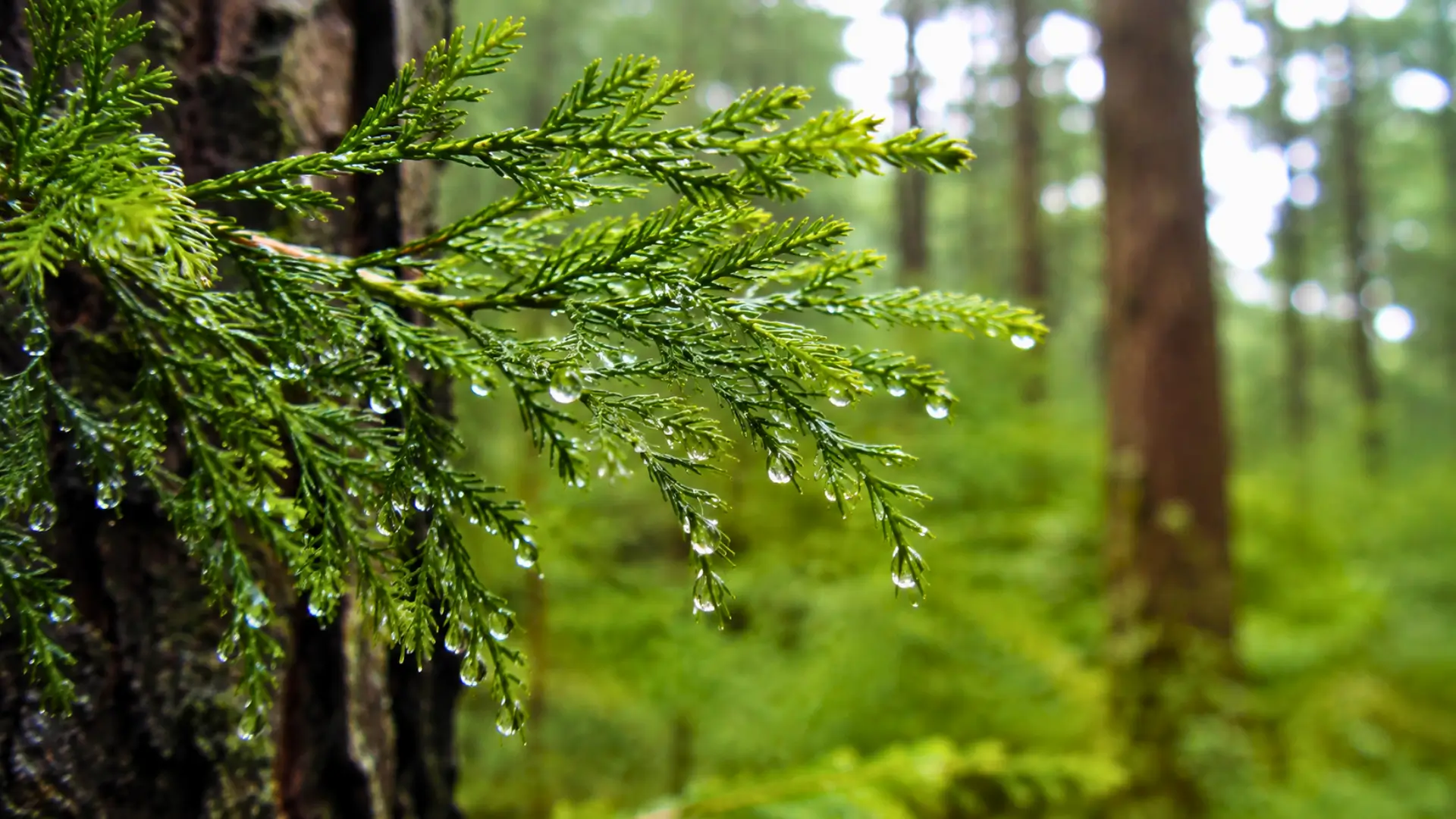
What if a leaf covered in dew was actually drinking? From coast redwoods to cultivated plants, scientists are discovering that water can enter directly through the foliage, overturning the classic image of a plant fed solely from the soil.
For decades, water seemed doomed to travel in only one direction
The pattern feels so familiar that it seems beyond question. Roots draw up water, vessels transport it skyward, and the leaves then shed a portion back into the atmosphere. Yet this one-way journey described in textbooks hides another, much more discreet circulation.
When fog, drizzle, or dew dampens the foliage, some plants can absorb this water directly. The phenomenon has a name—foliar absorption. A scientific synthesis published in New Phytologist indicates that it has been observed across nearly all major plant families studied and in many biomes.
In the coastal redwood forests of California, the figure is striking. A study published in Oecologia found that 80 % of the dominant species examined were capable of absorbing water through their leaves. After wetting, the leaf water content even rose by 2 to 11 %.
Under the dew drop lie several microscopic entryways
However, a leaf is not a sponge. Its waxy cuticle, far from being a passive barrier, protects against water loss. Yet this fortress does have passages. Depending on the species, water may enter via the stomata, traverse certain zones of the cuticle, or exploit specialized structures such as trichomes and hydathodes.
Once inside, other players take over. The aquaporins, proteins embedded in cell membranes, facilitate the movement of water. Studies have linked their activity to foliar absorption in some species. The visible drop, detectable to the naked eye, thus triggers, at the microscopic level, an entire hydraulic mechanism.
In the redwoods, some leaves appear almost specialized to “drink”
The coastal redwoods hold another surprise. Researchers at UC Davis showed that they possess two distinct leaf types serving different functions. The peripheral leaves primarily handle photosynthesis, while axial leaves are much more efficient at absorbing water deposited on the tree.
The efficiency can become spectacular when scaled to a giant. The researchers estimate that a large redwood could absorb up to 14 gallons, or about 53 liters, during the first hour when its foliage remains wet. With more than a hundred million leaves on some individuals, the canopy becomes a colossal surface for collection.
The fog offers a second advantage as well. By humidifying the air and reducing evaporative demand, it limits water losses to transpiration. In other words, water saved can count as much as water directly absorbed. In forests with dry summers, a few hours of mist can thus profoundly alter the hydric balance of plants.
A discovery that could also change the way we observe our crops
This capacity does not concern only extraordinary trees. Recent research is now turning attention to agricultural plants. In wheat, stomata remain partially open at night, and this nocturnal conductance can reach 18 % of the diurnal stomatal losses. Oxygen-18 experiments also show that water deposited at night can penetrate into the leaves.
The thread becomes especially intriguing with rising droughts. Understanding which plants most effectively capture dew and fog could help in selecting more resilient crops. Yet this strategy itself depends on atmospheric humidity. A question thus emerges: what happens to plants that know how to drink the sky when the sky no longer offers enough water?

Contact details
Address:
Farmers Forum,
36, Dominick Street,
Mullingar,
Co. Westmeath,
Ireland
Phone:
+353 (0)44 9310206
Or email us:
For technical issues please check out our FAQ's page or email - [email protected]
For general Queries email - [email protected]
Request to add event to our Calendar - [email protected]
Send us your mart reports - [email protected]
Suggestions and feedbacks - [email protected]
News Items / Press Release - [email protected]
To Advertise on Farmers Forum - [email protected]