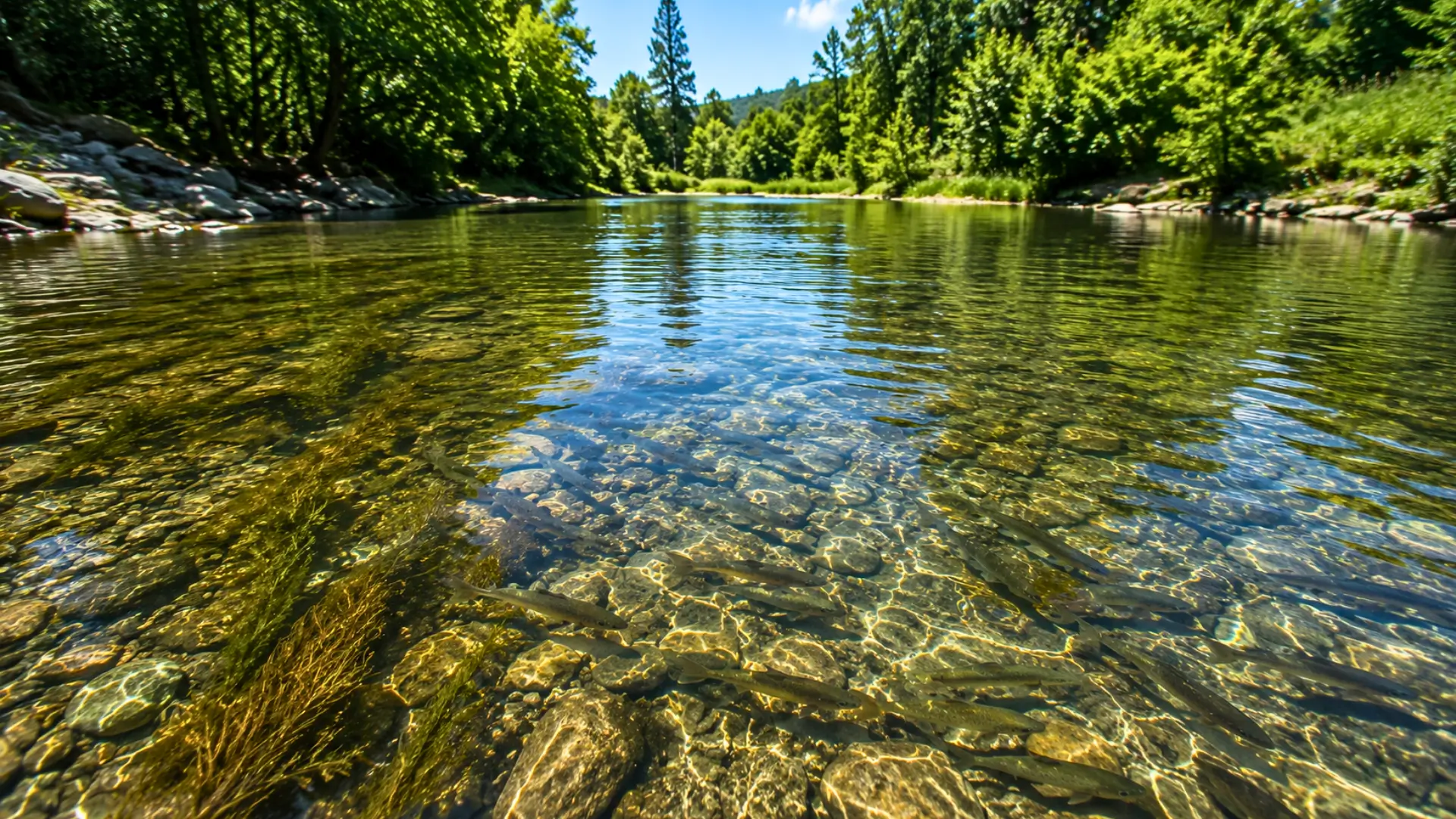
Why do some fish seem to seek air at the surface when the heat settles in? Behind this worrying scene lies a formidable paradox: the hotter a river becomes, the less oxygen it can hold, even as its inhabitants crave more of it.
When fish rise to the surface, the problem isn’t always pollution
On a scorching afternoon, the scene can be surprising: fish hover near the surface, gills quivering, mouths open. The first instinct is often to suspect pollution. Yet this strange agitation can reveal a far more subtle phenomenon: a lack of dissolved oxygen, worsened by water that has grown too warm.
For obviously, fish do not breathe the water molecules themselves. Their gills extract the oxygen dissolved in the water around them, supplied notably by exchanges with the atmosphere and aquatic photosynthesis. When its concentration drops sharply, the organism must work harder to recover each available breath. The USGS notes that these minima regularly occur in summer.
A simple physical law gradually turns warm water into a breathing trap
The mechanism begins with a fairly ordinary property of water: as its temperature rises, it can hold less dissolved gas. The American Environmental Protection Agency (EPA) confirms that high temperatures directly reduce the solubility of oxygen. A cool river therefore naturally holds an advantage that a overheated river progressively loses.
The image of a heated pot helps to understand. Even before boiling, small bubbles appear on the walls: some dissolved gases slowly escape the liquid. In a river, the phenomenon is less spectacular, but the same physics is at work. To this are added flow rate, turbulence, vegetation, light and biological activity.
And this is no longer merely a local curiosity. A study published in 2026 in Science Advances, summarized by Nature, analyzed more than 20,000 river courses via satellite. The result: roughly 78.8% show a trend toward deoxygenation. On a global scale, the phenomenon thus becomes difficult to regard as exceptional.
The cruel summer paradox: less oxygen available, but more is needed
For fish, heat triggers a kind of physiological squeeze. The water supplies less oxygen, while their metabolism, dependent on external temperature, speeds up. They must then sustain their vital functions in an environment where breathing becomes more costly. Some species adapted to cold waters are particularly vulnerable when these episodes persist.
The situation resembles strenuous physical effort performed in a room gradually deprived of air. A fish can quicken its branchial movements, move to a cooler zone or seek out breezier, well-ventilated areas. But those refuges are not always accessible. When oxygen falls sufficiently, respiratory stress can give way to mass fish die-offs.
The warning is not new. In 2023, researchers from Penn State reconstructed the evolution of 796 rivers in the United States and Central Europe. Their study published in Nature Climate Change showed that 87% had warmed in four decades and that 70% had lost oxygen.
New studies reveal that rivers are changing faster than we imagined
More surprisingly, the authors calculated average rates of deoxygenation higher than those observed in the oceans and projected future acceleration reaching 1.6 to 2.5 times historical paces. Agricultural rivers were especially quick to lose their oxygen, while urban waterways exhibited the fastest warming.
The danger is not limited to fish. Low oxygen alters the chemistry of the water, can favor the mobilization of certain metals and disrupt biological balances. Temperature never acts alone: nutrients, organic matter, drought and low flows can reinforce the phenomenon until some areas become temporarily hostile to life.
Thus, when a river seems perfectly calm under an August sun, an invisible battle may be taking place beneath its surface. Fish do not merely need water that is clear; they need water that stays breathable. With hotter summers, preserving cool and shaded zones could become one of the major challenges for our waterways.

Contact details
Address:
Farmers Forum,
36, Dominick Street,
Mullingar,
Co. Westmeath,
Ireland
Phone:
+353 (0)44 9310206
Or email us:
For technical issues please check out our FAQ's page or email - [email protected]
For general Queries email - [email protected]
Request to add event to our Calendar - [email protected]
Send us your mart reports - [email protected]
Suggestions and feedbacks - [email protected]
News Items / Press Release - [email protected]
To Advertise on Farmers Forum - [email protected]