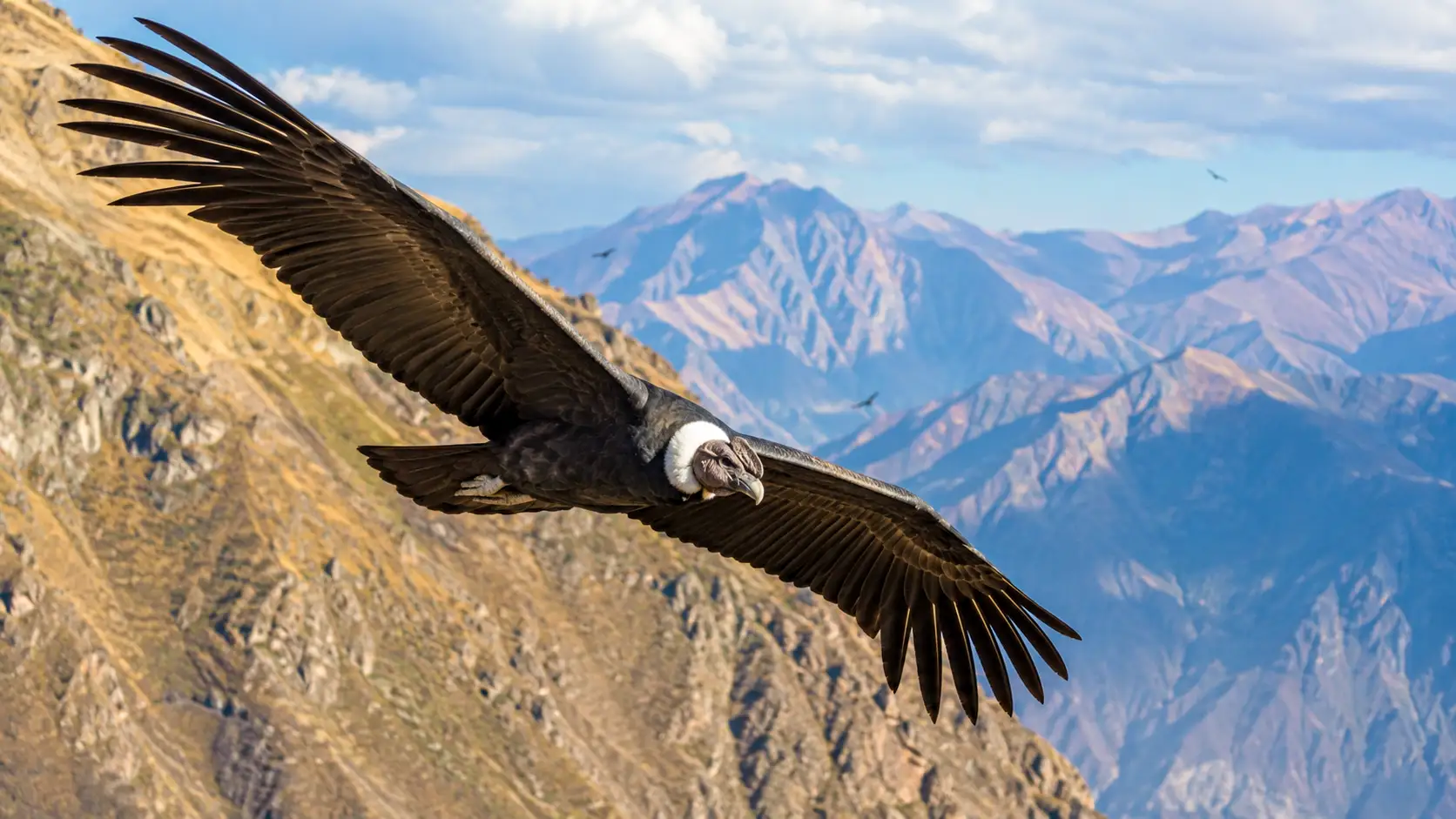
Sharing the skies proves highly advantageous for birds of prey. By carefully watching the routes of their flock, the Andean condor optimizes its daily journeys. Consequently, this aerial camaraderie helps them avoid a colossal physical toll in their search for food.
A daily, major physical challenge for these giants of the sky who must continuously adapt their trajectories
The Andean condor covers vast distances across the mountains on a daily basis. Indeed, this large bird is constantly seeking carcasses to feed on. Therefore, it must traverse rugged reliefs without exhausting its strength.
To conserve energy, the bird limits the flapping of its wings. As a result, it alternates between gliding and exploiting updrafts. These rising air masses allow it to gain altitude quickly.
However, the position of thermal currents constantly changes throughout the day. Moreover, resources remain highly dispersed in space. Finding the optimal route thus requires the raptor to adapt continuously.
Researchers develop a computer model to analyze collective navigation strategies
To better understand these flocks, German scientists have crafted a tailor-made computer model. This virtual tool simulates the birds’ exact behavior, taking into account their altitude, their speed, and the whims of the wind.
The study recently appeared in the Journal of the Royal Society Interface. The research team analyzes the use of social information. In other words, it compares solitary trajectories with flights adjusted thanks to the group.
A reduction of up to 41% in energy expenditure through collective spotting of the best air currents
Simulations reveal a clear advantage for group travel. Indeed, watching fellow birds helps quickly identify thermals. Thus, the birds avoid calm zones and save a substantial amount of physical effort.
Maximum efficiency occurs when individuals adopt a moderate risk approach. In the most unstable areas, this strategy reduces energy expenditures by 41%. Consequently, shared flight proves extremely cost-effective.
Therefore, this visual cooperation goes far beyond simply keeping the group together. It constitutes an essential survival mechanism for these birds. By contrast, an isolated individual tires much faster when facing headwinds.
Biological laws of shared flight that could refine the paths of drones and robots
This innovative model fuses the laws of aerodynamics with social behavior. Nevertheless, scientists do not want to stop at birds alone. They now plan to apply these equations to other animal species to validate their findings.
Moreover, these studies are of direct interest to the technology sector. In fact, this principle of information exchange could inspire the programming of autonomous drones. With this, these machines would consume far less energy during their missions.

Contact details
Address:
Farmers Forum,
36, Dominick Street,
Mullingar,
Co. Westmeath,
Ireland
Phone:
+353 (0)44 9310206
Or email us:
For technical issues please check out our FAQ's page or email - [email protected]
For general Queries email - [email protected]
Request to add event to our Calendar - [email protected]
Send us your mart reports - [email protected]
Suggestions and feedbacks - [email protected]
News Items / Press Release - [email protected]
To Advertise on Farmers Forum - [email protected]