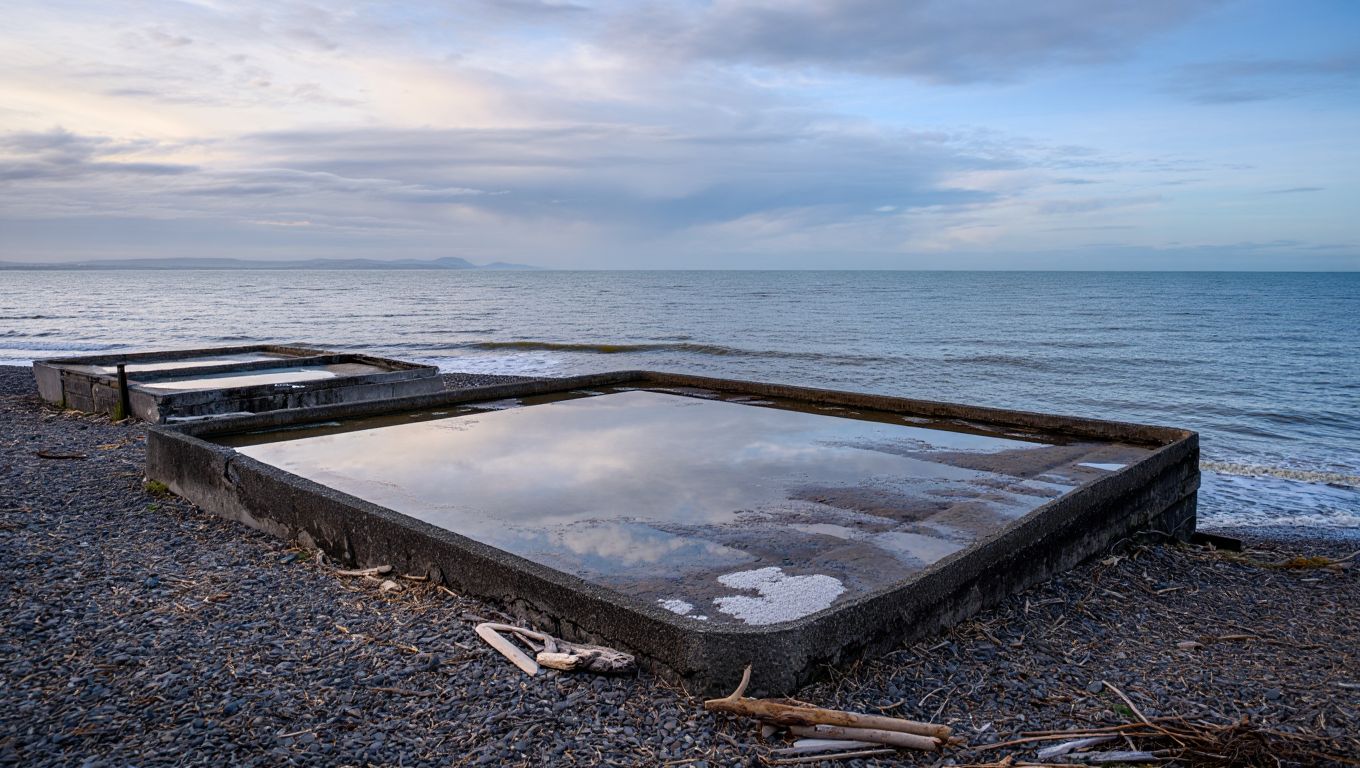
The shoreline faces east, and by September the light feels thinner, like a page worn at the edges. You can hear the wind pushing across the flats, a low scrape over the brine. Two shallow rectangles shimmer, last of their kind, and the people who tend them move in quiet arcs with long wooden rakes. “This is when we finish,” a caretaker says, “when the year folds itself down to the grain.”
A shoreline shaped by wind and patience
These pans sit close to the tide, low enough to taste the sea, high enough to avoid its temper. The banks are modest, tamped earth and stone, with skins that keep the salt from slipping back into the ground. Everything is simplicity by design, because the weather edits anything too clever.
The air does as much work as the sun here, carrying off moisture in gusts that feel like a blessing. On bright days, the surface tightens to a faint crust, then to petals of crystal that gather at the edges.
The rhythm of the season
Work starts in spring, when the pans are cleaned, seams checked, tools oiled. By late May, the brine is nursed to strength with quiet, repetitive care. The first rakes come in June, tentative and testing, and the best runs are the lean, windy weeks of high summer.
“By September, we’ve read the sky a thousand times,” a harvester says. “You don’t make salt here; you wait for it.”
What the pans actually do
Sea water is drawn in at high tide, then settled and concentrated as breeze and sun do their work. As the brine thickens, calcium and magnesium step out in layers, leaving a cleaner liquor for the final set. The rake’s job is not to stir, but to lift, coaxing the youngest flakes free without drowning the lot.
If you watch long enough, the method becomes monk-like. The sequence rarely changes, only the pace.
- Fill, settle, strengthen the brine; skim, test, and finally rake the set; drain, dry, and store the day’s crystals.
People of the rake
The crew is small, bound by tide tables and the kind of patience that can’t be taught in a book. One carries a notebook with salinity numbers and a pale string of weather notes. Another works by sound, listening for the rake’s faint scratch across the pan.
“We work by the tide, not the clock,” says an older hand. “If the wind goes soft, so do we. If it bucks, we lean in.”
Their calendars are built around emptiness and rush, mornings that stretch and afternoons that snap shut when a squall walks in off the sea.
Taste that maps the coast
The first flakes melt like a whisper, quick and bright, carrying a line of minerals that reads as clean, green edge. Later pulls feel more textured, small shingles that crackle under tooth, blooming into warm, marine sweetness. There’s a trace of iodine, a breath of samphire, a finish like wet stone.
Cooks come for the fidelity of it, that direct translation from coast to plate. “A pinch and you’re there,” a chef once told me. “You can hear the rake in the crunch.”
Weather, risk, and resolve
Everything here is a wager against weather. Rain unspools days of work in an hour, and an early gale can cap the season with the bluntest full stop. Warmer winters promise longer runs, then throw hard storms that overtop the banks.
The response is stubbornness tempered by prudence. Better drainage, tighter skins, more careful reads of the fronts. A few trial covers to keep a squall from ruining a week’s worth of set. “We won’t chase volume,” the caretaker says. “We chase clarity.”
When the year folds
Late September is a kind of reckoning. The brine cools faster, and every morning begins with a decision. You go in, or you don’t. You pull a last run, or you lock the gate and let the pans rest.
What’s kept is dried in a shallow room, air moving like a slow river across racks of faintly sparkling mounds. Bags are filled, labels inked, and the shed smells like clean, saline air after a storm. The tools are rinsed and hung, their handles going silver with salt and time.
How to visit, if you must
Curiosity is welcome if it comes with care. This is a workplace, not a museum, and every footprint has a cost. Keep to paths, ask before photos, and let the people with rakes keep their slow, exacting rhythm.
If you take some home, use it where texture matters: on grilled mackerel, new potatoes, a late tomato still warm from the sun. It doesn’t need tricks, only a plate that leaves room for place.
By dusk the shoreline goes quiet, and the pans turn mirrored, thin as breath. Another year steps back, and what remains is simple: wind, water, time, and a little human stubbornness that tastes like brightness on the tongue.

That was simply beautiful.