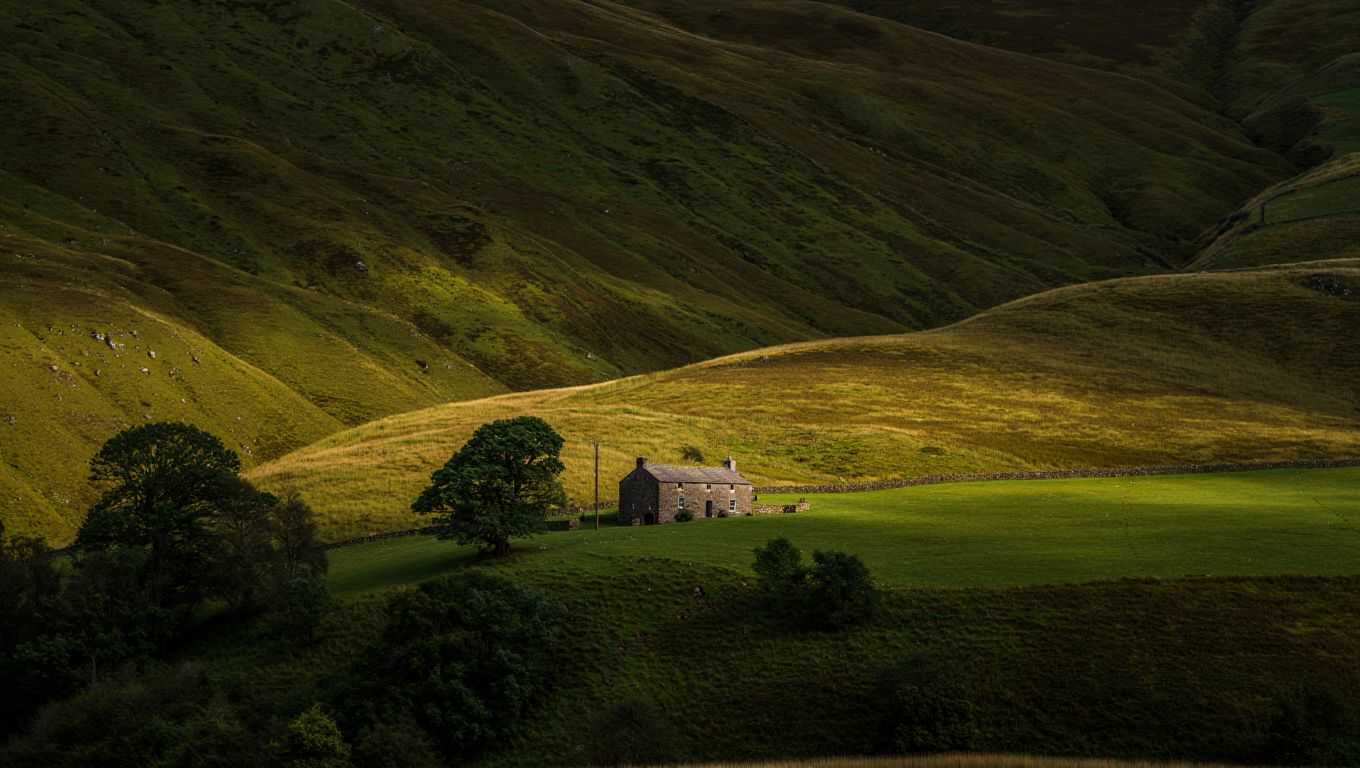
The first sight is gentle, almost Italian—low hills scalloped with hedgerows, stone walls stitched through grass, and farmhouses washed in soft light. A motorway hums within reach, yet the valley keeps its pulse slow, its air full of birds and the smell of hay.
You drive a few minutes, and the landscape widens, then whispers. A bend reveals an old mill, another a slate roof, another a tree dripping with lambs-ear leaves that seem to catch the sun and carry it all afternoon.
Light that tastes like olive oil
The light falls thick, almost edible, turning puddles into silver coins and barns into small museums of dust and grain. One farmer told me, “The fields aren’t green, they’re glossed, like a book you can re-read every day.”
Stone sits everywhere, useful, unshowy, and beautiful, with lintels that hold the year in their muscle and porches polished by boots. The houses don’t posture; they settle, the way a loaf settles after the oven lets it go.
A road that bends through time
History here isn’t a display; it’s terrain, folded into the paths your tires and boots actually use. A boy on a bicycle races past a Bronze Age story, and the wind writes the rest.
Newgrange rises like a bright thought, a white curve of quartz under a sky that can turn steel in a breath. Inside, the air is cool and grainy, and the guide says, “People have always waited for light,” and your shoulders feel smaller.
Up the road, Monasterboice keeps its dark script, crosses crowded with saints and knots and patient weather. At the Hill of Tara, sheep write their own glyphs across the grass, and you can feel your phone retreat.
Meals with meadow in them
Lunch tastes of distance measured in hedges, not miles, butter that behaves like custard and bread with a crackle like a log just catching fire. A cook in Slane said, “We fry in sun, not oil,” and everyone at the table nodded.
You’ll find beer that carries a small honeyed shadow, and ciders with a wet edge like bitten apples. Cheeses linger, nutty as old wood, and there’s a pudding with cream that feels stolen from a cloud.
Works of hand, not hurry
The craftwork is practical, the sort that keeps its promise even when nobody’s taking pictures. A potter shows mugs like pebbles, handles smoothed by a thousand tiny decisions.
A weaver speaks of sheen and shadow, of threads choosing each other the way neighbors decide to stay. “We make for use,” she says, “and if it’s lovely, that’s a good kind of accident.”
A small, elastic distance
This valley sits neatly off the motorway, a pocket of calm you can open with one turn, maybe two turns. Twenty minutes buys you space, and another twenty buys silence with birds stitching the gaps.
“People think quiet means nothing is happening,” a baker told me, kneading a stubborn dough until it learned to listen. “But quiet is just the room things need to become.”
A brief itinerary that breathes
- Dawn at the river, where mist braids into the willows and the water learns its own name again.
- Morning among stones, passing carvings with fingers you keep politely to yourself.
- Lunch in a small room where windows hold fields like paintings you might take home.
- An afternoon lane, hedges high and tidy, cow parsley lifting its little white novels to the sun.
- Evening in a pub with a sloping floor, music folding and unfolding like a weathered map.
How it feels to stay
Night settles easily, with one star, then fifty, then a sky so busy you forget to speak. The air moves like a shawl, and even the dogs sound softer when they decide to announce you.
In a farmhouse bedroom, the ceiling is low and honest, beams keeping their bark like a long-kept joke. You sleep inside a thick quiet, the kind that has texture, the kind that holds your dreams in place.
Not a replica, but a rhyme
The comparison to a certain Italian heartland is not a stunt, but a rhyme across latitude and taste. Both places prize patience, stone that warms by use, and hills with a measured stride.
Yet this valley keeps its own music, a lilt in the hedgerows and a wet glitter on the grass after rain. The accent is local, the humor dry as turf, the welcome unpracticed and real.
What lingers after you leave
You take away a light that knows how to be generous, and a map made of lanes you can’t quite forget. In your head, there’s a field with a gate, and the small click it makes when you close it.
“Come back when the barley is talking,” someone says as you fold your napkin and head for the car. The motorway returns with its purpose, but a part of you keeps the valley’s pace, and it keeps you company.

Lovely
I wish to live there at least for a week. Your brilliant writing will draw many to this place.Hope it remains the same
Regards,