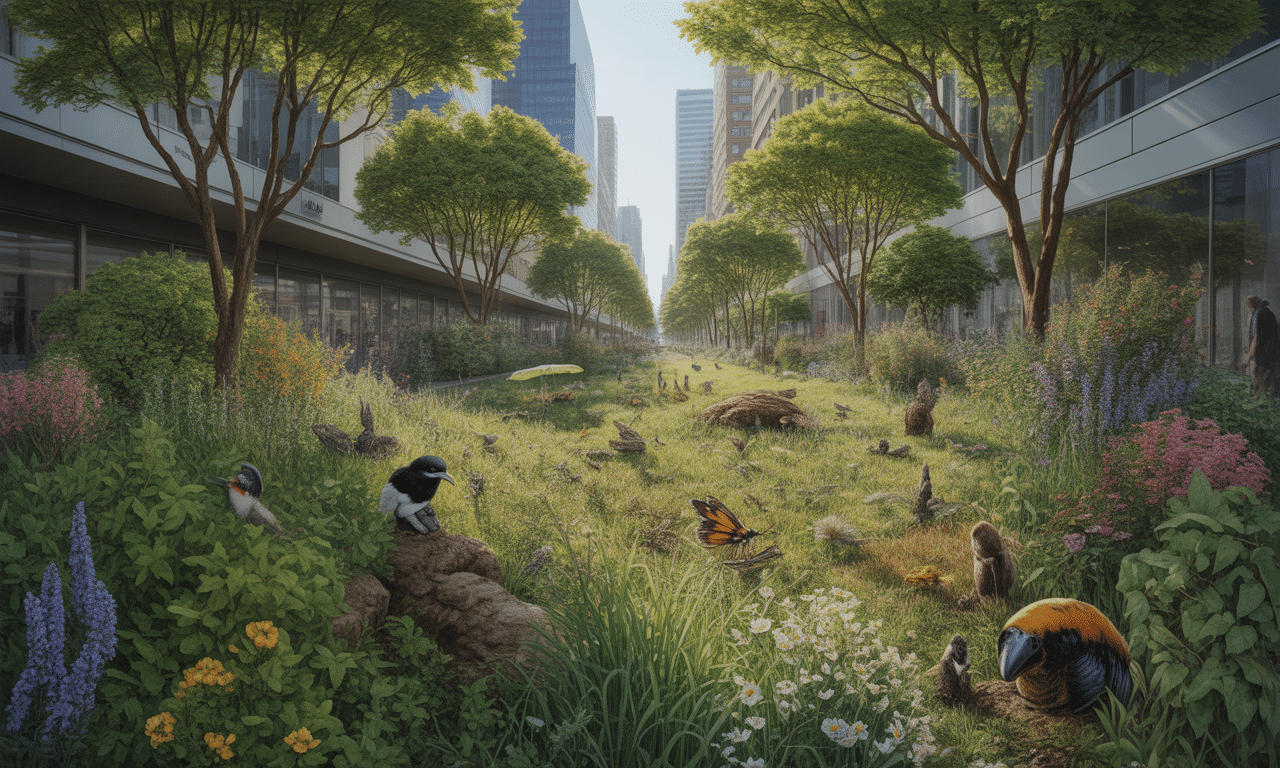
Preserving urban biodiversity is not a mere aesthetic luxury: it conditions the quality of life and the resilience of our cities. Considered as genuine ecosystems, urban areas host assemblies of species that are novel and whose dynamics are directly shaped by human activities. Parks, green roofs, and community gardens provide essential ecological services — local climate regulation, air filtration, pollination — while urban agriculture strengthens food autonomy and social bonds. Yet, these benefits are unevenly distributed: access to green spaces varies by neighborhood, revealing pronounced social inequalities. Threats such as light pollution or habitat fragmentation compromise the survival of nocturnal species and ecological connectivity. To respond, it is necessary to combine public policy, ecological engineering, and regenerative urbanism projects, bringing researchers and local stakeholders closer together. The question is no longer merely to protect nature in the city, but to reinvent the coexistence between living beings and urban spaces to ensure cities that are more sustainable and resilient.
Urban Biodiversity as an Essential Service
Biodiversity and quality of life are not merely peripheral concerns but levers for resilient cities. Fragmented natural areas and the populations of species that persist there generate tangible ecosystem services: thermal regulation, flood control, filtration of air and water, and pollination of urban crops. These services reduce infrastructure costs and improve public health by mitigating heat waves and air pollution. Ignoring this economic and social reality leads to planning decisions that are costly and less sustainable.
The value of these services is often underestimated because it does not appear directly in municipal balance sheets. Yet, restoring natural urban environments—whether green corridors, vegetated roofs, or vegetation-based hydraulic works—deeply alters the urban climate-related risk. Local initiatives in urban agriculture or micro-forests also contribute to food security and social cohesion. The benefits are multidimensional: ecological, economic, health-related, and symbolic.
The preservation of urban biodiversity must be regarded as a strategic public investment, not a budgetary constraint. Policies should incorporate a systemic evaluation of co-benefits: reductions in energy costs, mitigation of climate risks, improvement of well-being, and strengthening of social ties. Resources such as the Bank of Territories’ dossier on biodiversity in cities show how local actors can quantify and value these gains. Promoting the presence of living nature in urban projects is not an aesthetic luxury: it is an essential adaptation and prevention strategy for the sustainability of cities.
Urban Habitats and Their Little-Known Actors
Cities compose a mosaic of habitats: concrete or natural banks, roofs, façades, industrial wastelands, private gardens, small squares, and water networks. Each of these biotopes hosts assemblages of species often novel, adapted to urban constraints. Compacted soils, urban heat, and light pollution shape distinct communities that play precise functional roles. Seeing the city as its own ecosystem changes how we assess the impacts of development projects.
The carrying capacity of these biotopes varies greatly: a well-designed green roof can shelter rich flora and insect life, while a rehabilitated canal will sustain aquatic communities useful for water quality. Ecological engineering offers methods to strengthen these capacities: targeted rewilding, connectivity corridors, hydromorphological restoration. In parallel, biological innovations — such as micro-algae capable of treating polluted waters — open avenues to improve the quality of urban environments (example).
Mapping and analyzing these biotopes is essential to guide conservation and urban planning actions. The table below synthesizes the main types of urban biotopes, their characteristics, and the services they provide.
Access Inequalities and Ecological Justice
Access to green spaces and the services they provide is profoundly unequal. Some urban areas enjoy a dense network of parks and trees, while other neighborhoods, often more modest, suffer from a glaring deficit. These differences amplify social vulnerabilities to extreme temperatures, pollution, and climate risks. Ecological justice requires that urban nature not be a luxury reserved for a few privileged areas.
Urban planning sometimes tends to reproduce or deepen inequalities: densification without green compensation, concrete-dominated public spaces, restricted access to riverbanks. Participatory practices — community gardens, urban gardening leases, citizen workshops — help reverse this trend by redistributing access to natural benefits and strengthening social ties. Impact studies must incorporate socio-environmental criteria to prevent renaturation benefits from triggering uncontrolled gentrification.
Ensuring an equitable distribution of ecological commons is a political and technical responsibility. Local authorities have tools: ecological zoning, dedicated funds, targeted planting programs. Research also shows that involving residents from the design stage increases acceptance and the viability of projects. Case studies and experiences available on specialized platforms and engaged blogs, such as analyses on the importance of biodiversity in sustainable urban planning (reading), provide operational frameworks to reduce these inequalities. Acting equitably on urban nature means improving health, access to climate resilience, and the citywide social cohesion.
Public Policies, Management, and Innovations
Public policies must go beyond a simple green touch and adopt an integrated approach that combines environmental management, urban planning, and services. Effective strategies couple regulation, targeted subsidies, and nature-based approaches. Financial instruments and incentives can steer both private and public actors toward biodiversity-friendly practices. Substantial programs, such as large regional calls for proposals, demonstrate the potential of structural funding to multiply on-the-ground actions (funding example).
Communities now rely on recent scientific advances to set their priorities. The synthesis proposed by research teams, echoed by organizations like INRAE, clarifies possible trajectories: restoration of ecological connectivity, ecological engineering, adaptive management. Technological innovations — phyto-purification systems, pollutant-cleansing algae — complement traditional levers and open new options to improve water and soil quality (example).
We must couple scientific expertise with local governance to transform knowledge into operational policies. Territorial experiments, participatory observatories, and habitat contracts allow for adjusting ongoing actions. Moreover, communicating the benefits and training mayors and technicians strengthen the legitimacy and durability of choices. Relying on practical resources and field reports published on platforms like Hyssop (resource) or on-the-ground analyses facilitates turning ambitions into measurable results.
Toward Regenerative Urbanism and Sustainable Collaborations
Regenerative urbanism aims to transform the urban footprint into a positive dynamic: reestablish ecological continuity, recreate living soils, and promote efficient hydro-biological cycles. This approach requires real cooperation among researchers, public actors, and citizens to translate knowledge into actionable interventions. Transdisciplinary partnerships are the key to designing solutions that work ecologically and socially.
Innovative projects point the way: urban micro-forests, multifunctional corridors, integrated urban agriculture, and cooling street designs. The example of large-scale climate-controlled developments, though in a different context, highlights the importance of rethinking public space for comfort and resilience (Dubai case). At the same time, highlighting buried or little-known heritage can strengthen local ownership and interest in ecological preservation (cultural exhumation).
Implementing regenerative urbanism requires flexible institutional devices and innovative funding models. Projects must combine ecological ambition with social acceptability: co-design, small-scale experiments, iterative evaluation. Exchange platforms between territories and professional networks help accelerate the adoption of best practices, while circular economy and resource reuse initiatives strengthen sustainability. By placing biodiversity at the heart of planning decisions, the city becomes capable of generating rising ecological benefits, useful for both nature and residents. Sustainable collaborations are the engine of this necessary transformation.
Preserving Urban Biodiversity: Why It Is Essential
Preserving urban biodiversity is not an aesthetic option or accessory: it constitutes a cornerstone of city viability. Indeed, urban spaces function as real ecosystems where atypical habitats and assemblages of unique species come together. Ignoring this fact means neglecting the decisive role that human activities play in ecological dynamics and exposing city dwellers to direct consequences on quality of life.
Functionally, urban nature delivers essential ecosystem services: mitigating heat islands, filtering air and water, regulating hydrology, and pollinating urban crops. These benefits have tangible economic and health value, and preserving them reduces costs tied to artificial infrastructures. Consequently, integrating biodiversity into urban planning is as much a pragmatic calculation as an ethical one.
Biodiversity also enhances the climate resilience of territories. Diversified environments better withstand shocks — heat waves, floods, or invasive species — and facilitate cities’ adaptation to global changes. Strategies such as renaturation, ecological engineering, and the restoration of connectivity between habitats are concrete levers to strengthen this resilience.
Finally, social justice is inseparable from conservation: access to green spaces is unequal and conditions physical and mental well-being. Preserving and creating green corridors, supporting urban agriculture, and reducing light pollution are political choices that redistribute the benefits of nature. It is a collective responsibility involving researchers, public actors, and citizens to reconcile urban development with the protection of living beings.
FAQ — Why Urban Biodiversity Is Essential to Preserve
Q: What is meant by urban biodiversity and why should it be treated as a priority? R: Urban biodiversity encompasses all species — plants, animals, and microorganisms — that live in cities and their surrounding environments. The city is not merely a backdrop: it forms a specific ecosystem where novel species assemblages emerge and where human activities strongly steer ecological dynamics. Preserving this biodiversity is a priority because it guarantees essential ecological services (local climate regulation, air and water filtration, pollination) and supports residents’ quality of life. Q: How does urban biodiversity improve human well-being? R: Urban natural spaces — green spaces, gardens, vegetated roofs, micro-forests — reduce heat islands, improve air quality, offer resting places, and strengthen mental health. They also support beneficial practices like urban agriculture, which fosters food autonomy and social bonds. Arguing for biodiversity protection means defending a healthier and more resilient living environment in the face of climate shocks. Q: Why say cities are “ecosystems” and not just built environments? R: Cities present specific biotopes (streets, derelict lots, crafted waterways, roofs) capable of hosting life. These spaces face urban pressures yet also create new ecological niches and distinct biocenoses. Treating the city as an ecosystem allows integrating interactions between human and non-human actors into public policies and urban planning, and crafting responses adapted to real dynamics. Q: What are the main factors threatening biodiversity in urban settings? R: Major threats include soil artificialization, habitat fragmentation, pollution (air, water, noise), and light pollution that disrupts nocturnal cycles. Added to these are inequalities in access to natural spaces and planning choices that neglect nature. These factors reduce urban biotopes’ capacity to support diverse and functional biocenoses. Q: How do renaturation and green corridors address these challenges? R: Renaturation aims to reintroduce natural elements and ecological processes into the urban fabric: vegetation on roadways, creation of micro-forests, restoration of banks, green roofs and walls. Green corridors and the restoration of connectivity between habitats enable species movement, reduce population isolation, and increase ecological resilience. These measures demonstrate that biodiversity preservation can align with urban infrastructure and quality of life needs. Q: What public and technical strategies are effective for protecting biodiversity in cities? R: A combination of public policies, environmental management, and technological innovations is necessary: integrating biodiversity into urban plans, maintaining and creating accessible green spaces, reducing light pollution, practicing ecological soil and water management, and employing ecological engineering to restore habitats. Policies must combine regulation, incentives, and participatory governance to be effective and equitable. Q: What role do social inequalities play in access to nature in cities? R: Access to natural spaces is often unevenly distributed: disadvantaged neighborhoods have fewer quality green spaces, worsening vulnerabilities to heat and pollution. Addressing biodiversity without acknowledging these access inequalities risks reproducing injustices. A persuasive approach demands linking nature protection with social justice: the urban transition must guarantee fair access to the benefits of nature. Q: How can research better engage with city stakeholders? R: Advances in urban ecology show the value of co-constructing knowledge: researchers, municipalities, associations, and citizens must collaborate to define relevant objectives, co-produce indicators, and evaluate actions. This dialogue helps steer policies toward evidence-based interventions while considering local realities and social expectations. Q: Can urban biodiversity strengthen resilience to climate change? R: Yes. A diversified ecological network increases a city’s capacity to absorb and adapt to extreme events: green spaces cool the air, urban wetlands limit floods, and habitat networks improve the survival of useful species (pollinators, biological controllers). Protecting and restoring biodiversity is therefore an effective and cost-efficient climate adaptation strategy. Q: What can citizens and local authorities do today? R: Actions range from simple to structural: promote sustainable gardening, install nesting boxes and flowering strips, reduce unnecessary nighttime lighting, support urban agriculture, and participate in local renaturation initiatives. Local authorities can integrate biodiversity into planning, protect biodiverse wastelands, and encourage citizen participation. These initiatives show that acting locally yields direct benefits for both nature and residents. Q: Are there recent scientific resources to guide action? R: Yes. Recent syntheses in urban ecology gather knowledge and issues, describe urban biotopes, and evaluate management and restoration strategies. These works stress the need for alliances between researchers and territorial actors and pave the way for regenerative urbanism approaches that reconcile urban development with biodiversity protection.

Contact details
Address:
Farmers Forum,
36, Dominick Street,
Mullingar,
Co. Westmeath,
Ireland
Phone:
+353 (0)44 9310206
Or email us:
For technical issues please check out our FAQ's page or email - [email protected]
For general Queries email - [email protected]
Request to add event to our Calendar - [email protected]
Send us your mart reports - [email protected]
Suggestions and feedbacks - [email protected]
News Items / Press Release - [email protected]
To Advertise on Farmers Forum - [email protected]