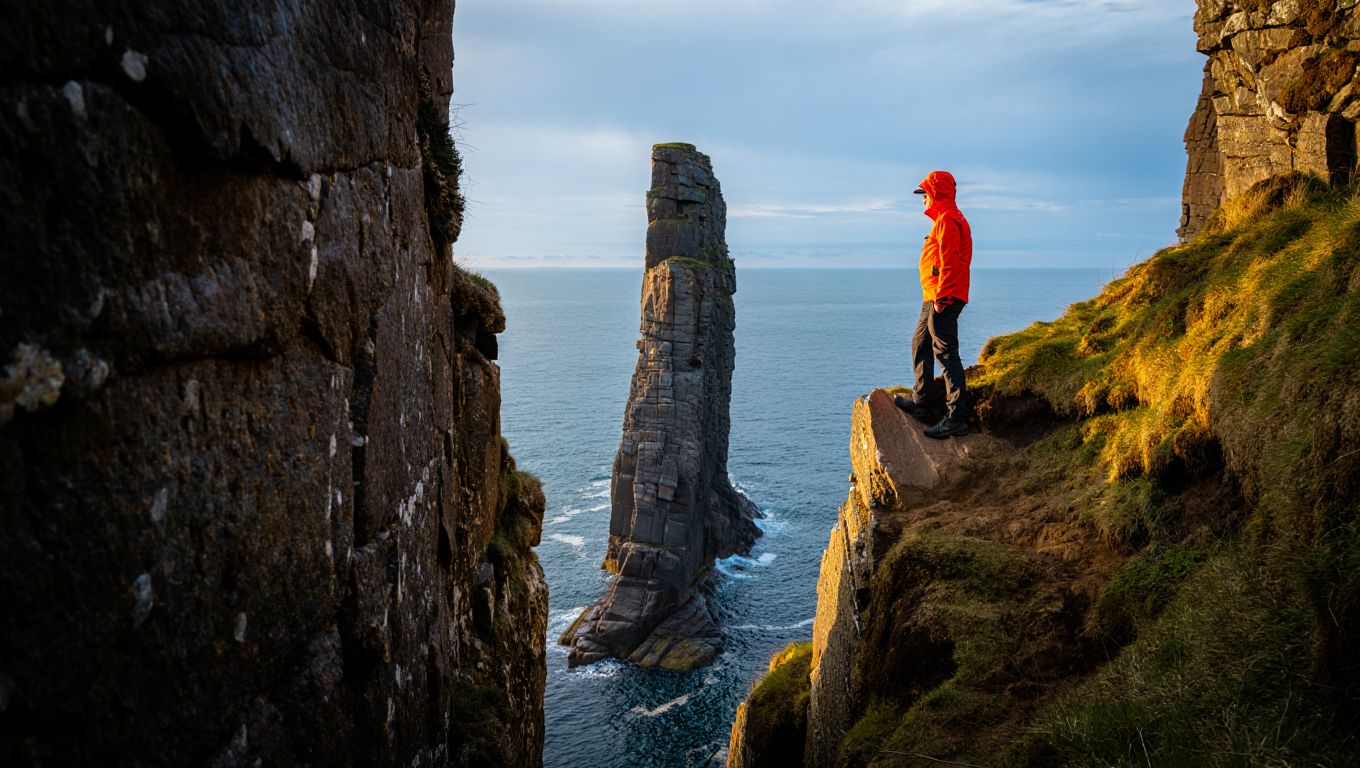
The Atlantic in Donegal doesn’t announce itself with turnstiles or ticket booths. It arrives as raw weather, as cliff-grass bent flat, as the thud of swell against quartzite. Out here, the horizon feels closer, the edges sharper, and the paths—when they exist at all—belong more to sheep than to signage.
Locals will point you toward a serrated headland called the Sturrall, a blade of stone that spears into the ocean west of Glencolmcille. From its narrow spine you look down on immense sea stacks—Cnoc na Mara, Tormore, and a flotilla of nameless teeth—stacked against a vertical drop that rivals Ireland’s most photographed cliffs, minus the queues and the tannoy announcements. “You hear the sea breathing up these gullies,” a walker told me. “On a still day, it’s louder than your thoughts.”
Where the wild edge begins
The Sturrall rises from the coast between An Port and Malin Beg, a stretch of unpeopled coves and moor that feels improbably remote for somewhere this accessible by car. A minor road buckles over the bog to a lonely end at Port, where a handful of sheep and the ruins of old houses face the Atlantic. From here the track is little more than intention.
There are no coach parks, no turnstiles, no branded ponchos. Just a line of trodden turf, a few rock steps, and an elemental sense that you’ve come to the edge of a very old island.
The walk in brief
The classic outing follows a rough coastal path from Port to the base of the Sturrall, then up onto the ridge for an out‑and‑back traverse. Expect 8–10 km of bog, tussock, and scramble, with sections where the ground falls away in sheer, sea-drummed walls.
- Best for experienced walkers comfortable with exposure, poor footing, and changeable weather.
From the ridge the Atlantic seems poured from a higher sky. To the north, the cliffs of Glenlough amphitheatre around a jade bay; to the south, the teeth of Cnoc na Mara/Tormore puncture long rollers. “It’s like someone pressed pause on a very big world,” said a hill-goer I met near the crest. “Everything holds still except the sea.”
Why it feels wilder
Scale is one thing; silence is another. The distance between you and the next voice can be an hour of walking. Without crowds, you notice small dramas—the track of a fox in sedge, kittiwakes riding a column of air, thrift flowers clenched like tiny pink fists. Even the wind sounds different here, riffling the grass in one direction, then the other, as if testing your nerve.
The geology helps with the theatre. The Sturrall is quartzite: hard, bright, and fractured, with lines that draw your eye down to the water’s boil. The stacks stand off like sentinels, their bases chewed into tunnels where the sea talks to itself.
Getting there without any fuss
From Glencolmcille, follow signs for Port along a narrow, view‑packed road; expect passing places, sheep, and the occasional meaningful stare from a cow. Park considerately at the very end by the ruined pier. There are no toilets, no bins, no kiosks—so arrive prepared and leave the place cleaner than you found it.
If visibility is poor, or wind speeds severe, choose another day. A coastal gust can feel like a hand at your back, and mist can turn easy ground mythic.
How the ridge feels underfoot
The approach crosses bog that behaves like a cranky mattress. Boots sink, then spring; a misstep finds a wet hole or a loose stone smothered in lichen. On the crest, the path narrows to boot‑width with angled turf and occasional scrambles. You’ll use hands on rough quartzite, grateful for its grit and its refusal to feel slippery.
Take your time on the airy bits. There’s no prize for speed, only the slow accumulation of views: a gannet spearing the slick, a dark shower sweeping the Sound, the sun burning a pewter sea into steel.
A word on safety and seasons
“Respect the edge,” as a local guide put it. “This coast rewards caution more than bravado.” Late spring to early autumn offers longer light and friendlier wind; winter brings purity, but also short days, heavier swell, and colder, emptier hills.
Check tide and forecast. Fog can arrive like a pulled curtain. Carry a map (OSi Sheet 10), a charged phone, and the kind of layers that make you feel slightly overdressed at the car and perfectly judged on the ridge.
What to bring if you like your ankles
- Waterproof boots, a real rain shell, warm layers, hat/gloves, lunch you actually want to eat, 1.5–2L water, map/compass or GPS, headtorch, small first aid kit, and a respect for places that don’t need your noise.
The payoff
There’s a moment—often on the return, when muscles are warm and the light has shifted—when everything aligns. The wind drops, the sea turns glass, and the stacks seem closer, like ships easing toward harbor. You stand there, a small figure on a long edge, and feel the country tilt just enough to pour all sound into the Atlantic.
On the drive back, turf smoke drifts from a cottage chimney, and the radio finds a fiddle that understands weather. You’ve traded turnstiles for skylarks, timetables for tides, and it feels not like escape, but like permission—as if the coast agreed to share its more private self, just this once, with anyone willing to walk beyond the signs.

Contact details
Address:
Farmers Forum,
36, Dominick Street,
Mullingar,
Co. Westmeath,
Ireland
Phone:
+353 (0)44 9310206
Or email us:
For technical issues please check out our FAQ's page or email - [email protected]
For general Queries email - [email protected]
Request to add event to our Calendar - [email protected]
Send us your mart reports - [email protected]
Suggestions and feedbacks - [email protected]
News Items / Press Release - [email protected]
To Advertise on Farmers Forum - [email protected]