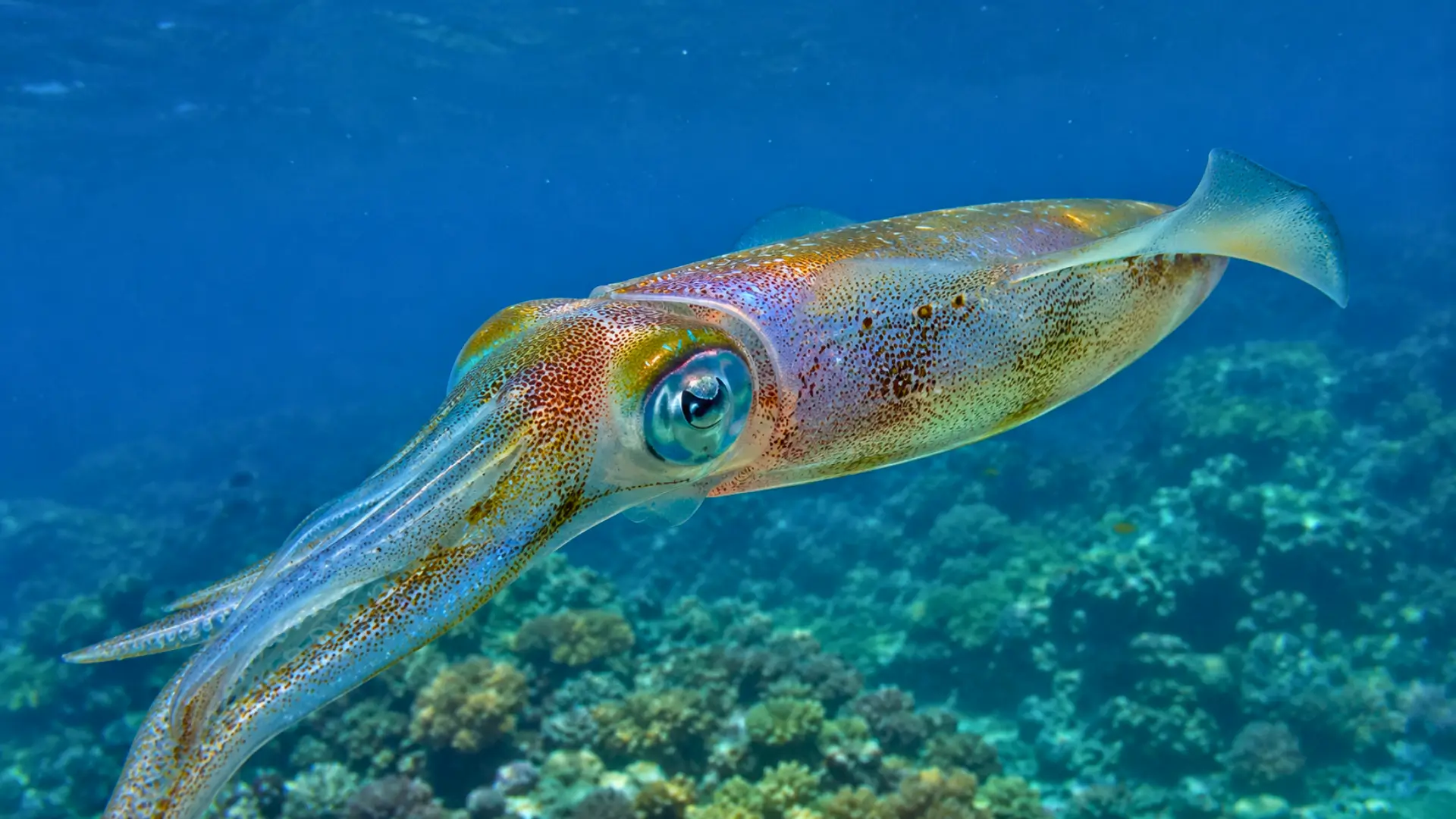
They see, remember, learn and calculate their strikes in a fraction of a second. Yet a recent experiment suggests that ocean acidification could dramatically reduce the brains of some squids. What would become of these gifted hunters in the seas of 2100?
The Remarkable Intelligence of Cephalopods Revealed by Their Learning Abilities
A crab confined in a jar might seem out of reach. Not for a cephalopod. After a few observations, an octopus can manipulate the lid with its suction cups and access its meal. These feats revealed an astonishingly sophisticated intelligence, capable of solving problems, learning and sometimes even anticipating.
Cephalopods belong to this family of marine prodigies. Their nervous system counts hundreds of millions of neurons, spread between the brain and the arms. In these fast predators, vision plays a central role: it helps detect prey, assess its trajectory, and then trigger an almost instantaneous attack.
A Scientific Experiment Simulating the Oceanic Conditions Expected for 2100
At Acadia University in Canada, researchers raised bigfin reef squids in two environments. The first replicated current water, with a pH of 8.2. The second simulated an oceanic scenario for 2100, in which the pH dropped to 7.8 under the influence of CO2.
This difference may seem tiny. Yet the pH scale is logarithmic: a few tenths are enough to markedly alter water chemistry. The ocean absorbs about a quarter of human CO2 emissions, which limits atmospheric warming, but gradually increases its acidity and disrupts many marine organisms.
After 90 days, the animals were examined using diffusion MRI, a technique allowing detailed study of brain tissues. The result initially looked like a computer glitch: in squids exposed to acidified water, the average brain volume had decreased by about 49%. Their bodies, however, had not shrunk.
A Marked Reduction in Brain Areas Linked to Visual Processing
Not all brain regions were affected equally. The structures related to visual processing ranked among the most reduced. Some had lost up to nearly 62% of their volume, according to the early results presented by the team. For a hunter guided by its eyes, the finding is particularly troubling.
Research published in Communications Biology had already shown that acidification altered the functioning of the optic lobes and sharply reduced predatory behaviors. Squids exposed to more CO2 attacked their prey less often. The problem would thus not originate from the eyes, but from how the brain interprets their signals.
A less effective squid not only risks missing its lunch. It can also become more vulnerable to tuna, sharks, seabirds, or mammals that feed on it. By weakening an essential intermediate predator, acidification could trigger cascading reactions in oceanic food webs.
Des conséquences potentielles majeures sur les écosystèmes marins et leurs équilibres
Caution remains essential, however. These observations come from a controlled experiment conducted on a particular species, and analyses of the brain reduction still need to be solidified by peer-reviewed work. The researchers are now examining animals after 30 and 60 days to understand when the phenomenon appears during their growth.
Several avenues are being explored: oxidative stress, lack of energy available to build the brain, or disruption of neuronal metabolism. No definitive explanation has yet emerged. But the signal extends far beyond the question of weakened shells: climate change could alter the cognitive abilities of animals that seemed perfectly equipped to survive.
The Ocean of 2100 may therefore not be merely warmer, higher, or more acidic. It could become a world where some predators still see their prey, without being able to understand quickly enough what they are looking at. And in the sea, a few seconds of hesitation can decide who eats and who disappears.

Contact details
Address:
Farmers Forum,
36, Dominick Street,
Mullingar,
Co. Westmeath,
Ireland
Phone:
+353 (0)44 9310206
Or email us:
For technical issues please check out our FAQ's page or email - [email protected]
For general Queries email - [email protected]
Request to add event to our Calendar - [email protected]
Send us your mart reports - [email protected]
Suggestions and feedbacks - [email protected]
News Items / Press Release - [email protected]
To Advertise on Farmers Forum - [email protected]