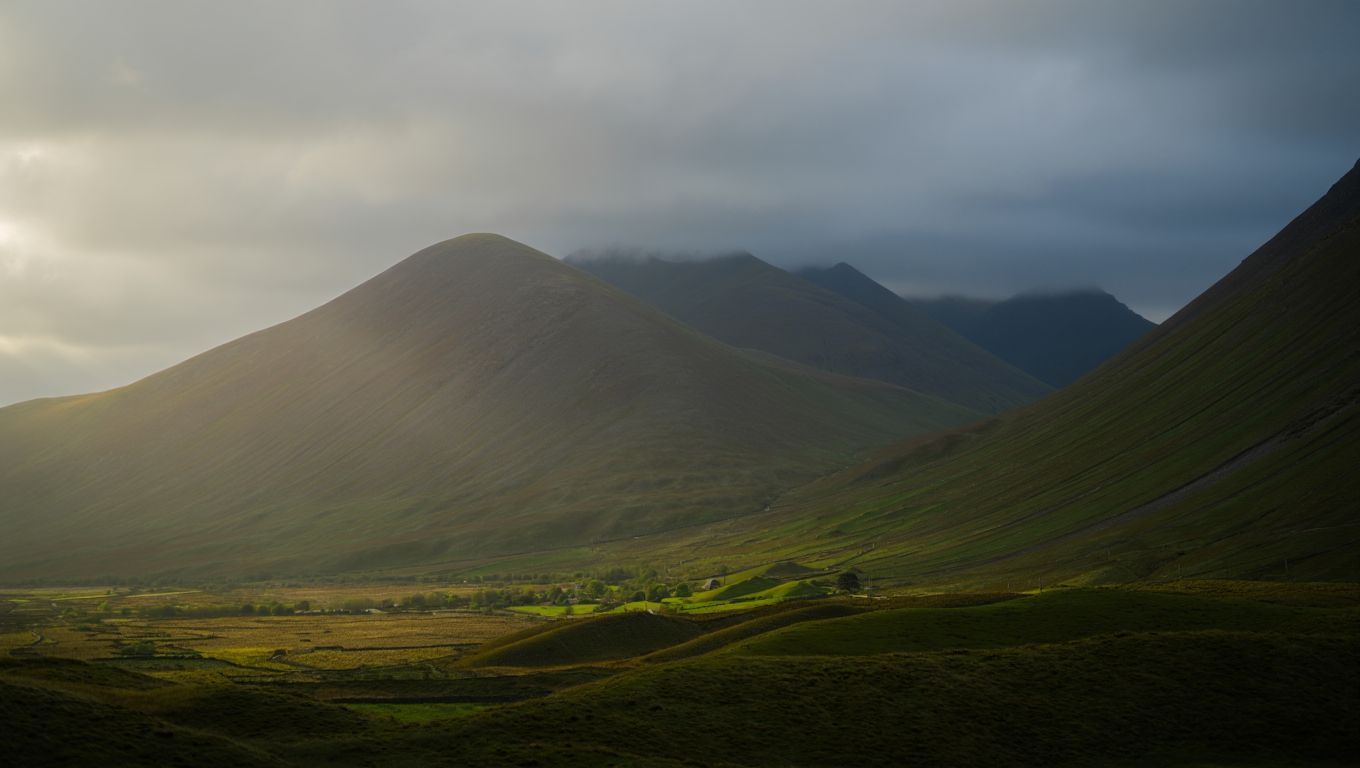
Morning light slips over a row of shadowed ridges, and the first thing your eye does is swear allegiance to the Alps. Then the wind carries a breath of heather, a curlew sketches its loop in the air, and Ireland quietly takes back the truth. This is the Nire Valley, a bowl of deep glens and glacial walls tucked into the Comeragh mountains, where modest height strikes a strange, elegant pose that feels much bigger than the map suggests. “It looks like a postcard somebody forgot to label,” says a hiker, laughing into the cool air.
The valley that plays with your sense of place
What gives the trick its power is shape, not altitude. Sheer corrie headwalls cradle dark lakes, and long, sweeping spurs taper into the valley like careful brushstrokes on wet paper. You read verticality where there’s mostly careful carving. The lines are crisp, the spaces are clean, and the horizon folds so neatly it could slide into a mountaineer’s pocket.
“Stand still for ten seconds,” a local walker once told me, “and the land will shift a little under your own story.” She was right. You watch cloud pause on a cliff, and suddenly the scene feels like a borrowed memory.
Stone, ice, and a patient kind of drama
Here the language of the landscape is written in old granite and newer green. Ice once scooped amphitheaters from the mountain, leaving corries that hold light like bowls. The rims are sharp, the floors are strewn with erratics that look deliberate, as if a sculptor kept changing minds. Water gathers, turns glassy, and keeps a quiet temper.
What feels “Alpine” is the tidy geometry. Angles meet. Shadows perform. You can trace ridgelines with a finger and hear the sentence end. Yet the undernote is Irish, all moss and dove-grey stone, all gentleness where you expected only strict height.
Weather with a theater kid’s timing
Skies here like to rehearse five acts before lunch. Sun blinks in and catches the ferns, and a second later a gauze of rain sharpens the edges. The result is clarity you can almost hold, like a sheet of cold glass. Photographers grin because the valley gifts contrast without the noise, saturation without the shout.
“The clouds never just pass,” someone said on the trail. “They make an entrance.” And when they part, you see the corries glow from within, a private lamp switched on behind the stone.
Trails that invite, not intimidate
Paths rise in steady curves, threading heather, bog-cotton, and the occasional splash of yellow gorse. Underfoot, it’s a dialogue between soft peat and firm rock, a rhythm your legs quickly learn. The climbs are honest, the rewards close at hand. Lakes appear suddenly, tucked into bowls like coins in a worn purse.
If you bring a pocket plan, keep it simple:
- Layer for swift changes
- Watch your footing on wet slabs
- Carry a real map
- Treat the lakes like quiet chapels
Silence with texture
The quiet here isn’t empty; it’s layered with low water, wingbeats, and the thrum of wind plucking long grass like loose strings. Sheep print commas into damp soil, and far across the walls a raven writes a black accent. You don’t need summit frenzy to feel arrival; the valley gives you that at a lake’s dark lip.
Sit a while and you notice how the color palette breathes. Greens go from bottle to sea, then to something you can’t name. The rock keeps its serious face, but lichen drops little jokes in pale circles.
Light that edits as it goes
Afternoon trims the scene to bare essentials. Foreground warms. Background cools. Detail steps forward, then backs away like a patient actor. You take photos and they look staged, but the stage manager is the weather, and it hates repeating the same trick twice.
At dusk, the corries collect a blue that seems poured from a bottle. It’s then you understand why memory insists on mountains taller than these really are. Scale is a feeling, and feelings don’t carry rulers.
Roots, names, and the slow burn of place
Irish place-names tuck meanings into sound, often pointing to water, hollows, and the rooms carved by ancient ice. The valley inherits that lexicon and adds its own whisper. Farmers, walkers, and wanderers braid paths not just across turf, but across time. You sense a practiced hospitality in the way the hills step aside to make a view.
“Go lightly,” someone chalked on a gate, small and almost shy. It fits. This is a landscape that rewards care, attention, the kind of looking that takes a half-step closer.
What the eye believes, the heart keeps
You come for the postcard and stay for the slow, human scale. The grandeur is intimate, the drama kind, the edges precise without being cold. You leave with boots muddied and a camera proud, but the real souvenir is a sharpened gaze.
Call it Alpine if you must; the hills won’t correct you out loud. They’ll simply stand their ground, fold the light one last time, and let the valley do what it always does best—make a big feeling inside a small, perfectly held place.

Contact details
Address:
Farmers Forum,
36, Dominick Street,
Mullingar,
Co. Westmeath,
Ireland
Phone:
+353 (0)44 9310206
Or email us:
For technical issues please check out our FAQ's page or email - [email protected]
For general Queries email - [email protected]
Request to add event to our Calendar - [email protected]
Send us your mart reports - [email protected]
Suggestions and feedbacks - [email protected]
News Items / Press Release - [email protected]
To Advertise on Farmers Forum - [email protected]