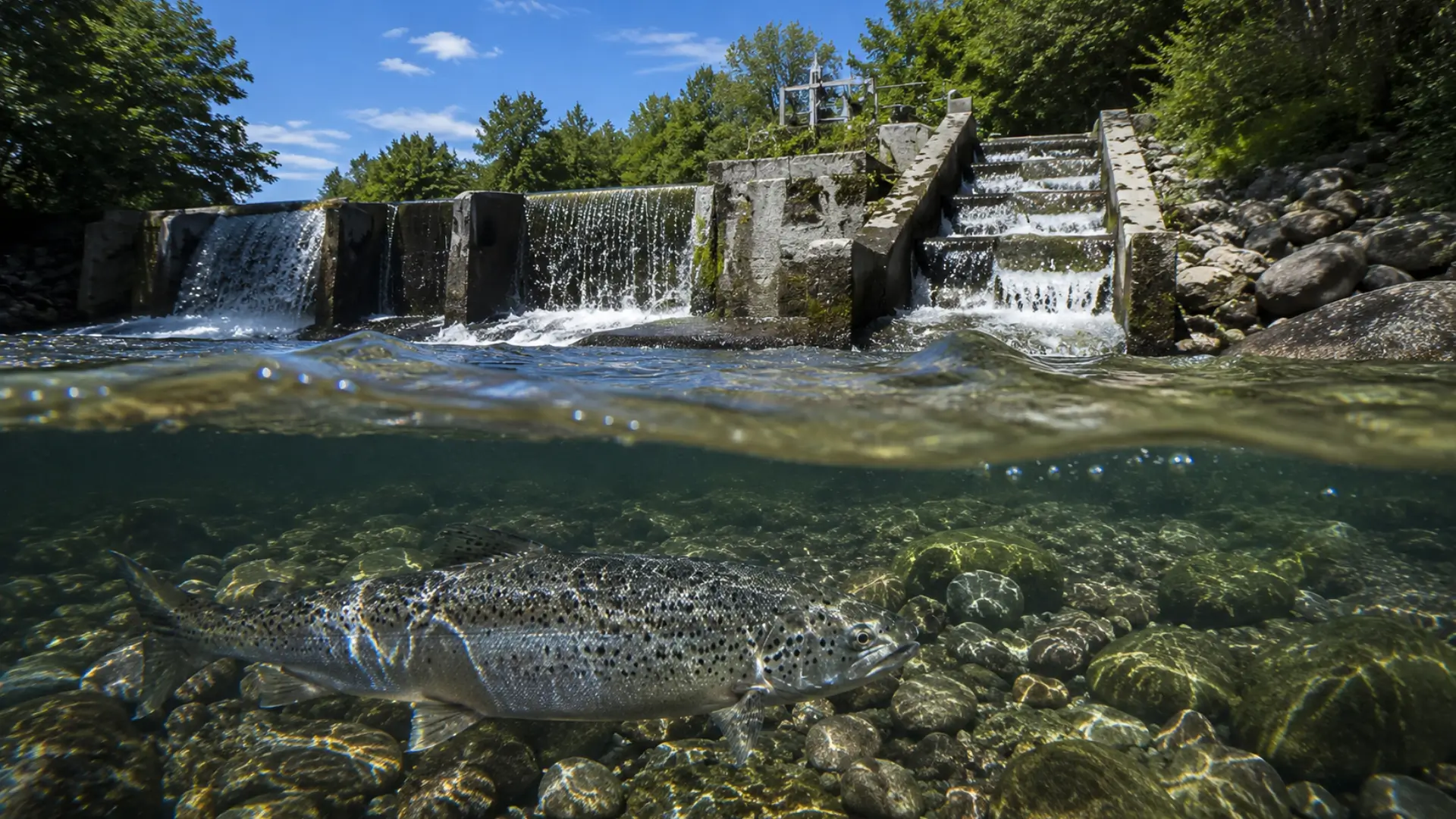
A fish passage allows roughly seven out of ten travelers to get through. That seems commendable, until the obstacles add up. After ten successive dams, less than 3% of the fish still reach their destination. How can an ecological solution produce such a dizzying result?
The cumulative effect of dams drastically reduces migration chances
Imagine a hundred salmon swimming upstream toward their birthplace. At the first dam, thirty disappear from the journey. At the second, only 49 of the initial hundred fish continue on. The fish ladder works as intended, but its effectiveness must be recalculated at each barrier, on a population already diminished.
After ten successful crossings at 70%, the result drops precisely to 2.82% of the initial population. This is neither an alarmist estimate nor a catastrophe scenario, but a simple multiplication. France Nature Environnement uses this calculation to show that the accumulation of structures gradually turns the river into an almost impassable route.
Not all species react in the same way. A sturdy salmon, an undulating eel, or a lamprey capable of gripping do not possess the same abilities or needs. Yet, each crossing demands energy and delays migration, sometimes causing the short breeding period to be missed.
Massive fragmentation of river systems that disrupts ecosystems
The French Biodiversity Office now records more than 100,000 obstacles to flow in France. Dams, weirs, culverts, and old industrial installations fragment rivers. Some still generate energy or preserve a useful resource, while others remain in place after their original function disappeared.
The problem goes beyond the movement of fish. A structure also traps sediments, slows the current, and sometimes promotes the warming of the water. downstream, banks may erode and habitats become simpler. A fragmented river loses part of its natural machinery, well beyond the scope of migration alone.
Dismantling dams reveals a rapid capacity for regeneration
In Normandy, two walls once blocked the Sélune: Vezins, standing 36 meters high, and La Roche-Qui-Boit, at 16 meters. Before their dismantling, only a quarter of the valley remained accessible from the sea. The works, completed in 2022, constituted a scientific operation nearly unique in Europe.
The river’s response was swift. After more than a century of absence upstream, Atlantic salmon, European eels, and sea lampreys have begun to move up the basin once again. Researchers from INRAE monitor this recolonization to understand how species, sediments, and habitats reappear after the removal of dams.
However, demolishing a structure is never a simple backhoe operation. The accumulated sediments must be studied, local uses discussed, and risks assessed. A poorly prepared removal can release pollutants or radically disrupt certain environments. The challenge is therefore to distinguish unnecessary obstacles from infrastructures still indispensable.
European momentum to remove obstacles remains limited but is growing
The movement is gaining momentum. After 487 obstacles were removed in 2023, Europe has removed at least 603 in 2025, reconnecting more than 3,740 kilometers of rivers. The progress is striking, even if most operations concern small, aging thresholds rather than large hydroelectric dams.
Fish passes remain valuable when an installation must be kept. But on a river already saturated, they cannot erase the cumulative effect of obstacles on their own. The question becomes less technical than political: should we keep equipping every barrier, or should we prioritize restoring freedom to rivers that no longer need to be blocked?

Contact details
Address:
Farmers Forum,
36, Dominick Street,
Mullingar,
Co. Westmeath,
Ireland
Phone:
+353 (0)44 9310206
Or email us:
For technical issues please check out our FAQ's page or email - [email protected]
For general Queries email - [email protected]
Request to add event to our Calendar - [email protected]
Send us your mart reports - [email protected]
Suggestions and feedbacks - [email protected]
News Items / Press Release - [email protected]
To Advertise on Farmers Forum - [email protected]