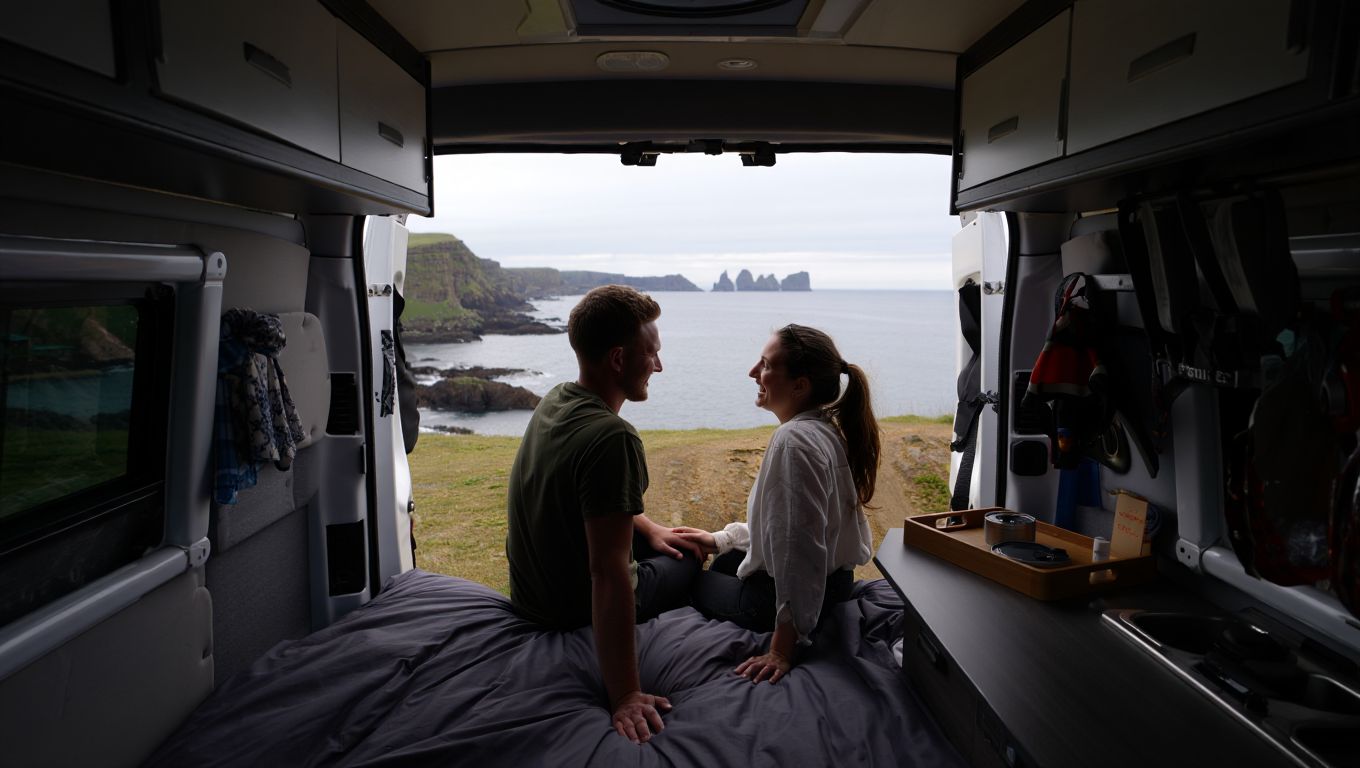
They left Mullingar in a white van that still whispered of bandages and blue lights. By the first week of June, it had become a home, and the siren’s old wiring was feeding fairy lights. They pointed the nose toward the north, chased weather apps and tide tables, and kept asking the same question: where does the land turn to sky the quickest.
From Siren to Slow Lane
The rig began life as an ambulance, square-shouldered and stern. They stripped decals, patched holes, and dressed the box in pine and patience. “We wanted a space that felt quiet, even when the sea was loud,” says Aoife, running a hand over a countertop they sanded to a soft sheen.
They kept the bulkhead, but cut a pass-through for rainy mornings. Two solar panels feed a leisure battery; a diesel heater waits for Atlantic moods. “It’s not fancy,” Ciarán laughs, “but the kettle boils fast, and the view changes every hour.”
A Tiny Home With Big Windows
Inside, the palette is light, with open shelves and latches that click like commas. A pull-out bed becomes a sofa, framing cliffs like postcards. Hooks carry wet jackets; baskets carry books and butter; a narrow drawer guards maps and spare fuses.
They kept one medical cabinet, its frosted glass now holding mugs. “We wanted traces of its past,” Aoife says, “not to erase the story.” When the door slides shut, their world is six metres long and as deep as a tide.
The Rhythm of the Causeway
They didn’t chase beaches; they chased edges. From Downhill and Mussenden Temple to Torr Head’s tight lanes, they learned to park early and breathe. Wind writes the daily agenda; squalls turn cups of tea into little theatres.
“Out here, you read clouds like books,” Ciarán says, watching a front peel off the Atlantic. The cliffs absorb mood; the basalt holds its own soft heat. Evenings drift into torches and tidelines, gulls stitching silver through dusk.
Headlands That Hooked Them
They found a rhythm of arriving late, leaving light, and walking just far enough to feel the cliff’s slow pulse. Three places live in their pockets:
- Torr Head, where roads turn spinal and the sea turns steel
- Kinbane Head, a chalk-white finger pointing at old stories
- Magilligan Point, where dunes hold wind and ships draw rulers
At each, the ambulance curled into a lee and let the body exhale. “There’s a moment when the van settles,” Aoife says, “and the whole headland seems to listen.”
Learning Curves and Quiet Joys
They learned to ration water, smile at midges, and cook with three flames and two spoons. A folding table lives in the rear door, and dinner finds its way to sand if they push the knives too fast.
They never wild-camped on fragile ground, always asked locals, and packed out more than they brought. “Respect isn’t a rulebook,” says Ciarán, “it’s a set of small habits repeated until they make a place better.”
Missteps happened: a low branch scraped a vent, a wheel kissed a soft verge, coffee erupted in a slow motion geyser. Each time the fix was part toolkit, part humour, and part long walk to let tempers cool.
Moments That Stay
One dawn at Benone Strand, a fog line lifted like a curtain, and the sand turned mirror-flat and endless. Another evening, they stood under Dunluce Castle, where swallows cut black script against a sherbet sky. “I kept thinking of pages,” Aoife says, “how every cove is a margin where notes get brave.”
At the Giant’s Causeway, they waited past the last coach and noise. Basalt grew tender in the hush; hexagons warmed to a dull ember under bare feet. The van lights were off; the stars were on; the road back felt carved from quiet.
The Cost of Freedom
The purchase was a battered steal, the work a long evening repeated for months. They learned 12-volt logic, bought a multimeter with more patience than they had, and trusted YouTube as a late-night teacher.
Fuel was their biggest line, ice cream their sweetest sin, parking their frequent puzzle. “We spent less on rooms, more on routes,” Ciarán says, “and we traded plans for weather without feeling we’d lost a thing.”
Why They’ll Keep Going
The map is now furred with sand, the logbook clipped with dried sea pinks, and the van carries a faint hospital echo that somehow sounds like a lullaby. They came for headlands; they found a slowness that holds.
“We thought we were building a camper,” Aoife says, “but really we were building a different clock.” The ambulance, once built for urgency, now measures only presence and the distance between kettle and horizon. Tomorrow’s plan is simple and bright: drive until the cliff says stop, and let the day finish the sentence.

So so interesting.
Enjoyed the journey.
What a beautiful story and written like a poem
The author needs to write a book…this and his other articles are beautifully written and so descriptive .